

Algae and Plants
31
shaped in the dorsiventral view
with a size of 3.5–8 × 3–6 µm and
1.5–3 µm thick. Anterior flagellum
is 7 × 10 µm and posterior flagellum
3–9 µm. Haptonema is about 1 µm
long. Hair points are seen at the tip of
the flagella. Lateral hairs are absent. As
this species synthesizes eicosapentaenoic (EPA) (a PUFA), it may be incorporated into the daily diet. Further, this
species has applications in the preparation of food gels (John, 2002).
Nutritional Facts
Proximate Composition (% DM)
Protein
CHO a
Lipid
57.0
32.0
6
a Carbohydrate.
Source: Data from Gouveia et al. (2008).
PhyLuM: rhodoPhyta (red aLGae)
Porphyridium cruentum (S.F. Gray) Nägeli 1849
(= Porphyridium purpureum)
Phylum: Rhodophyta
Class: Porphyridiophyceae
Order: Porphyridiales
Family: Porphyridiaceae
Common name: Red alga.
Distribution: Europe, Asia, Australia
and New Zealand (AlgaeBase).
Habitat; Freshwater/terrestrial species.
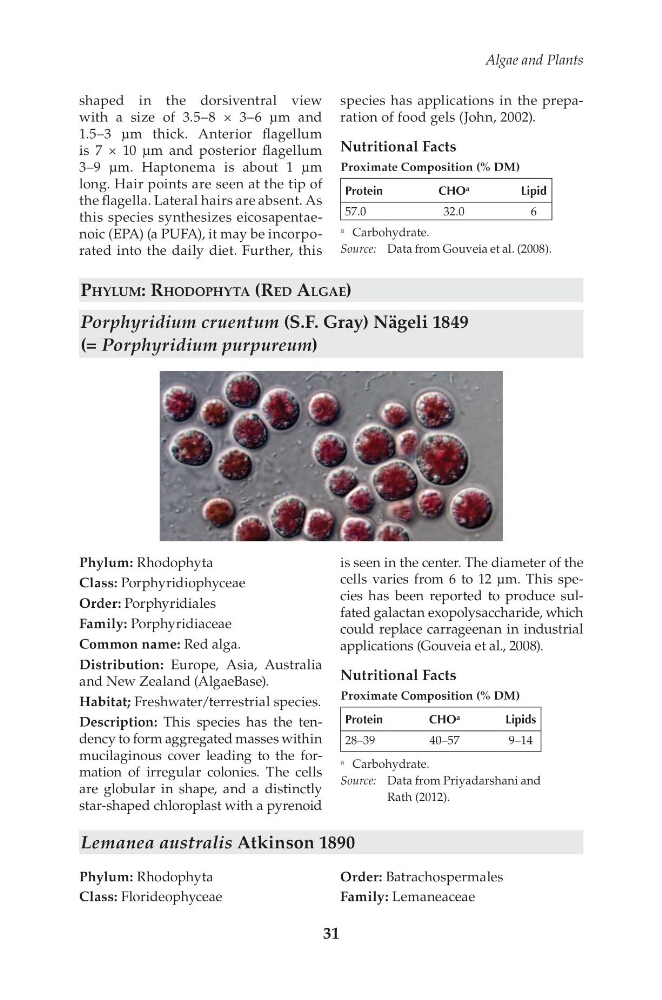
Description: This species has the tendency to form aggregated masses within
mucilaginous cover leading to the formation of irregular colonies. The cells
are globular in shape, and a distinctly
star-shaped chloroplast with a pyrenoid
is seen in the center. The diameter of the
cells varies from 6 to 12 µm. This species has been reported to produce sulfated galactan exopolysaccharide, which
could replace carrageenan in industrial
applications (Gouveia et al., 2008).
Nutritional Facts
Proximate Composition (% DM)
Protein
CHO a
Lipids
28–39
40–57
9–14
a Carbohydrate.
Source: Data from Priyadarshani and
Rath (2012).
Lemanea australis Atkinson 1890
Phylum: Rhodophyta
Class: Florideophyceae
Order: Batrachospermales
Family: Lemaneaceae
31
shaped in the dorsiventral view
with a size of 3.5–8 × 3–6 µm and
1.5–3 µm thick. Anterior flagellum
is 7 × 10 µm and posterior flagellum
3–9 µm. Haptonema is about 1 µm
long. Hair points are seen at the tip of
the flagella. Lateral hairs are absent. As
this species synthesizes eicosapentaenoic (EPA) (a PUFA), it may be incorporated into the daily diet. Further, this
species has applications in the preparation of food gels (John, 2002).
Nutritional Facts
Proximate Composition (% DM)
Protein
CHO a
Lipid
57.0
32.0
6
a Carbohydrate.
Source: Data from Gouveia et al. (2008).
PhyLuM: rhodoPhyta (red aLGae)
Porphyridium cruentum (S.F. Gray) Nägeli 1849
(= Porphyridium purpureum)
Phylum: Rhodophyta
Class: Porphyridiophyceae
Order: Porphyridiales
Family: Porphyridiaceae
Common name: Red alga.
Distribution: Europe, Asia, Australia
and New Zealand (AlgaeBase).
Habitat; Freshwater/terrestrial species.
Description: This species has the tendency to form aggregated masses within
mucilaginous cover leading to the formation of irregular colonies. The cells
are globular in shape, and a distinctly
star-shaped chloroplast with a pyrenoid
is seen in the center. The diameter of the
cells varies from 6 to 12 µm. This species has been reported to produce sulfated galactan exopolysaccharide, which
could replace carrageenan in industrial
applications (Gouveia et al., 2008).
Nutritional Facts
Proximate Composition (% DM)
Protein
CHO a
Lipids
28–39
40–57
9–14
a Carbohydrate.
Source: Data from Priyadarshani and
Rath (2012).
Lemanea australis Atkinson 1890
Phylum: Rhodophyta
Class: Florideophyceae
Order: Batrachospermales
Family: Lemaneaceae