

Nutritional Freshwater Life
30
Basal cells are infrequent with rhizoidal
holdfasts. Cells are uninucleate and chloroplasts are from 1 to 15 per cell. Plastids are ribbon-like, coiled. Cytoplasmic
strands support centrally located nucleus
within central vacuole. The oil derived
from this species may be more suitable to
utilize as a food source (such as supplements) (Andini, 2009).
Nutritional Facts
Proximate Composition (% DM)
Protein
CHO a
Lipids
6–20
33–64
11–21
a Carbohydrate.
Source: Data from Becker (2006).
Fatty Acid Composition (% DM)
14:0
2.6
16:0
48.2
16:1
10.8
18:0
1.1
18:1
9.1
18:2
8.4
18:3
16.0
18:4
0.9
20:0
0.9
20:4
0.6
20:5
0.6
22:0
0.6
22:6
0.2
Source: Data from Iyanova et al.
(2002).
PhyLuM: haPtoPhyta (CoCCoLithoPhoridS)
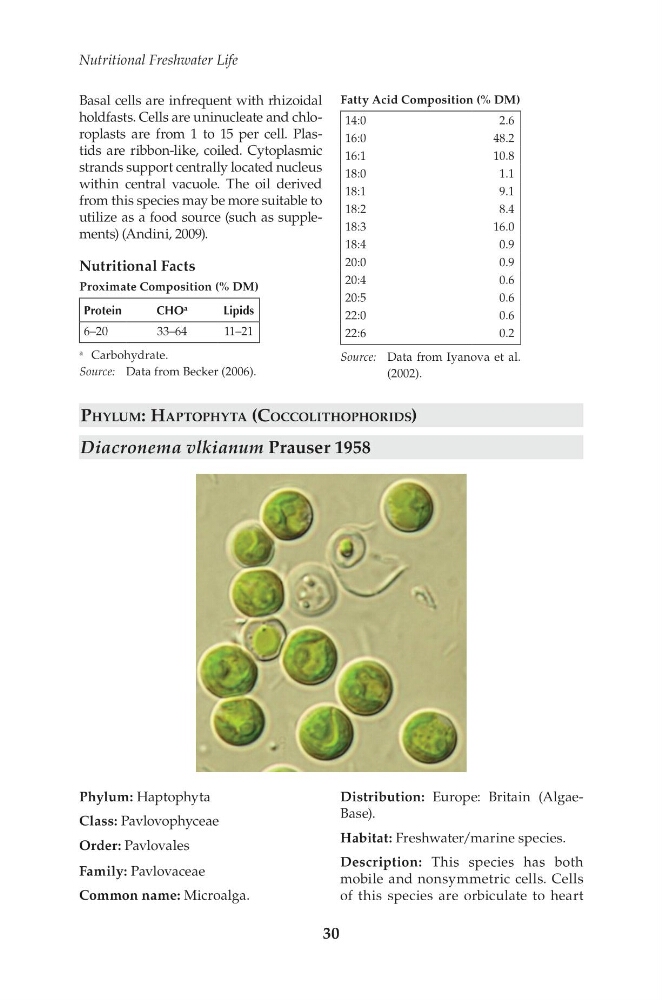
Diacronema vlkianum Prauser 1958
Phylum: Haptophyta
Class: Pavlovophyceae
Order: Pavlovales
Family: Pavlovaceae
Common name: Microalga.
Distribution: Europe: Britain (AlgaeBase).
Habitat: Freshwater/marine species.
Description: This species has both
mobile and nonsymmetric cells. Cells
of this species are orbiculate to heart
30
Basal cells are infrequent with rhizoidal
holdfasts. Cells are uninucleate and chloroplasts are from 1 to 15 per cell. Plastids are ribbon-like, coiled. Cytoplasmic
strands support centrally located nucleus
within central vacuole. The oil derived
from this species may be more suitable to
utilize as a food source (such as supplements) (Andini, 2009).
Nutritional Facts
Proximate Composition (% DM)
Protein
CHO a
Lipids
6–20
33–64
11–21
a Carbohydrate.
Source: Data from Becker (2006).
Fatty Acid Composition (% DM)
14:0
2.6
16:0
48.2
16:1
10.8
18:0
1.1
18:1
9.1
18:2
8.4
18:3
16.0
18:4
0.9
20:0
0.9
20:4
0.6
20:5
0.6
22:0
0.6
22:6
0.2
Source: Data from Iyanova et al.
(2002).
PhyLuM: haPtoPhyta (CoCCoLithoPhoridS)
Diacronema vlkianum Prauser 1958
Phylum: Haptophyta
Class: Pavlovophyceae
Order: Pavlovales
Family: Pavlovaceae
Common name: Microalga.
Distribution: Europe: Britain (AlgaeBase).
Habitat: Freshwater/marine species.
Description: This species has both
mobile and nonsymmetric cells. Cells
of this species are orbiculate to heart