

Nutritional Freshwater Life
28
Habitat: Hypersaline thermal springs;
attached to hard substrate or soil; to 3 m
deep in freshwater.
Description: Filaments of this species
are solitary, usually straight or irregularly screw-like, coiled at ends, and
their sheath is hyaline and coloress.
Individual cells measure 5 µm wide
and 6 µm long. Apical cells are acute,
conical, thorn-like or needle-like, without calyptras. No constriction at crosswalls or slightly constricted (Dadheech
et al., 2013).
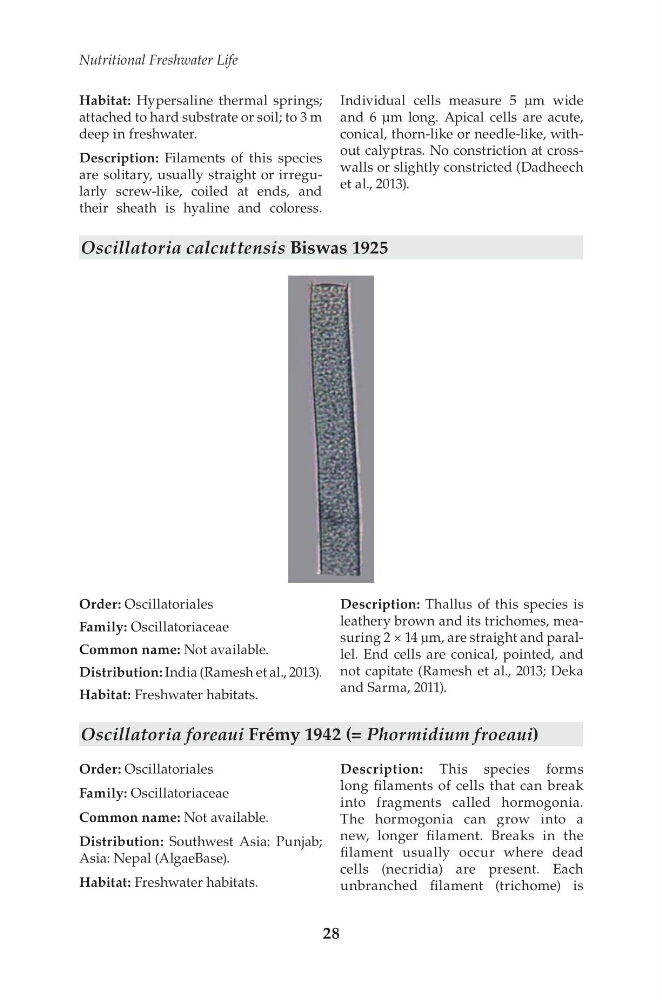
Oscillatoria calcuttensis Biswas 1925
Order: Oscillatoriales
Family: Oscillatoriaceae
Common name: Not available.
Distribution: India (Ramesh et al., 2013).
Habitat: Freshwater habitats.
Description: Thallus of this species is
leathery brown and its trichomes, measuring 2 × 14 µm, are straight and parallel. End cells are conical, pointed, and
not capitate (Ramesh et al., 2013; Deka
and Sarma, 2011).
Oscillatoria foreaui Frémy 1942 (= Phormidium froeaui)
Order: Oscillatoriales
Family: Oscillatoriaceae
Common name: Not available.
Distribution: Southwest Asia: Punjab;
Asia: Nepal (AlgaeBase).
Habitat: Freshwater habitats.
Description: This species forms
long filaments of cells that can break
into fragments called hormogonia.
The hormogonia can grow into a
new, longer filament. Breaks in the
filament usually occur where dead
cells (necridia) are present. Each
unbranched filament (trichome) is
28
Habitat: Hypersaline thermal springs;
attached to hard substrate or soil; to 3 m
deep in freshwater.
Description: Filaments of this species
are solitary, usually straight or irregularly screw-like, coiled at ends, and
their sheath is hyaline and coloress.
Individual cells measure 5 µm wide
and 6 µm long. Apical cells are acute,
conical, thorn-like or needle-like, without calyptras. No constriction at crosswalls or slightly constricted (Dadheech
et al., 2013).
Oscillatoria calcuttensis Biswas 1925
Order: Oscillatoriales
Family: Oscillatoriaceae
Common name: Not available.
Distribution: India (Ramesh et al., 2013).
Habitat: Freshwater habitats.
Description: Thallus of this species is
leathery brown and its trichomes, measuring 2 × 14 µm, are straight and parallel. End cells are conical, pointed, and
not capitate (Ramesh et al., 2013; Deka
and Sarma, 2011).
Oscillatoria foreaui Frémy 1942 (= Phormidium froeaui)
Order: Oscillatoriales
Family: Oscillatoriaceae
Common name: Not available.
Distribution: Southwest Asia: Punjab;
Asia: Nepal (AlgaeBase).
Habitat: Freshwater habitats.
Description: This species forms
long filaments of cells that can break
into fragments called hormogonia.
The hormogonia can grow into a
new, longer filament. Breaks in the
filament usually occur where dead
cells (necridia) are present. Each
unbranched filament (trichome) is