

Nutritional Freshwater Life
268
Nutritional Facts
Proximate Composition (mg/g DM)
CHO a Glycogen Protein Amino Acids Lipids Fatty Acids
1.2
3.2
70.8
8.4
38.5
20.4
a Carbohydrate.
Source: Data from Janakiram et al. (1983).
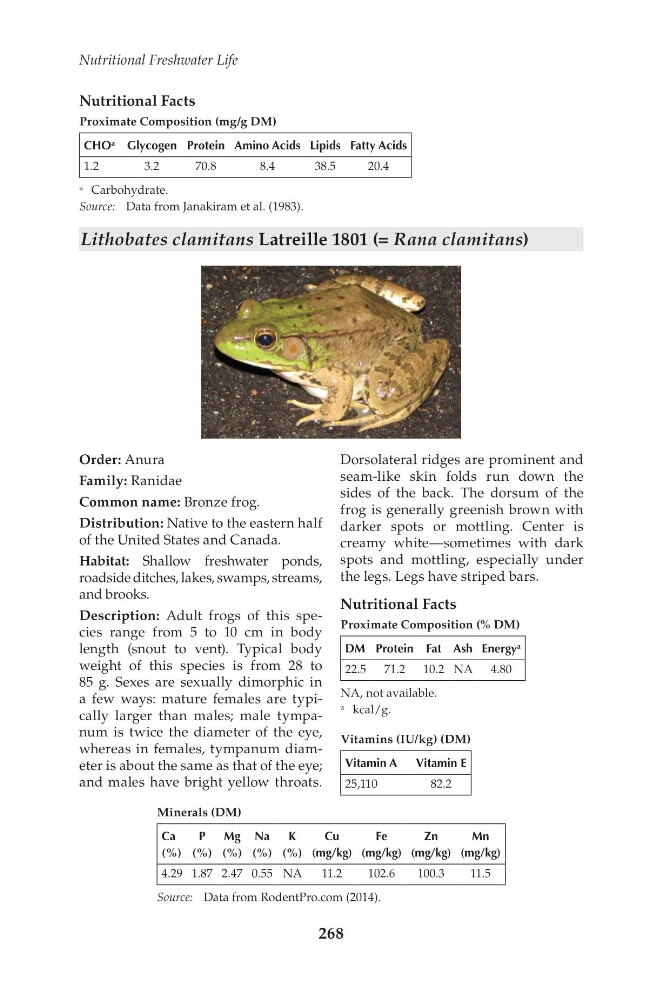
Lithobates clamitans Latreille 1801 (= Rana clamitans)
Order: Anura
Family: Ranidae
Common name: Bronze frog.
Distribution: Native to the eastern half
of the United States and Canada.
Habitat: Shallow freshwater ponds,
roadside ditches, lakes, swamps, streams,
and brooks.
Description: Adult frogs of this species range from 5 to 10 cm in body
length (snout to vent). Typical body
weight of this species is from 28 to
85 g. Sexes are sexually dimorphic in
a few ways: mature females are typically larger than males; male tympanum is twice the diameter of the eye,
whereas in females, tympanum diameter is about the same as that of the eye;
and males have bright yellow throats.
Dorsolateral ridges are prominent and
seam-like skin folds run down the
sides of the back. The dorsum of the
frog is generally greenish brown with
darker spots or mottling. Center is
creamy white—sometimes with dark
spots and mottling, especially under
the legs. Legs have striped bars.
Nutritional Facts
Proximate Composition (% DM)
DM Protein Fat Ash Energy a
22.5 71.2 10.2 NA 4.80
NA, not available.
a kcal/g.
Vitamins (IU/kg) (DM)
Vitamin A
Vitamin E
25,110
82.2
Minerals (DM)
Ca
(%)
P
(%)
Mg
(%)
Na
(%)
K
(%)
Cu
(mg/kg)
Fe
(mg/kg)
Zn
(mg/kg)
Mn
(mg/kg)
4.29 1.87 2.47 0.55 NA
11.2
102.6
100.3
11.5
Source: Data from RodentPro.com (2014).
268
Nutritional Facts
Proximate Composition (mg/g DM)
CHO a Glycogen Protein Amino Acids Lipids Fatty Acids
1.2
3.2
70.8
8.4
38.5
20.4
a Carbohydrate.
Source: Data from Janakiram et al. (1983).
Lithobates clamitans Latreille 1801 (= Rana clamitans)
Order: Anura
Family: Ranidae
Common name: Bronze frog.
Distribution: Native to the eastern half
of the United States and Canada.
Habitat: Shallow freshwater ponds,
roadside ditches, lakes, swamps, streams,
and brooks.
Description: Adult frogs of this species range from 5 to 10 cm in body
length (snout to vent). Typical body
weight of this species is from 28 to
85 g. Sexes are sexually dimorphic in
a few ways: mature females are typically larger than males; male tympanum is twice the diameter of the eye,
whereas in females, tympanum diameter is about the same as that of the eye;
and males have bright yellow throats.
Dorsolateral ridges are prominent and
seam-like skin folds run down the
sides of the back. The dorsum of the
frog is generally greenish brown with
darker spots or mottling. Center is
creamy white—sometimes with dark
spots and mottling, especially under
the legs. Legs have striped bars.
Nutritional Facts
Proximate Composition (% DM)
DM Protein Fat Ash Energy a
22.5 71.2 10.2 NA 4.80
NA, not available.
a kcal/g.
Vitamins (IU/kg) (DM)
Vitamin A
Vitamin E
25,110
82.2
Minerals (DM)
Ca
(%)
P
(%)
Mg
(%)
Na
(%)
K
(%)
Cu
(mg/kg)
Fe
(mg/kg)
Zn
(mg/kg)
Mn
(mg/kg)
4.29 1.87 2.47 0.55 NA
11.2
102.6
100.3
11.5
Source: Data from RodentPro.com (2014).