

Amphibians (Frogs)
265
Pelophylax ridibundus Pallas 1771 (= Rana ridibunda)
Order: Anura
Family: Ranidae
Common name: Eurasian marsh frog.
Distribution: Afghanistan, Albania,
Armenia, Austria, Azerbaijan, Bahrain,
Belarus, Bosnia and Herzegovina, Bulgaria, China, Croatia, Cyprus, Czech
Republic, Denmark, Estonia, Finland,
France, Georgia, Germany, Greece,
Hungary, Islamic Republic of Iran, Iraq,
Israel, Italy, Kazakhstan, Kyrgyzstan,
Latvia, Lithuania, Luxembourg, the Former Yugoslav Republic of Macedonia,
Republic of Moldova, Montenegro, Netherlands, Poland, Romania, Russian Federation, Saudi Arabia, Serbia, Slovakia,
Slovenia, Tajikistan, Turkey, Turkmenistan, Ukraine. Introduced: Belgium,
Spain, Switzerland, and United Kingdom (AmphibiaWeb, 2014d).
Habitat: Arid areas are largely colonized through river valleys and
channels.
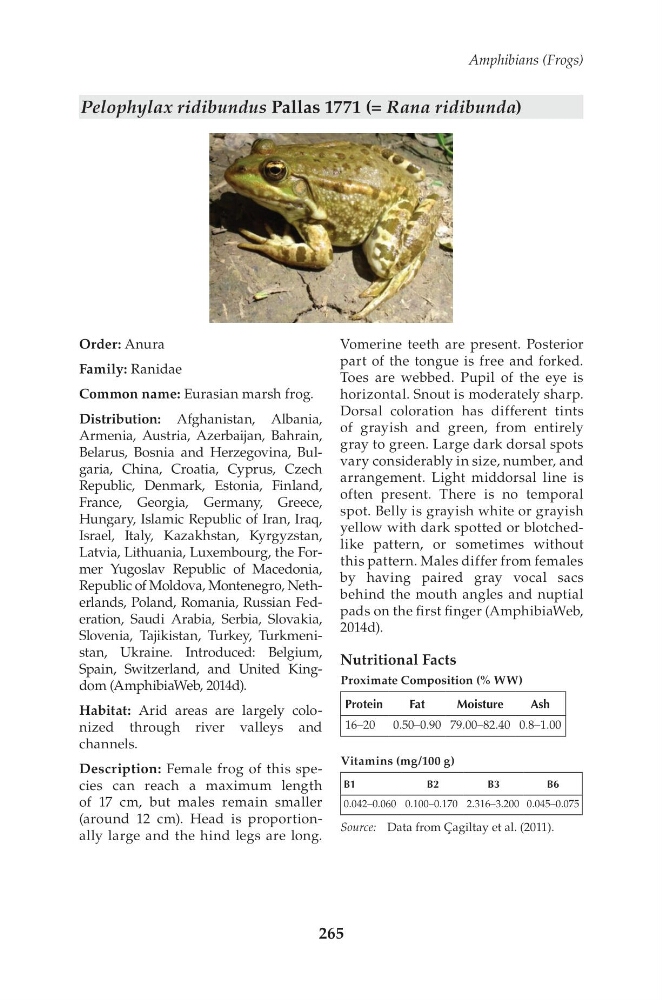
Description: Female frog of this species can reach a maximum length
of 17 cm, but males remain smaller
(around 12 cm). Head is proportionally large and the hind legs are long.
Vomerine teeth are present. Posterior
part of the tongue is free and forked.
Toes are webbed. Pupil of the eye is
horizontal. Snout is moderately sharp.
Dorsal coloration has different tints
of grayish and green, from entirely
gray to green. Large dark dorsal spots
vary considerably in size, number, and
arrangement. Light middorsal line is
often present. There is no temporal
spot. Belly is grayish white or grayish
yellow with dark spotted or blotchedlike pattern, or sometimes without
this pattern. Males differ from females
by having paired gray vocal sacs
behind the mouth angles and nuptial
pads on the first finger (AmphibiaWeb,
2014d).
Nutritional Facts
Proximate Composition (% WW)
Protein
Fat
Moisture
Ash
16–20 0.50–0.90 79.00–82.40 0.8–1.00
Vitamins (mg/100 g)
B1
B2
B3
B6
0.042–0.060 0.100–0.170 2.316–3.200 0.045–0.075
Source: Data from Çagiltay et al. (2011).
265
Pelophylax ridibundus Pallas 1771 (= Rana ridibunda)
Order: Anura
Family: Ranidae
Common name: Eurasian marsh frog.
Distribution: Afghanistan, Albania,
Armenia, Austria, Azerbaijan, Bahrain,
Belarus, Bosnia and Herzegovina, Bulgaria, China, Croatia, Cyprus, Czech
Republic, Denmark, Estonia, Finland,
France, Georgia, Germany, Greece,
Hungary, Islamic Republic of Iran, Iraq,
Israel, Italy, Kazakhstan, Kyrgyzstan,
Latvia, Lithuania, Luxembourg, the Former Yugoslav Republic of Macedonia,
Republic of Moldova, Montenegro, Netherlands, Poland, Romania, Russian Federation, Saudi Arabia, Serbia, Slovakia,
Slovenia, Tajikistan, Turkey, Turkmenistan, Ukraine. Introduced: Belgium,
Spain, Switzerland, and United Kingdom (AmphibiaWeb, 2014d).
Habitat: Arid areas are largely colonized through river valleys and
channels.
Description: Female frog of this species can reach a maximum length
of 17 cm, but males remain smaller
(around 12 cm). Head is proportionally large and the hind legs are long.
Vomerine teeth are present. Posterior
part of the tongue is free and forked.
Toes are webbed. Pupil of the eye is
horizontal. Snout is moderately sharp.
Dorsal coloration has different tints
of grayish and green, from entirely
gray to green. Large dark dorsal spots
vary considerably in size, number, and
arrangement. Light middorsal line is
often present. There is no temporal
spot. Belly is grayish white or grayish
yellow with dark spotted or blotchedlike pattern, or sometimes without
this pattern. Males differ from females
by having paired gray vocal sacs
behind the mouth angles and nuptial
pads on the first finger (AmphibiaWeb,
2014d).
Nutritional Facts
Proximate Composition (% WW)
Protein
Fat
Moisture
Ash
16–20 0.50–0.90 79.00–82.40 0.8–1.00
Vitamins (mg/100 g)
B1
B2
B3
B6
0.042–0.060 0.100–0.170 2.316–3.200 0.045–0.075
Source: Data from Çagiltay et al. (2011).