

Nutritional Freshwater Life
248
Order: Characiformes
Family: Citharinidae
Common name: Nurse tetra.
Distribution: Widely distributed in
West Africa (Geelhand, 2013a).
Habitat: Rivers, lakes, irrigation canals,
and fringing vegetation.
Description: In this species, dorsal fin
originates at about the same level as the
pelvic fin insertion. Sexual dimorphism
affects anal fin shape. There are 24–34
lateral line scales and 14–20 gill rakers
on the lower limb of the first gill arch.
A total of only eight teeth are present in
the outer premaxillary row. Snout is short
and is more than three times the head
length. There are 10–11.5 predorsal scales
and flanks are without lateral band. It
grows to a maximum length of 25 cm and
weight is 200 g (Geelhand, 2013a).
Nutritonial Facts
Proximate Composition (% WW)
Moisture Protein Fiber CHO a Ash Energy b
72.26
20.26 0.93 0.67 2.47 0.625
a Carbohydrate.
b mg/kg DM.
Source: Data from Anene et al. (2013).
ORDER: ELOPIFORMES (TARPONS, TENPOUNDERS)
FaMiLy: MeGaLoPidae (oxeye herrinGS, tarPonS)
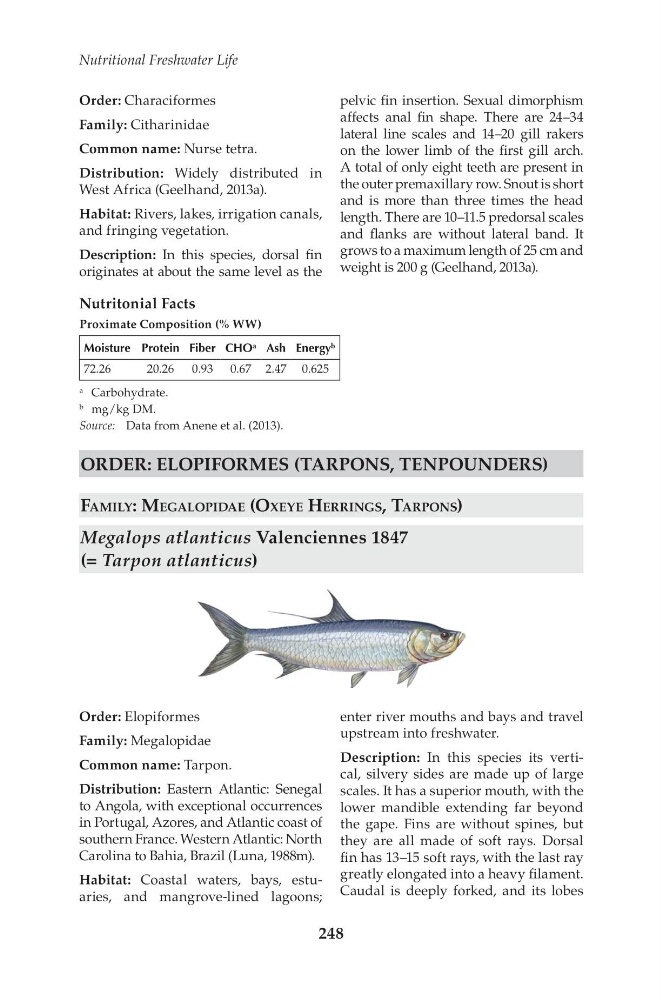
Megalops atlanticus Valenciennes 1847
(= Tarpon atlanticus)
Order: Elopiformes
Family: Megalopidae
Common name: Tarpon.
Distribution: Eastern Atlantic: Senegal
to Angola, with exceptional occurrences
in Portugal, Azores, and Atlantic coast of
southern France. Western Atlantic: North
Carolina to Bahia, Brazil (Luna, 1988m).
Habitat: Coastal waters, bays, estuaries, and mangrove-lined lagoons;
enter river mouths and bays and travel
upstream into freshwater.
Description: In this species its vertical, silvery sides are made up of large
scales. It has a superior mouth, with the
lower mandible extending far beyond
the gape. Fins are without spines, but
they are all made of soft rays. Dorsal
fin has 13–15 soft rays, with the last ray
greatly elongated into a heavy filament.
Caudal is deeply forked, and its lobes
248
Order: Characiformes
Family: Citharinidae
Common name: Nurse tetra.
Distribution: Widely distributed in
West Africa (Geelhand, 2013a).
Habitat: Rivers, lakes, irrigation canals,
and fringing vegetation.
Description: In this species, dorsal fin
originates at about the same level as the
pelvic fin insertion. Sexual dimorphism
affects anal fin shape. There are 24–34
lateral line scales and 14–20 gill rakers
on the lower limb of the first gill arch.
A total of only eight teeth are present in
the outer premaxillary row. Snout is short
and is more than three times the head
length. There are 10–11.5 predorsal scales
and flanks are without lateral band. It
grows to a maximum length of 25 cm and
weight is 200 g (Geelhand, 2013a).
Nutritonial Facts
Proximate Composition (% WW)
Moisture Protein Fiber CHO a Ash Energy b
72.26
20.26 0.93 0.67 2.47 0.625
a Carbohydrate.
b mg/kg DM.
Source: Data from Anene et al. (2013).
ORDER: ELOPIFORMES (TARPONS, TENPOUNDERS)
FaMiLy: MeGaLoPidae (oxeye herrinGS, tarPonS)
Megalops atlanticus Valenciennes 1847
(= Tarpon atlanticus)
Order: Elopiformes
Family: Megalopidae
Common name: Tarpon.
Distribution: Eastern Atlantic: Senegal
to Angola, with exceptional occurrences
in Portugal, Azores, and Atlantic coast of
southern France. Western Atlantic: North
Carolina to Bahia, Brazil (Luna, 1988m).
Habitat: Coastal waters, bays, estuaries, and mangrove-lined lagoons;
enter river mouths and bays and travel
upstream into freshwater.
Description: In this species its vertical, silvery sides are made up of large
scales. It has a superior mouth, with the
lower mandible extending far beyond
the gape. Fins are without spines, but
they are all made of soft rays. Dorsal
fin has 13–15 soft rays, with the last ray
greatly elongated into a heavy filament.
Caudal is deeply forked, and its lobes