

Nutritional Freshwater Life
244
Order: Salmoniformes
Family: Salmonidae
Common name: Brook trout.
Distribution: North America: Most of
eastern Canada from Newfoundland to
western side of Hudson Bay; south in
Atlantic, Great Lakes, and Mississippi
River Basins to Minnesota and northern Georgia in the United States. South
America: Argentina (Torres, 1991n).
Habitat: Marine, freshwater, and brackish water.
Description: This species is distinguished by the combination of dark
green marbling on its back and dorsal
fin and by the red spots with blue halos
on its sides. Caudal fin is nearly straight
or with a shallow indentation. Color of
the body varies, but generally rather
green to brownish on back, marked
with paler vermiculations or marbling
that extends onto the dorsal fin and
sometimes the caudal. Sides are lighter
than back, marked with numerous pale
spots and some red spots, each of the
latter surrounded by a blue halo. Anal,
pelvic, and pectoral fins have a white
leading edge followed by a dark stripe,
and the rest of the fins are reddish. This
species grows to a maximum size of
86 cm (Torres, 1991n).
Nutritional Facts
Proximate Composition (% WW)
Moisture
Ash
Protein Fat
74.3
1.3
21.5
3.4
Source: Data from Sarma et al. (2011).
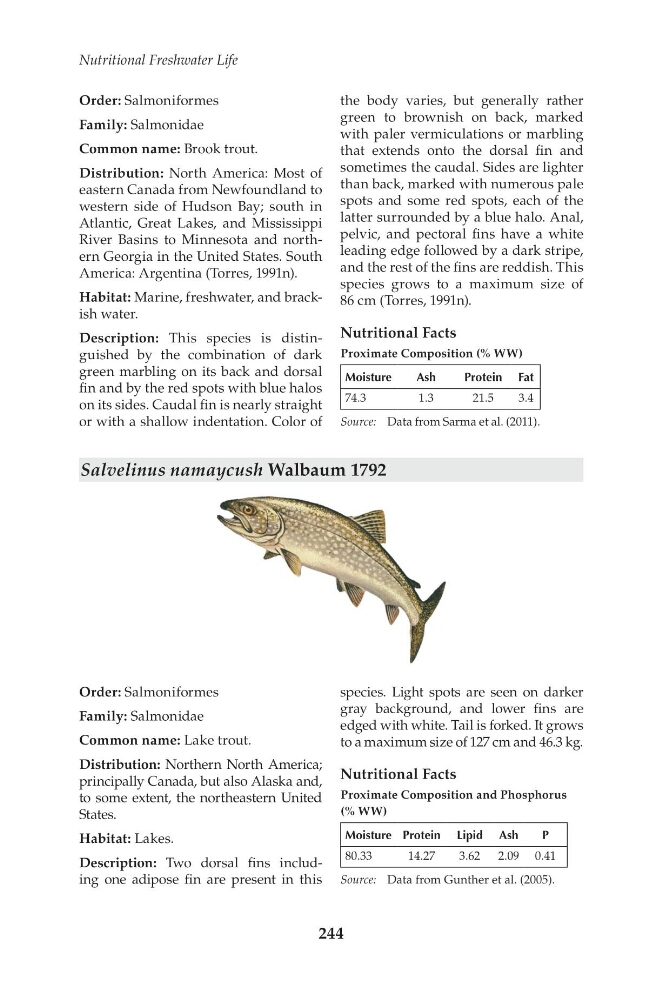
Salvelinus namaycush Walbaum 1792
Order: Salmoniformes
Family: Salmonidae
Common name: Lake trout.
Distribution: Northern North America;
principally Canada, but also Alaska and,
to some extent, the northeastern United
States.
Habitat: Lakes.
Description: Two dorsal fins including one adipose fin are present in this
species. Light spots are seen on darker
gray background, and lower fins are
edged with white. Tail is forked. It grows
to a maximum size of 127 cm and 46.3 kg.
Nutritional Facts
Proximate Composition and Phosphorus
(% WW)
Moisture Protein Lipid Ash
P
80.33
14.27
3.62 2.09 0.41
Source: Data from Gunther et al. (2005).
244
Order: Salmoniformes
Family: Salmonidae
Common name: Brook trout.
Distribution: North America: Most of
eastern Canada from Newfoundland to
western side of Hudson Bay; south in
Atlantic, Great Lakes, and Mississippi
River Basins to Minnesota and northern Georgia in the United States. South
America: Argentina (Torres, 1991n).
Habitat: Marine, freshwater, and brackish water.
Description: This species is distinguished by the combination of dark
green marbling on its back and dorsal
fin and by the red spots with blue halos
on its sides. Caudal fin is nearly straight
or with a shallow indentation. Color of
the body varies, but generally rather
green to brownish on back, marked
with paler vermiculations or marbling
that extends onto the dorsal fin and
sometimes the caudal. Sides are lighter
than back, marked with numerous pale
spots and some red spots, each of the
latter surrounded by a blue halo. Anal,
pelvic, and pectoral fins have a white
leading edge followed by a dark stripe,
and the rest of the fins are reddish. This
species grows to a maximum size of
86 cm (Torres, 1991n).
Nutritional Facts
Proximate Composition (% WW)
Moisture
Ash
Protein Fat
74.3
1.3
21.5
3.4
Source: Data from Sarma et al. (2011).
Salvelinus namaycush Walbaum 1792
Order: Salmoniformes
Family: Salmonidae
Common name: Lake trout.
Distribution: Northern North America;
principally Canada, but also Alaska and,
to some extent, the northeastern United
States.
Habitat: Lakes.
Description: Two dorsal fins including one adipose fin are present in this
species. Light spots are seen on darker
gray background, and lower fins are
edged with white. Tail is forked. It grows
to a maximum size of 127 cm and 46.3 kg.
Nutritional Facts
Proximate Composition and Phosphorus
(% WW)
Moisture Protein Lipid Ash
P
80.33
14.27
3.62 2.09 0.41
Source: Data from Gunther et al. (2005).