

Nutritional Freshwater Life
190
is larger than that of females. Lateral
line is interrupted. Spinous and soft
ray parts of the dorsal fin are continuous. Caudal fin is truncated. Native
coloration is a dull greenish or yellowish, and there may be weak banding.
During spawning season, pectoral,
dorsal, and caudal fins become reddish.
Adults reach a size of 35 cm and 1.13 kg.
Nutritional Facts
Proximate Composition (g/100 g Edible
Portion, WW)
Energy a Water Protein Fat CHO b Ash
96
78.9
16.4
3.0
0.8
0.9
a kcal.
b Carbohydrate.
Minerals (mg/100 g Edible Portion)
Ca
P
Fe
Na
K
22
147
0.6
48
253
Vitamins (μg per 100 g Edible Portion)
Retinol a Carotene a Thiamin Riboflavin
Niacin
Vitamin C
21 µg
0 µg
0 mg
0.30 mg
1.6 mg
0.6 mg
a µg.
Source: Data from Tee et al. (1989).
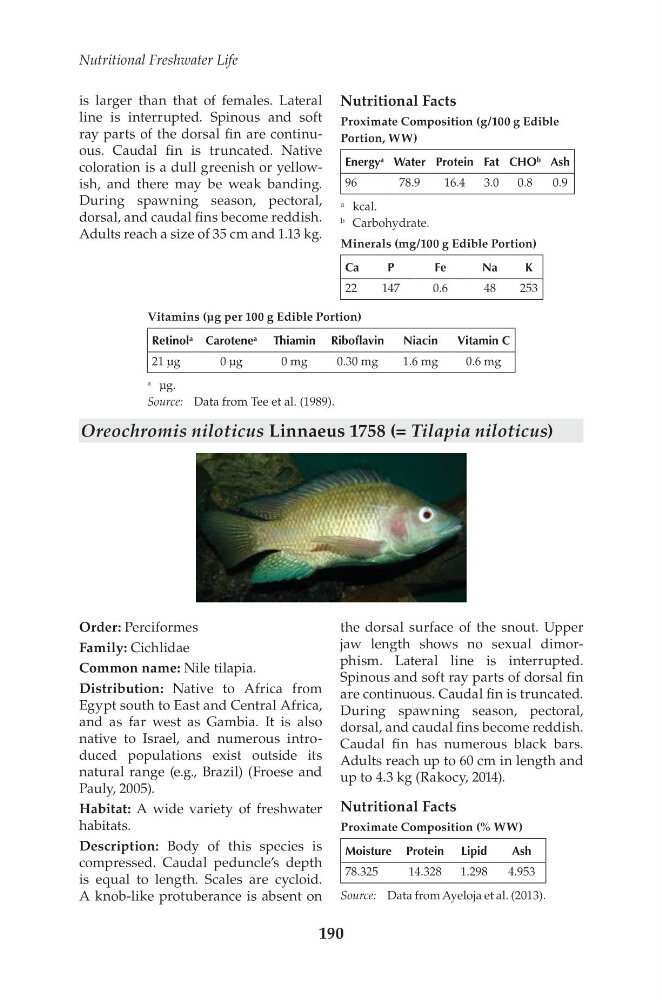
Oreochromis niloticus Linnaeus 1758 (= Tilapia niloticus)
Order: Perciformes
Family: Cichlidae
Common name: Nile tilapia.
Distribution: Native to Africa from
Egypt south to East and Central Africa,
and as far west as Gambia. It is also
native to Israel, and numerous introduced populations exist outside its
natural range (e.g., Brazil) (Froese and
Pauly, 2005).
Habitat: A wide variety of freshwater
habitats.
Description: Body of this species is
compressed. Caudal peduncle’s depth
is equal to length. Scales are cycloid.
A knob-like protuberance is absent on
the dorsal surface of the snout. Upper
jaw length shows no sexual dimorphism. Lateral line is interrupted.
Spinous and soft ray parts of dorsal fin
are continuous. Caudal fin is truncated.
During spawning season, pectoral,
dorsal, and caudal fins become reddish.
Caudal fin has numerous black bars.
Adults reach up to 60 cm in length and
up to 4.3 kg (Rakocy, 2014).
Nutritional Facts
Proximate Composition (% WW)
Moisture Protein Lipid
Ash
78.325
14.328
1.298
4.953
Source: Data from Ayeloja et al. (2013).
190
is larger than that of females. Lateral
line is interrupted. Spinous and soft
ray parts of the dorsal fin are continuous. Caudal fin is truncated. Native
coloration is a dull greenish or yellowish, and there may be weak banding.
During spawning season, pectoral,
dorsal, and caudal fins become reddish.
Adults reach a size of 35 cm and 1.13 kg.
Nutritional Facts
Proximate Composition (g/100 g Edible
Portion, WW)
Energy a Water Protein Fat CHO b Ash
96
78.9
16.4
3.0
0.8
0.9
a kcal.
b Carbohydrate.
Minerals (mg/100 g Edible Portion)
Ca
P
Fe
Na
K
22
147
0.6
48
253
Vitamins (μg per 100 g Edible Portion)
Retinol a Carotene a Thiamin Riboflavin
Niacin
Vitamin C
21 µg
0 µg
0 mg
0.30 mg
1.6 mg
0.6 mg
a µg.
Source: Data from Tee et al. (1989).
Oreochromis niloticus Linnaeus 1758 (= Tilapia niloticus)
Order: Perciformes
Family: Cichlidae
Common name: Nile tilapia.
Distribution: Native to Africa from
Egypt south to East and Central Africa,
and as far west as Gambia. It is also
native to Israel, and numerous introduced populations exist outside its
natural range (e.g., Brazil) (Froese and
Pauly, 2005).
Habitat: A wide variety of freshwater
habitats.
Description: Body of this species is
compressed. Caudal peduncle’s depth
is equal to length. Scales are cycloid.
A knob-like protuberance is absent on
the dorsal surface of the snout. Upper
jaw length shows no sexual dimorphism. Lateral line is interrupted.
Spinous and soft ray parts of dorsal fin
are continuous. Caudal fin is truncated.
During spawning season, pectoral,
dorsal, and caudal fins become reddish.
Caudal fin has numerous black bars.
Adults reach up to 60 cm in length and
up to 4.3 kg (Rakocy, 2014).
Nutritional Facts
Proximate Composition (% WW)
Moisture Protein Lipid
Ash
78.325
14.328
1.298
4.953
Source: Data from Ayeloja et al. (2013).