

Fishes
189
Description: This species has a narrow
preorbital bone (depth maximum of
21.5% of head length in fishes up to
21.3 cm standard length). There is no
enlargement of the jaws in mature fish
(lower jaw not exceeding and usually
less than 36.8% head length). Caudal
is without regular dark vertical stripes
but with a broad pink to bright red
distal margin. Breeding males assume
an intense bright metallic blue on the
head, a vermilion edge to the dorsal
fin, and a more intense pink on the
caudal margin. This species grows
to a maximum size of 45.7 cm and
2 kg (Casal, 1995c).
Nutritional Facts
Proximate Composition (%)
Dry Matter Protein a
Lipid a
Ash a
24.50
20.20
3.01
1.22
a Wet weight basis.
Amino Acids (g/100 g)
Threonine
3.49
Valine
4.23
Methionine
2.40
Isoleucine
3.90
Leucine
6.16
Phenylalanine
3.45
Histidine
2.20
Lysine
7.80
Arginine
4.71
Total EAAs
38.36
Serine
4.31
Glutamic acid
6.86
Proline
3.63
Glycine
3.62
Alanine
5.27
Aspartic acid
7.39
Tyrosine
1.90
Total NEAAs
32.97
EAA, essential amino acid; NEAA,
nonessential amino acid.
Source: Data from Taşbozan et al.
(2013b).
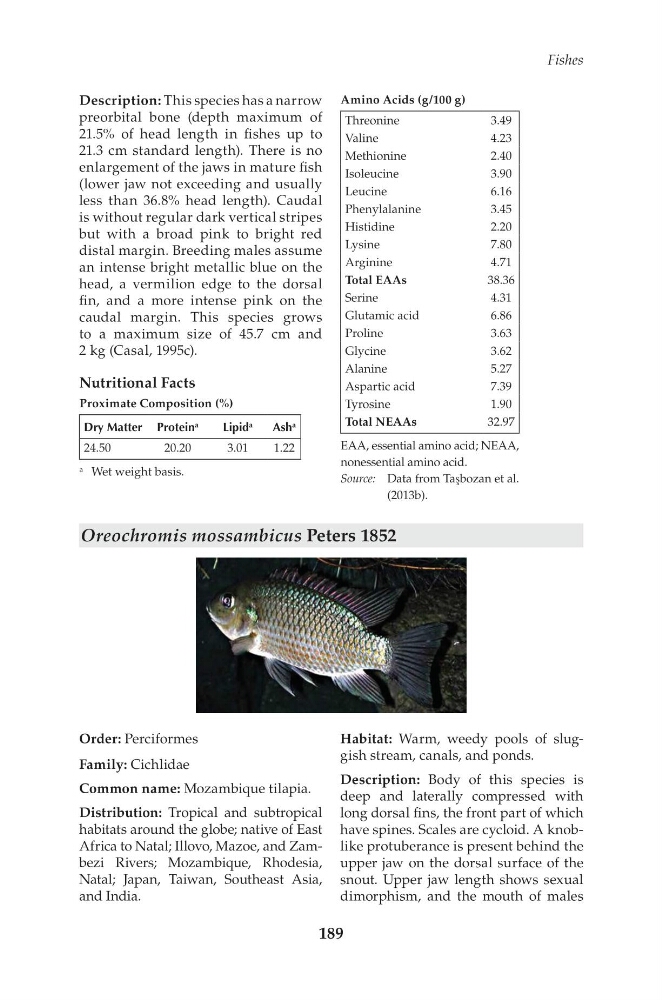
Oreochromis mossambicus Peters 1852
Order: Perciformes
Family: Cichlidae
Common name: Mozambique tilapia.
Distribution: Tropical and subtropical
habitats around the globe; native of East
Africa to Natal; Illovo, Mazoe, and Zambezi Rivers; Mozambique, Rhodesia,
Natal; Japan, Taiwan, Southeast Asia,
and India.
Habitat: Warm, weedy pools of sluggish stream, canals, and ponds.
Description: Body of this species is
deep and laterally compressed with
long dorsal fins, the front part of which
have spines. Scales are cycloid. A knoblike protuberance is present behind the
upper jaw on the dorsal surface of the
snout. Upper jaw length shows sexual
dimorphism, and the mouth of males
189
Description: This species has a narrow
preorbital bone (depth maximum of
21.5% of head length in fishes up to
21.3 cm standard length). There is no
enlargement of the jaws in mature fish
(lower jaw not exceeding and usually
less than 36.8% head length). Caudal
is without regular dark vertical stripes
but with a broad pink to bright red
distal margin. Breeding males assume
an intense bright metallic blue on the
head, a vermilion edge to the dorsal
fin, and a more intense pink on the
caudal margin. This species grows
to a maximum size of 45.7 cm and
2 kg (Casal, 1995c).
Nutritional Facts
Proximate Composition (%)
Dry Matter Protein a
Lipid a
Ash a
24.50
20.20
3.01
1.22
a Wet weight basis.
Amino Acids (g/100 g)
Threonine
3.49
Valine
4.23
Methionine
2.40
Isoleucine
3.90
Leucine
6.16
Phenylalanine
3.45
Histidine
2.20
Lysine
7.80
Arginine
4.71
Total EAAs
38.36
Serine
4.31
Glutamic acid
6.86
Proline
3.63
Glycine
3.62
Alanine
5.27
Aspartic acid
7.39
Tyrosine
1.90
Total NEAAs
32.97
EAA, essential amino acid; NEAA,
nonessential amino acid.
Source: Data from Taşbozan et al.
(2013b).
Oreochromis mossambicus Peters 1852
Order: Perciformes
Family: Cichlidae
Common name: Mozambique tilapia.
Distribution: Tropical and subtropical
habitats around the globe; native of East
Africa to Natal; Illovo, Mazoe, and Zambezi Rivers; Mozambique, Rhodesia,
Natal; Japan, Taiwan, Southeast Asia,
and India.
Habitat: Warm, weedy pools of sluggish stream, canals, and ponds.
Description: Body of this species is
deep and laterally compressed with
long dorsal fins, the front part of which
have spines. Scales are cycloid. A knoblike protuberance is present behind the
upper jaw on the dorsal surface of the
snout. Upper jaw length shows sexual
dimorphism, and the mouth of males