

Nutritional Freshwater Life
170
Order: Cypriniformes
Family: Cyprinidae
Common name: Annandale garra,
Tunga garra.
Distribution: India (northern Bengal,
Bihar, and Assam), eastern and central
Nepal (Kosi drainage), and Bangladesh
(Rayamajhi and Jha, 2010a).
Habitat: Swift and clear mountain
streams with rocks and bounders.
Description: Body of this species
is elongated and cylindrical with a
slightly depressed head. Mouth is
small and semicircular. Proboscis is
absent and two pairs of barbels are
seen. Pectoral is shorter than head and
caudal fin is deeply emarginated. Body
color is grayish and dorsal side is dark
gray. Belly is pale. There is a black spot
on the upper angle of the gill opening.
Lower lobe of caudal fin is black and
other fins are blackish (Fahad, 2011b).
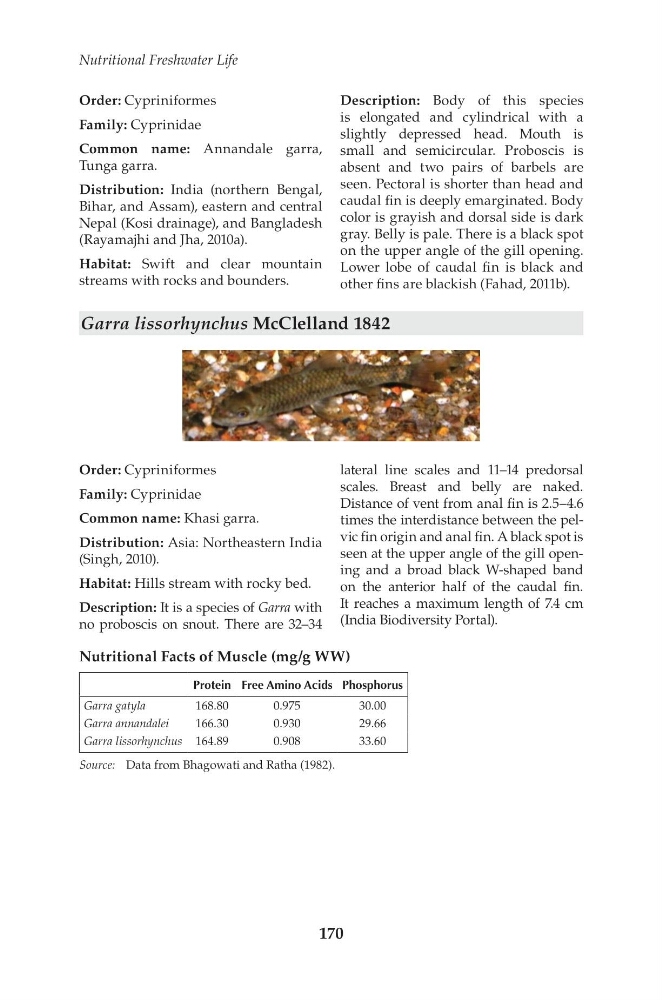
Garra lissorhynchus McClelland 1842
Order: Cypriniformes
Family: Cyprinidae
Common name: Khasi garra.
Distribution: Asia: Northeastern India
(Singh, 2010).
Habitat: Hills stream with rocky bed.
Description: It is a species of Garra with
no proboscis on snout. There are 32–34
lateral line scales and 11–14 predorsal
scales. Breast and belly are naked.
Distance of vent from anal fin is 2.5–4.6
times the interdistance between the pelvic fin origin and anal fin. A black spot is
seen at the upper angle of the gill opening and a broad black W-shaped band
on the anterior half of the caudal fin.
It reaches a maximum length of 7.4 cm
(India Biodiversity Portal).
Nutritional Facts of Muscle (mg/g WW)
Protein Free Amino Acids Phosphorus
Garra gatyla
168.80
0.975
30.00
Garra annandalei
166.30
0.930
29.66
Garra lissorhynchus 164.89
0.908
33.60
Source: Data from Bhagowati and Ratha (1982).
170
Order: Cypriniformes
Family: Cyprinidae
Common name: Annandale garra,
Tunga garra.
Distribution: India (northern Bengal,
Bihar, and Assam), eastern and central
Nepal (Kosi drainage), and Bangladesh
(Rayamajhi and Jha, 2010a).
Habitat: Swift and clear mountain
streams with rocks and bounders.
Description: Body of this species
is elongated and cylindrical with a
slightly depressed head. Mouth is
small and semicircular. Proboscis is
absent and two pairs of barbels are
seen. Pectoral is shorter than head and
caudal fin is deeply emarginated. Body
color is grayish and dorsal side is dark
gray. Belly is pale. There is a black spot
on the upper angle of the gill opening.
Lower lobe of caudal fin is black and
other fins are blackish (Fahad, 2011b).
Garra lissorhynchus McClelland 1842
Order: Cypriniformes
Family: Cyprinidae
Common name: Khasi garra.
Distribution: Asia: Northeastern India
(Singh, 2010).
Habitat: Hills stream with rocky bed.
Description: It is a species of Garra with
no proboscis on snout. There are 32–34
lateral line scales and 11–14 predorsal
scales. Breast and belly are naked.
Distance of vent from anal fin is 2.5–4.6
times the interdistance between the pelvic fin origin and anal fin. A black spot is
seen at the upper angle of the gill opening and a broad black W-shaped band
on the anterior half of the caudal fin.
It reaches a maximum length of 7.4 cm
(India Biodiversity Portal).
Nutritional Facts of Muscle (mg/g WW)
Protein Free Amino Acids Phosphorus
Garra gatyla
168.80
0.975
30.00
Garra annandalei
166.30
0.930
29.66
Garra lissorhynchus 164.89
0.908
33.60
Source: Data from Bhagowati and Ratha (1982).