

Fishes
167
Distribution: Asia: Nepal (Reyes, 1993d).
Habitat: Streams and rivers.
Description: This species has very
well-developed cycloid scales over
its body, but its thorax on the ventral surface is scaleless and smooth.
Pectoral and pelvic fins are more ventrally attached to body. Fin rays are
segmented and branched distally.
Anterior lip is densely beset with
tubercles. It has an adhesion apparatus consisting of a sucking disc as part
of its mentum (the protruding part of
the lower jaw), along with modified
lips and paired fins, which enable the
fish to adhere to rocky substrates in
torrential streams. This species has a
maximum size of 17 cm (Saxena, 1959).
Nutritional Facts
Proximate Composition (per 100 g DM)
Protein (g)
Lipid (mg)
Moisture a (%)
17.85
3.60
75.90
a Wet weight.
Source: Data from Patole (2012).
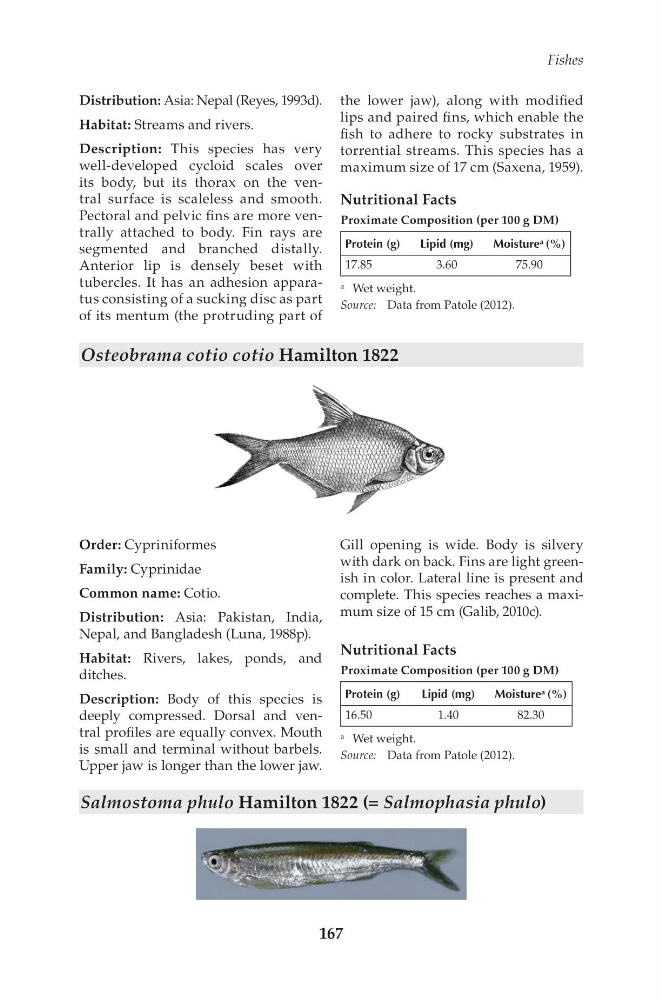
Osteobrama cotio cotio Hamilton 1822
Order: Cypriniformes
Family: Cyprinidae
Common name: Cotio.
Distribution: Asia: Pakistan, India,
Nepal, and Bangladesh (Luna, 1988p).
Habitat: Rivers, lakes, ponds, and
ditches.
Description: Body of this species is
deeply compressed. Dorsal and ventral profiles are equally convex. Mouth
is small and terminal without barbels.
Upper jaw is longer than the lower jaw.
Gill opening is wide. Body is silvery
with dark on back. Fins are light greenish in color. Lateral line is present and
complete. This species reaches a maximum size of 15 cm (Galib, 2010c).
Nutritional Facts
Proximate Composition (per 100 g DM)
Protein (g)
Lipid (mg)
Moisture a (%)
16.50
1.40
82.30
a Wet weight.
Source: Data from Patole (2012).
Salmostoma phulo Hamilton 1822 (= Salmophasia phulo)
167
Distribution: Asia: Nepal (Reyes, 1993d).
Habitat: Streams and rivers.
Description: This species has very
well-developed cycloid scales over
its body, but its thorax on the ventral surface is scaleless and smooth.
Pectoral and pelvic fins are more ventrally attached to body. Fin rays are
segmented and branched distally.
Anterior lip is densely beset with
tubercles. It has an adhesion apparatus consisting of a sucking disc as part
of its mentum (the protruding part of
the lower jaw), along with modified
lips and paired fins, which enable the
fish to adhere to rocky substrates in
torrential streams. This species has a
maximum size of 17 cm (Saxena, 1959).
Nutritional Facts
Proximate Composition (per 100 g DM)
Protein (g)
Lipid (mg)
Moisture a (%)
17.85
3.60
75.90
a Wet weight.
Source: Data from Patole (2012).
Osteobrama cotio cotio Hamilton 1822
Order: Cypriniformes
Family: Cyprinidae
Common name: Cotio.
Distribution: Asia: Pakistan, India,
Nepal, and Bangladesh (Luna, 1988p).
Habitat: Rivers, lakes, ponds, and
ditches.
Description: Body of this species is
deeply compressed. Dorsal and ventral profiles are equally convex. Mouth
is small and terminal without barbels.
Upper jaw is longer than the lower jaw.
Gill opening is wide. Body is silvery
with dark on back. Fins are light greenish in color. Lateral line is present and
complete. This species reaches a maximum size of 15 cm (Galib, 2010c).
Nutritional Facts
Proximate Composition (per 100 g DM)
Protein (g)
Lipid (mg)
Moisture a (%)
16.50
1.40
82.30
a Wet weight.
Source: Data from Patole (2012).
Salmostoma phulo Hamilton 1822 (= Salmophasia phulo)