

Nutritional Freshwater Life
160
Description: It is a deep-bodied fish
with a high back and flattened sides.
Head is comparatively small. Mouth is
subinferior and it can be extended as
a tube. Eyes are small. Color of body
is dark brown or grayish on the back.
Fins are gray or light brown, and
those underneath are reddish tinted.
It grows to a maximum length of 75 cm
and weight of 9.1 kg (FAO, 2014b; Luna,
1988a).
Nutritional Facts
Proximate Composition (g/100 g WW)
Moisture Protein Fat
Ash
CHO a,b
78.66
17.59
3.24
0.80
41.93
a mg/100 g.
b Carbohydrate.
Fatty Acids (g/100 g)
SFA
MUFA
PUFA
PUFA/SFA
27.27
56.09
17.07
0.63
Source: Data from Ljubojevic et al. (2013).
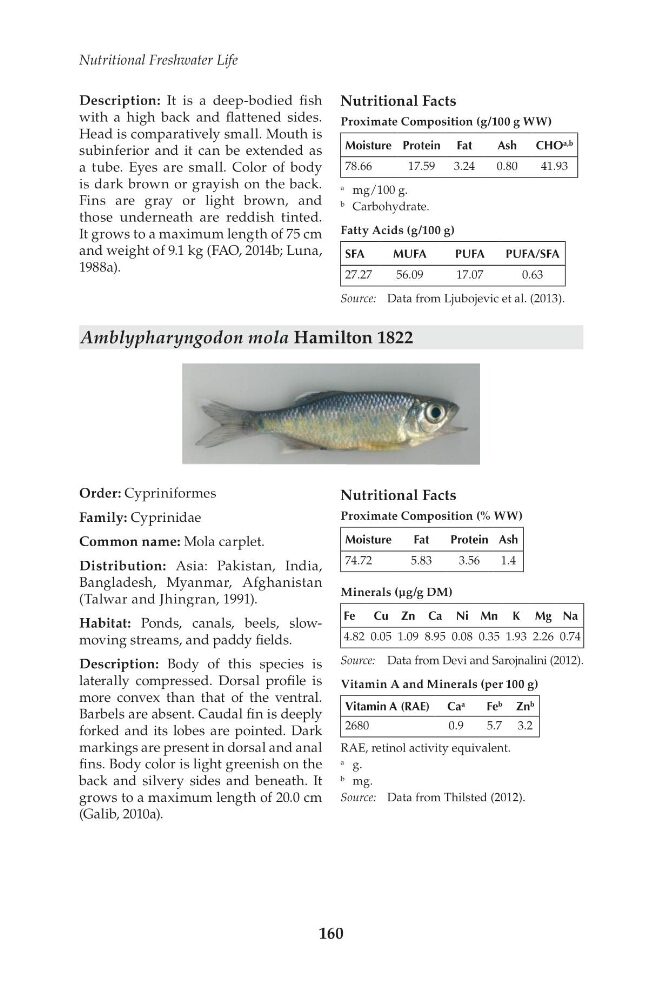
Amblypharyngodon mola Hamilton 1822
Order: Cypriniformes
Family: Cyprinidae
Common name: Mola carplet.
Distribution: Asia: Pakistan, India,
Bangladesh, Myanmar, Afghanistan
(Talwar and Jhingran, 1991).
Habitat: Ponds, canals, beels, slowmoving streams, and paddy fields.
Description: Body of this species is
laterally compressed. Dorsal profile is
more convex than that of the ventral.
Barbels are absent. Caudal fin is deeply
forked and its lobes are pointed. Dark
markings are present in dorsal and anal
fins. Body color is light greenish on the
back and silvery sides and beneath. It
grows to a maximum length of 20.0 cm
(Galib, 2010a).
Nutritional Facts
Proximate Composition (% WW)
Moisture
Fat
Protein Ash
74.72
5.83
3.56
1.4
Minerals (µg/g DM)
Fe
Cu Zn Ca Ni Mn K Mg Na
4.82 0.05 1.09 8.95 0.08 0.35 1.93 2.26 0.74
Source: Data from Devi and Sarojnalini (2012).
Vitamin A and Minerals (per 100 g)
Vitamin A (RAE) Ca a
Fe b Zn b
2680
0.9
5.7 3.2
RAE, retinol activity equivalent.
a g.
b mg.
Source: Data from Thilsted (2012).
160
Description: It is a deep-bodied fish
with a high back and flattened sides.
Head is comparatively small. Mouth is
subinferior and it can be extended as
a tube. Eyes are small. Color of body
is dark brown or grayish on the back.
Fins are gray or light brown, and
those underneath are reddish tinted.
It grows to a maximum length of 75 cm
and weight of 9.1 kg (FAO, 2014b; Luna,
1988a).
Nutritional Facts
Proximate Composition (g/100 g WW)
Moisture Protein Fat
Ash
CHO a,b
78.66
17.59
3.24
0.80
41.93
a mg/100 g.
b Carbohydrate.
Fatty Acids (g/100 g)
SFA
MUFA
PUFA
PUFA/SFA
27.27
56.09
17.07
0.63
Source: Data from Ljubojevic et al. (2013).
Amblypharyngodon mola Hamilton 1822
Order: Cypriniformes
Family: Cyprinidae
Common name: Mola carplet.
Distribution: Asia: Pakistan, India,
Bangladesh, Myanmar, Afghanistan
(Talwar and Jhingran, 1991).
Habitat: Ponds, canals, beels, slowmoving streams, and paddy fields.
Description: Body of this species is
laterally compressed. Dorsal profile is
more convex than that of the ventral.
Barbels are absent. Caudal fin is deeply
forked and its lobes are pointed. Dark
markings are present in dorsal and anal
fins. Body color is light greenish on the
back and silvery sides and beneath. It
grows to a maximum length of 20.0 cm
(Galib, 2010a).
Nutritional Facts
Proximate Composition (% WW)
Moisture
Fat
Protein Ash
74.72
5.83
3.56
1.4
Minerals (µg/g DM)
Fe
Cu Zn Ca Ni Mn K Mg Na
4.82 0.05 1.09 8.95 0.08 0.35 1.93 2.26 0.74
Source: Data from Devi and Sarojnalini (2012).
Vitamin A and Minerals (per 100 g)
Vitamin A (RAE) Ca a
Fe b Zn b
2680
0.9
5.7 3.2
RAE, retinol activity equivalent.
a g.
b mg.
Source: Data from Thilsted (2012).