

Nutritional Freshwater Life
156
Distribution: Mekong, Chao Phraya,
and Salween Basins, the northern
Malay Peninsula, and westward to the
Indus and Sri Lanka; Indonesia (Borneo
and Sumatra) (Jenkins and Ali, 2013).
Habitat: Freshwater and brackish
water; ditches, ponds, canals, streams,
rivers, and inundated fields.
Description: Body of this species is
oblong and compressed. The greatest
width of the head equals its post-orbital
length. Lateral line is complete with
only the last few scales lacking pores.
Overall it has a silver body with olivecolored undertones, but the scales
are large and highly reflective, giving
a sparkling effect. The belly of the male
is yellow or reddish, while the female’s
is whiter. However, its most prominent
feature is a blue-black line that runs
the body length. This line is finely outlined in a bright gold. It reaches 15 cm
in length (Froese and Pauly, 2006b;
Animal-world).
Nutritional Facts
Proximate Composition (per 100 g DM)
Protein (g)
Lipid (mg) Moisture a (%)
17.90
01.47
81. 20
a Wet weight.
Source: Data from Patole (2012).
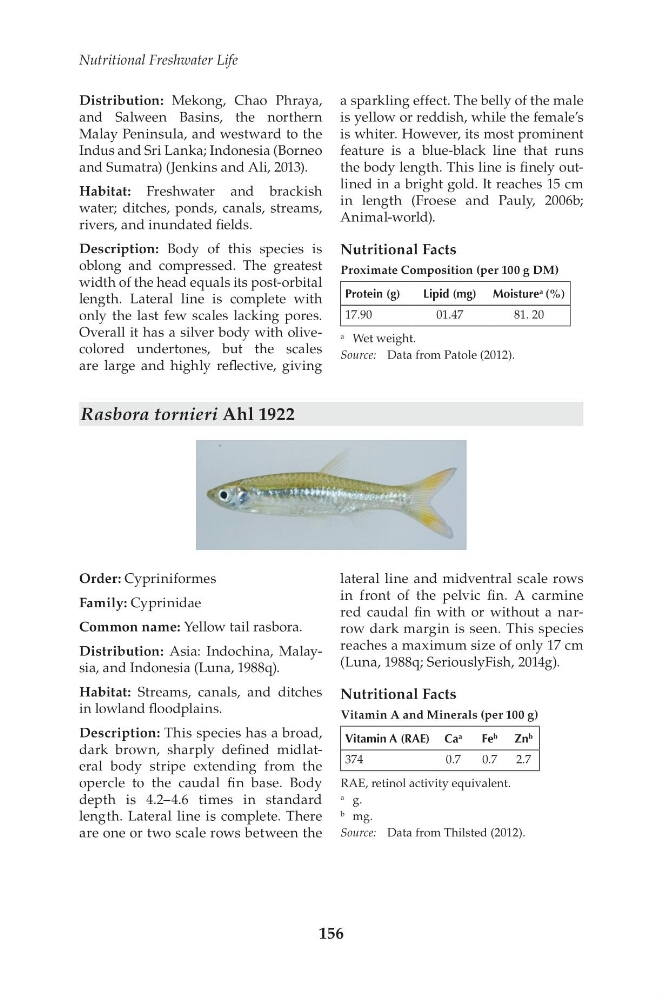
Rasbora tornieri Ahl 1922
Order: Cypriniformes
Family: Cyprinidae
Common name: Yellow tail rasbora.
Distribution: Asia: Indochina, Malaysia, and Indonesia (Luna, 1988q).
Habitat: Streams, canals, and ditches
in lowland floodplains.
Description: This species has a broad,
dark brown, sharply defined midlateral body stripe extending from the
opercle to the caudal fin base. Body
depth is 4.2–4.6 times in standard
length. Lateral line is complete. There
are one or two scale rows between the
lateral line and midventral scale rows
in front of the pelvic fin. A carmine
red caudal fin with or without a narrow dark margin is seen. This species
reaches a maximum size of only 17 cm
(Luna, 1988q; SeriouslyFish, 2014g).
Nutritional Facts
Vitamin A and Minerals (per 100 g)
Vitamin A (RAE) Ca a
Fe b Zn b
374
0.7
0.7
2.7
RAE, retinol activity equivalent.
a g.
b mg.
Source: Data from Thilsted (2012).
156
Distribution: Mekong, Chao Phraya,
and Salween Basins, the northern
Malay Peninsula, and westward to the
Indus and Sri Lanka; Indonesia (Borneo
and Sumatra) (Jenkins and Ali, 2013).
Habitat: Freshwater and brackish
water; ditches, ponds, canals, streams,
rivers, and inundated fields.
Description: Body of this species is
oblong and compressed. The greatest
width of the head equals its post-orbital
length. Lateral line is complete with
only the last few scales lacking pores.
Overall it has a silver body with olivecolored undertones, but the scales
are large and highly reflective, giving
a sparkling effect. The belly of the male
is yellow or reddish, while the female’s
is whiter. However, its most prominent
feature is a blue-black line that runs
the body length. This line is finely outlined in a bright gold. It reaches 15 cm
in length (Froese and Pauly, 2006b;
Animal-world).
Nutritional Facts
Proximate Composition (per 100 g DM)
Protein (g)
Lipid (mg) Moisture a (%)
17.90
01.47
81. 20
a Wet weight.
Source: Data from Patole (2012).
Rasbora tornieri Ahl 1922
Order: Cypriniformes
Family: Cyprinidae
Common name: Yellow tail rasbora.
Distribution: Asia: Indochina, Malaysia, and Indonesia (Luna, 1988q).
Habitat: Streams, canals, and ditches
in lowland floodplains.
Description: This species has a broad,
dark brown, sharply defined midlateral body stripe extending from the
opercle to the caudal fin base. Body
depth is 4.2–4.6 times in standard
length. Lateral line is complete. There
are one or two scale rows between the
lateral line and midventral scale rows
in front of the pelvic fin. A carmine
red caudal fin with or without a narrow dark margin is seen. This species
reaches a maximum size of only 17 cm
(Luna, 1988q; SeriouslyFish, 2014g).
Nutritional Facts
Vitamin A and Minerals (per 100 g)
Vitamin A (RAE) Ca a
Fe b Zn b
374
0.7
0.7
2.7
RAE, retinol activity equivalent.
a g.
b mg.
Source: Data from Thilsted (2012).