

Nutritional Freshwater Life
148
Description: This species is cylindrical
in appearance. It is dark olive, which
looks lighter at the abdomen area. It has
four whiskers and protruding plump
lips. This species can grow to a length
of nearly 2 m and a weight of over 50 kg
(Crispina, 1990).
Nutritional Facts
Proximate Composition (g/100 g WW)
Protein Fat Moisture Ash CHO a Energy b
19.34
4.04 74.65 1.06 0.88
117.5
a Carbohydrate.
b kcal/100 g.
Minerals (mg/100 g)
Cu
Zn Fe
P
Ca
0.21 1.05 0.68 264.82 32.95
Fatty Acids (%)
SFA MUFA PUFA
PUFA/
SFA
PUFA
n-3
PUFA
n-6 n6/n-3
30.03 33.85 20.74 0.71 17.09 1.91
0.11
Amino Acids (mg/100 g)
Alanine
1015
Glycine
827.91
Valine
1018.03
Leucine
1473.02
Isoleucine
1007.62
Threonine
840.85
Serine
645.05
Proline
684.2
Aspartic acid
2462.3
Methionine
432.4
Hydrochloride proline
166.5
Glutamic acid
2385.2
Phenylalanine
663.8
Lysine
1425.1
Histidine
449.9
Tyrosine
727.3
Source: Data from Olgunoglu et al. (2011).
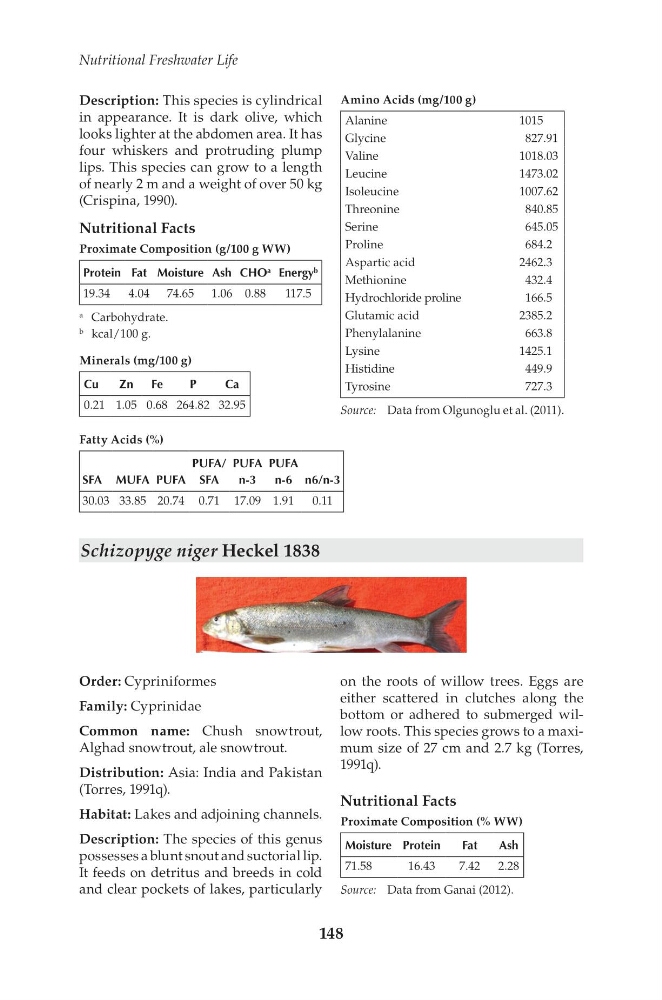
Schizopyge niger Heckel 1838
Order: Cypriniformes
Family: Cyprinidae
Common name: Chush snowtrout,
Alghad snowtrout, ale snowtrout.
Distribution: Asia: India and Pakistan
(Torres, 1991q).
Habitat: Lakes and adjoining channels.
Description: The species of this genus
possesses a blunt snout and suctorial lip.
It feeds on detritus and breeds in cold
and clear pockets of lakes, particularly
on the roots of willow trees. Eggs are
either scattered in clutches along the
bottom or adhered to submerged willow roots. This species grows to a maximum size of 27 cm and 2.7 kg (Torres,
1991q).
Nutritional Facts
Proximate Composition (% WW)
Moisture Protein
Fat
Ash
71.58
16.43
7.42 2.28
Source: Data from Ganai (2012).
148
Description: This species is cylindrical
in appearance. It is dark olive, which
looks lighter at the abdomen area. It has
four whiskers and protruding plump
lips. This species can grow to a length
of nearly 2 m and a weight of over 50 kg
(Crispina, 1990).
Nutritional Facts
Proximate Composition (g/100 g WW)
Protein Fat Moisture Ash CHO a Energy b
19.34
4.04 74.65 1.06 0.88
117.5
a Carbohydrate.
b kcal/100 g.
Minerals (mg/100 g)
Cu
Zn Fe
P
Ca
0.21 1.05 0.68 264.82 32.95
Fatty Acids (%)
SFA MUFA PUFA
PUFA/
SFA
PUFA
n-3
PUFA
n-6 n6/n-3
30.03 33.85 20.74 0.71 17.09 1.91
0.11
Amino Acids (mg/100 g)
Alanine
1015
Glycine
827.91
Valine
1018.03
Leucine
1473.02
Isoleucine
1007.62
Threonine
840.85
Serine
645.05
Proline
684.2
Aspartic acid
2462.3
Methionine
432.4
Hydrochloride proline
166.5
Glutamic acid
2385.2
Phenylalanine
663.8
Lysine
1425.1
Histidine
449.9
Tyrosine
727.3
Source: Data from Olgunoglu et al. (2011).
Schizopyge niger Heckel 1838
Order: Cypriniformes
Family: Cyprinidae
Common name: Chush snowtrout,
Alghad snowtrout, ale snowtrout.
Distribution: Asia: India and Pakistan
(Torres, 1991q).
Habitat: Lakes and adjoining channels.
Description: The species of this genus
possesses a blunt snout and suctorial lip.
It feeds on detritus and breeds in cold
and clear pockets of lakes, particularly
on the roots of willow trees. Eggs are
either scattered in clutches along the
bottom or adhered to submerged willow roots. This species grows to a maximum size of 27 cm and 2.7 kg (Torres,
1991q).
Nutritional Facts
Proximate Composition (% WW)
Moisture Protein
Fat
Ash
71.58
16.43
7.42 2.28
Source: Data from Ganai (2012).