

Nutritional Freshwater Life
136
Habitat: Fast-flowing streams and rivers.
Description: Body is bilaterally symmetrical and streamlined, and its depth is
about equal to the length of the head.
Head is without scales. Snout is blunt,
often with pores. Mouth is broad and
transverse. Upper lip is entire and not
continuous with lower lip Lower lip is
most indistinct. A single pair of short rostral barbels is seen. Origin of dorsal fin is
nearer to end of snout than base of caudal.
Pectoral fins are shorter than head, and
caudal fin is deeply forked. Anal fin is
not extending to caudal fin. Body is dark
gray above and silvery below. Dorsal fin
is grayish, and pectoral, pelvic, and anal
fins are orange-tipped (especially during
breeding season). This species attains
a maximum size of 99 cm and 12.7 kg
(Torres, 1991c; Ayyappan, 2014).
Nutritional Facts
Proximate Composition (% WW)
Moisture Protein Fat
Ash CHO a
78.6
15.6
1.62
1.55
1.50
a Carbohydrate.
Source: Data from Babu et al. (2013).
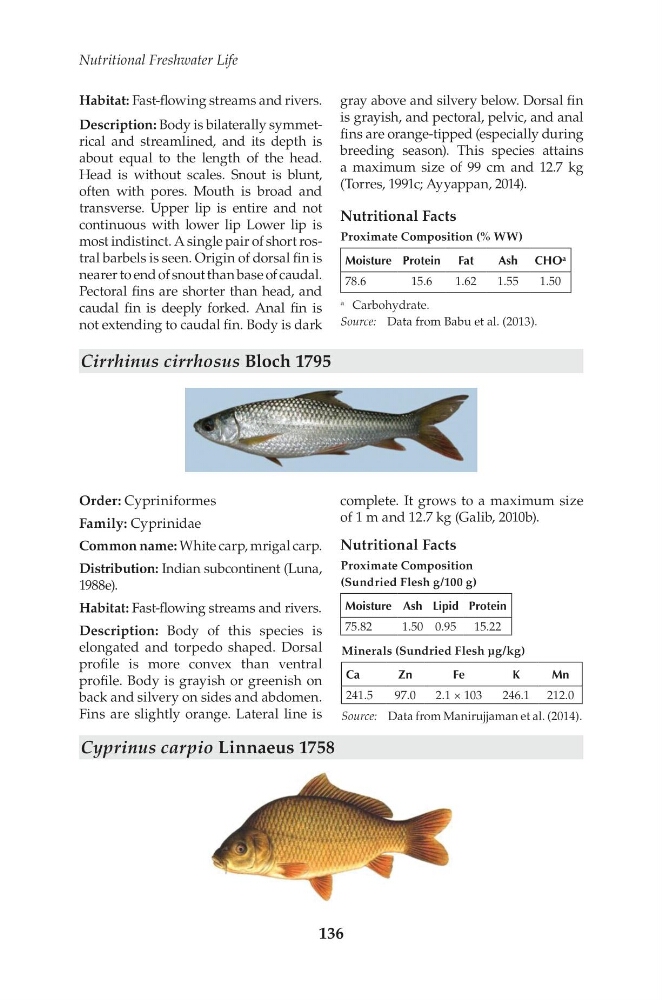
Cirrhinus cirrhosus Bloch 1795
Order: Cypriniformes
Family: Cyprinidae
Common name: White carp, mrigal carp.
Distribution: Indian subcontinent (Luna,
1988e).
Habitat: Fast-flowing streams and rivers.
Description: Body of this species is
elongated and torpedo shaped. Dorsal
profile is more convex than ventral
profile. Body is grayish or greenish on
back and silvery on sides and abdomen.
Fins are slightly orange. Lateral line is
complete. It grows to a maximum size
of 1 m and 12.7 kg (Galib, 2010b).
Nutritional Facts
Proximate Composition
(Sundried Flesh g/100 g)
Moisture Ash Lipid Protein
75.82
1.50 0.95 15.22
Minerals (Sundried Flesh µg/kg)
Ca
Zn
Fe
K
Mn
241.5
97.0
2.1 × 10³
246.1 212.0
Source: Data from Manirujjaman et al. (2014).
Cyprinus carpio Linnaeus 1758
136
Habitat: Fast-flowing streams and rivers.
Description: Body is bilaterally symmetrical and streamlined, and its depth is
about equal to the length of the head.
Head is without scales. Snout is blunt,
often with pores. Mouth is broad and
transverse. Upper lip is entire and not
continuous with lower lip Lower lip is
most indistinct. A single pair of short rostral barbels is seen. Origin of dorsal fin is
nearer to end of snout than base of caudal.
Pectoral fins are shorter than head, and
caudal fin is deeply forked. Anal fin is
not extending to caudal fin. Body is dark
gray above and silvery below. Dorsal fin
is grayish, and pectoral, pelvic, and anal
fins are orange-tipped (especially during
breeding season). This species attains
a maximum size of 99 cm and 12.7 kg
(Torres, 1991c; Ayyappan, 2014).
Nutritional Facts
Proximate Composition (% WW)
Moisture Protein Fat
Ash CHO a
78.6
15.6
1.62
1.55
1.50
a Carbohydrate.
Source: Data from Babu et al. (2013).
Cirrhinus cirrhosus Bloch 1795
Order: Cypriniformes
Family: Cyprinidae
Common name: White carp, mrigal carp.
Distribution: Indian subcontinent (Luna,
1988e).
Habitat: Fast-flowing streams and rivers.
Description: Body of this species is
elongated and torpedo shaped. Dorsal
profile is more convex than ventral
profile. Body is grayish or greenish on
back and silvery on sides and abdomen.
Fins are slightly orange. Lateral line is
complete. It grows to a maximum size
of 1 m and 12.7 kg (Galib, 2010b).
Nutritional Facts
Proximate Composition
(Sundried Flesh g/100 g)
Moisture Ash Lipid Protein
75.82
1.50 0.95 15.22
Minerals (Sundried Flesh µg/kg)
Ca
Zn
Fe
K
Mn
241.5
97.0
2.1 × 10³
246.1 212.0
Source: Data from Manirujjaman et al. (2014).
Cyprinus carpio Linnaeus 1758