

131
5
FISHES
ORDER: CYPRINIFORMES (CARPS)
FaMiLy: CyPrinidae (MinnowS or CarPS)
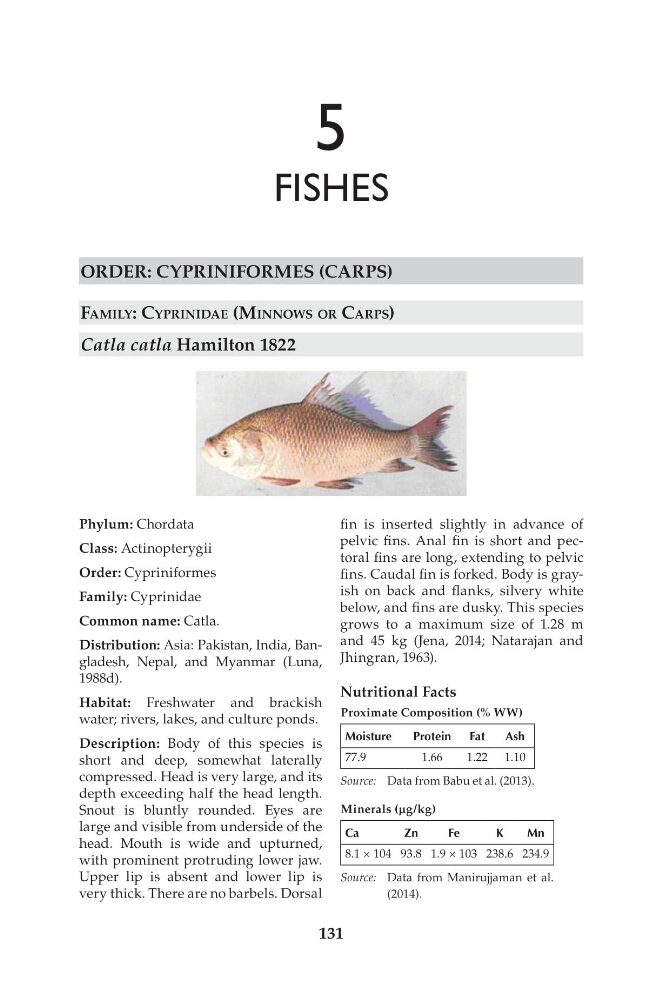
Catla catla Hamilton 1822
Phylum: Chordata
Class: Actinopterygii
Order: Cypriniformes
Family: Cyprinidae
Common name: Catla.
Distribution: Asia: Pakistan, India, Bangladesh, Nepal, and Myanmar (Luna,
1988d).
Habitat: Freshwater and brackish
water; rivers, lakes, and culture ponds.
Description: Body of this species is
short and deep, somewhat laterally
compressed. Head is very large, and its
depth exceeding half the head length.
Snout is bluntly rounded. Eyes are
large and visible from underside of the
head. Mouth is wide and upturned,
with prominent protruding lower jaw.
Upper lip is absent and lower lip is
very thick. There are no barbels. Dorsal
fin is inserted slightly in advance of
pelvic fins. Anal fin is short and pectoral fins are long, extending to pelvic
fins. Caudal fin is forked. Body is grayish on back and flanks, silvery white
below, and fins are dusky. This species
grows to a maximum size of 1.28 m
and 45 kg (Jena, 2014; Natarajan and
Jhingran, 1963).
Nutritional Facts
Proximate Composition (% WW)
Moisture
Protein
Fat
Ash
77.9
1.66
1.22 1.10
Source: Data from Babu et al. (2013).
Minerals (µg/kg)
Ca
Zn
Fe
K
Mn
8.1 × 10⁴ 93.8 1.9 × 10³ 238.6 234.9
Source: Data from Manirujjaman et al.
(2014).
5
FISHES
ORDER: CYPRINIFORMES (CARPS)
FaMiLy: CyPrinidae (MinnowS or CarPS)
Catla catla Hamilton 1822
Phylum: Chordata
Class: Actinopterygii
Order: Cypriniformes
Family: Cyprinidae
Common name: Catla.
Distribution: Asia: Pakistan, India, Bangladesh, Nepal, and Myanmar (Luna,
1988d).
Habitat: Freshwater and brackish
water; rivers, lakes, and culture ponds.
Description: Body of this species is
short and deep, somewhat laterally
compressed. Head is very large, and its
depth exceeding half the head length.
Snout is bluntly rounded. Eyes are
large and visible from underside of the
head. Mouth is wide and upturned,
with prominent protruding lower jaw.
Upper lip is absent and lower lip is
very thick. There are no barbels. Dorsal
fin is inserted slightly in advance of
pelvic fins. Anal fin is short and pectoral fins are long, extending to pelvic
fins. Caudal fin is forked. Body is grayish on back and flanks, silvery white
below, and fins are dusky. This species
grows to a maximum size of 1.28 m
and 45 kg (Jena, 2014; Natarajan and
Jhingran, 1963).
Nutritional Facts
Proximate Composition (% WW)
Moisture
Protein
Fat
Ash
77.9
1.66
1.22 1.10
Source: Data from Babu et al. (2013).
Minerals (µg/kg)
Ca
Zn
Fe
K
Mn
8.1 × 10⁴ 93.8 1.9 × 10³ 238.6 234.9
Source: Data from Manirujjaman et al.
(2014).