

Nutritional Freshwater Life
104
pincers at the front end, followed by four
pairs of walking legs and then four pairs
of small swimming legs called swimmerets. A central tail flap is surrounded
by four other flaps. There are two eyes
on the end of eyestalks (ARKive).
Nutritional Facts
Proximate Composition, Minerals, and
Energy (% DM)
CDW CDS CTW CTS
Protein
47.3
38.7
46.5
45.8
Fat
3.6
7.5
5.1
7.3
Fiber
10.2
10.3
13.6
11.5
Ash
28.0
31.4
26.9
24.5
Moisture a
—
74.5
—
75.0
Ca
9.4
11.9
8.7
9.6
Energy b
14.6
16.3
12.3
18.7
CDW, Cherax destructor of Western Australia;
CDS, Cherax destructor of South Australia;
CTW, Cherax tenuimanus of Western Australia;
CTS, Cherax tenuimanus of South Australia.
a Wet weight.
b kJ/g DM.
Source: Data from Huner et al. (1996).
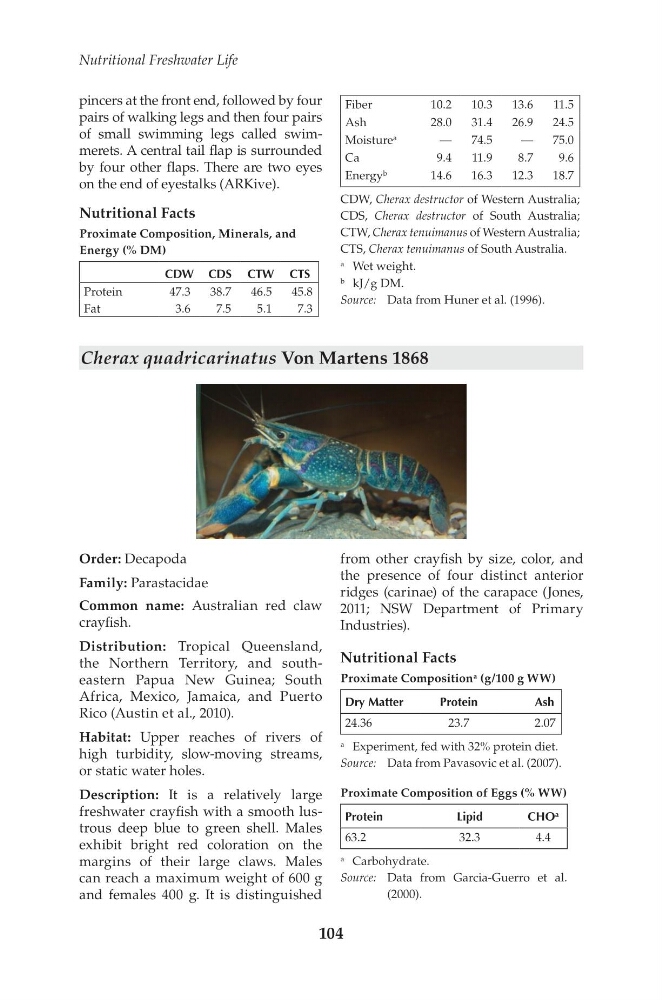
Cherax quadricarinatus Von Martens 1868
Order: Decapoda
Family: Parastacidae
Common name: Australian red claw
crayfish.
Distribution: Tropical Queensland,
the Northern Territory, and southeastern Papua New Guinea; South
Africa, Mexico, Jamaica, and Puerto
Rico (Austin et al., 2010).
Habitat: Upper reaches of rivers of
high turbidity, slow-moving streams,
or static water holes.
Description: It is a relatively large
freshwater crayfish with a smooth lustrous deep blue to green shell. Males
exhibit bright red coloration on the
margins of their large claws. Males
can reach a maximum weight of 600 g
and females 400 g. It is distinguished
from other crayfish by size, color, and
the presence of four distinct anterior
ridges (carinae) of the carapace (Jones,
2011; NSW Department of Primary
Industries).
Nutritional Facts
Proximate Composition a (g/100 g WW)
Dry Matter
Protein
Ash
24.36
23.7
2.07
a Experiment, fed with 32% protein diet.
Source: Data from Pavasovic et al. (2007).
Proximate Composition of Eggs (% WW)
Protein
Lipid
CHO a
63.2
32.3
4.4
a Carbohydrate.
Source: Data from Garcia-Guerro et al.
(2000).
104
pincers at the front end, followed by four
pairs of walking legs and then four pairs
of small swimming legs called swimmerets. A central tail flap is surrounded
by four other flaps. There are two eyes
on the end of eyestalks (ARKive).
Nutritional Facts
Proximate Composition, Minerals, and
Energy (% DM)
CDW CDS CTW CTS
Protein
47.3
38.7
46.5
45.8
Fat
3.6
7.5
5.1
7.3
Fiber
10.2
10.3
13.6
11.5
Ash
28.0
31.4
26.9
24.5
Moisture a
—
74.5
—
75.0
Ca
9.4
11.9
8.7
9.6
Energy b
14.6
16.3
12.3
18.7
CDW, Cherax destructor of Western Australia;
CDS, Cherax destructor of South Australia;
CTW, Cherax tenuimanus of Western Australia;
CTS, Cherax tenuimanus of South Australia.
a Wet weight.
b kJ/g DM.
Source: Data from Huner et al. (1996).
Cherax quadricarinatus Von Martens 1868
Order: Decapoda
Family: Parastacidae
Common name: Australian red claw
crayfish.
Distribution: Tropical Queensland,
the Northern Territory, and southeastern Papua New Guinea; South
Africa, Mexico, Jamaica, and Puerto
Rico (Austin et al., 2010).
Habitat: Upper reaches of rivers of
high turbidity, slow-moving streams,
or static water holes.
Description: It is a relatively large
freshwater crayfish with a smooth lustrous deep blue to green shell. Males
exhibit bright red coloration on the
margins of their large claws. Males
can reach a maximum weight of 600 g
and females 400 g. It is distinguished
from other crayfish by size, color, and
the presence of four distinct anterior
ridges (carinae) of the carapace (Jones,
2011; NSW Department of Primary
Industries).
Nutritional Facts
Proximate Composition a (g/100 g WW)
Dry Matter
Protein
Ash
24.36
23.7
2.07
a Experiment, fed with 32% protein diet.
Source: Data from Pavasovic et al. (2007).
Proximate Composition of Eggs (% WW)
Protein
Lipid
CHO a
63.2
32.3
4.4
a Carbohydrate.
Source: Data from Garcia-Guerro et al.
(2000).