

Nutritional Freshwater Life
98
Nutritional Facts
Proximate Composition of Edible Portion (% DM)
Dry Matter Moisture Ash Protein Fiber
M. vollenhovenii
94.13
5.87
20.00
53.85
1.00
M. macrobrachion
92.37
7.63
21.00
58.92
1.00
Source: Data from Ehigiator and Nwangwu (2011).
CRAYFISH (FRESHWATER LOBSTERS)
Astacus astacus Linnaeus 1758
Phylum: Arthropoda
Class: Crustacea
Order: Decapoda
Family: Astacidae
Common name: Noble crayfish, redfooted crayfish, red-clawed crayfish,
broad-fingered crayfish.
Distribution: Throughout Europe (Edsman et al., 2010).
Habitat: Rivers, lakes, ponds, and
reservoirs.
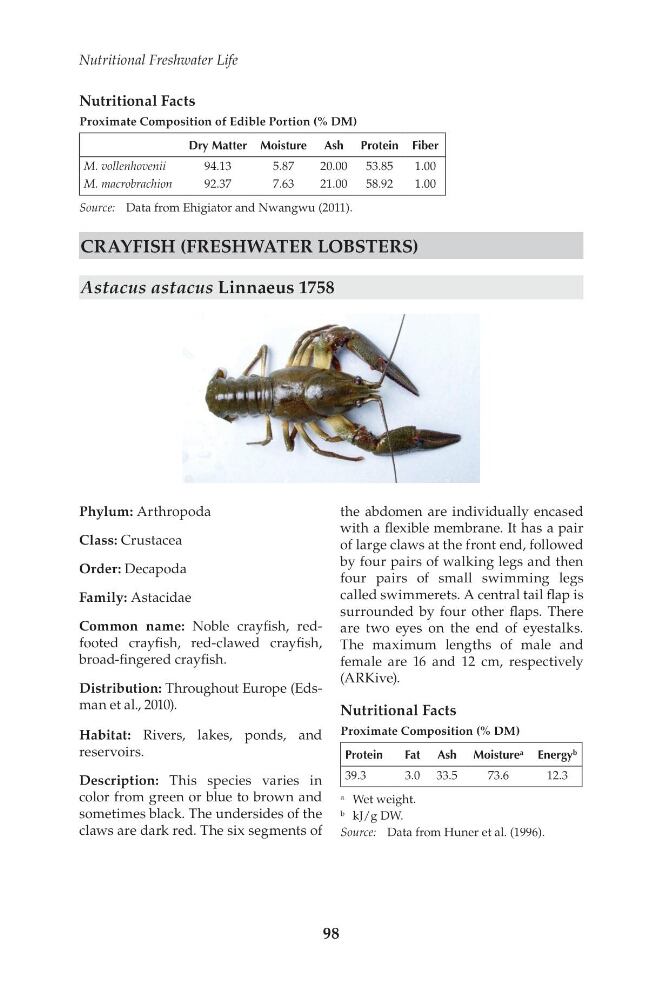
Description: This species varies in
color from green or blue to brown and
sometimes black. The undersides of the
claws are dark red. The six segments of
the abdomen are individually encased
with a flexible membrane. It has a pair
of large claws at the front end, followed
by four pairs of walking legs and then
four pairs of small swimming legs
called swimmerets. A central tail flap is
surrounded by four other flaps. There
are two eyes on the end of eyestalks.
The maximum lengths of male and
female are 16 and 12 cm, respectively
(ARKive).
Nutritional Facts
Proximate Composition (% DM)
Protein
Fat Ash Moisture a Energy b
39.3
3.0 33.5
73.6
12.3
a Wet weight.
b kJ/g DW.
Source: Data from Huner et al. (1996).
98
Nutritional Facts
Proximate Composition of Edible Portion (% DM)
Dry Matter Moisture Ash Protein Fiber
M. vollenhovenii
94.13
5.87
20.00
53.85
1.00
M. macrobrachion
92.37
7.63
21.00
58.92
1.00
Source: Data from Ehigiator and Nwangwu (2011).
CRAYFISH (FRESHWATER LOBSTERS)
Astacus astacus Linnaeus 1758
Phylum: Arthropoda
Class: Crustacea
Order: Decapoda
Family: Astacidae
Common name: Noble crayfish, redfooted crayfish, red-clawed crayfish,
broad-fingered crayfish.
Distribution: Throughout Europe (Edsman et al., 2010).
Habitat: Rivers, lakes, ponds, and
reservoirs.
Description: This species varies in
color from green or blue to brown and
sometimes black. The undersides of the
claws are dark red. The six segments of
the abdomen are individually encased
with a flexible membrane. It has a pair
of large claws at the front end, followed
by four pairs of walking legs and then
four pairs of small swimming legs
called swimmerets. A central tail flap is
surrounded by four other flaps. There
are two eyes on the end of eyestalks.
The maximum lengths of male and
female are 16 and 12 cm, respectively
(ARKive).
Nutritional Facts
Proximate Composition (% DM)
Protein
Fat Ash Moisture a Energy b
39.3
3.0 33.5
73.6
12.3
a Wet weight.
b kJ/g DW.
Source: Data from Huner et al. (1996).