

Crustaceans
97
Habitat: Freshwater and low-salinity
waters.
Description: It is a very large Macrobrachium species with characteristic
flesh-colored scissors with blue fingers and an orange spot on the scissor
hinge. The whole scissors leg is covered
with small spines. Males possess significantly larger shears and an appendix
masculina on the second pair of swimming legs, and females have a fülligerem abdomen. This species grows to a
maximum length of 195 mm (maximum
weight 83 g) and a carapace length of
38.0 mm (Aquaristik-Elmshorn).
Nutritional Facts
Proximate Composition of Edible Portion
(% DM)
Protein Fat Ash Fiber Moisture CHO a
71.37
7.33 10.31 0.45
10.71
2.42
a Carbohydrate.
Minerals (mg/100 g)
Ca
Mg
P
Zn
47.64
20.80 106.71 1.16
Amino Acids (mg/100 g)
Alanine
37.18
Arginine
39.55
Asparagine
68.35
Glutamine
108.03
Glycine
36.98
Histidine
13.46
Serine
14.56
Threonine
21.75
Leucine
62.15
Lysine
65.39
Methionine
12.26
Phenylalanine
26.61
Valine
41.36
Source: Data from Ehigiator and
Oterai (2012).
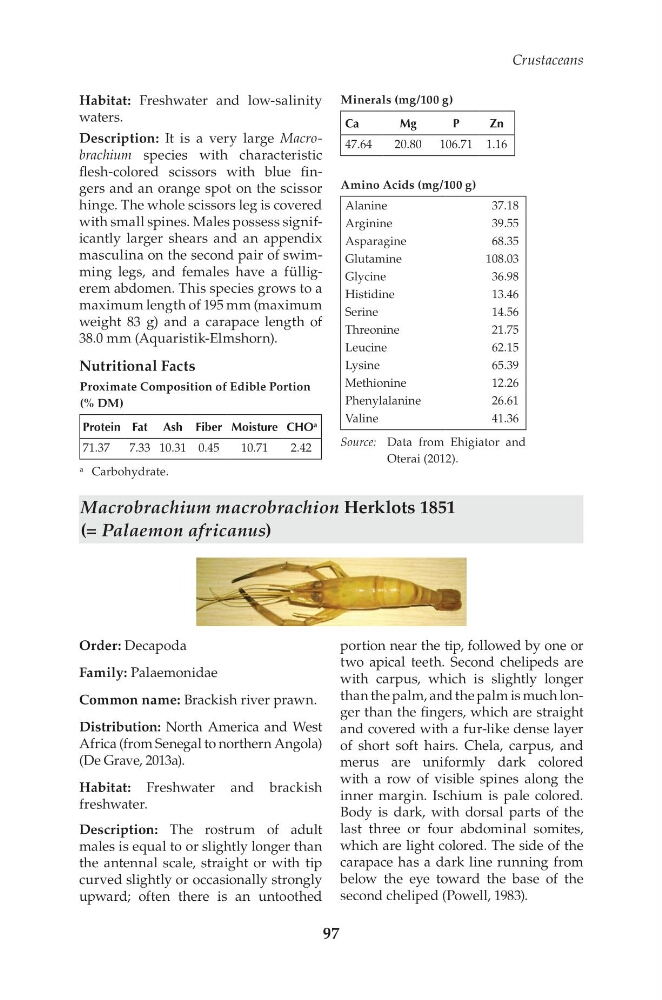
Macrobrachium macrobrachion Herklots 1851
(= Palaemon africanus)
Order: Decapoda
Family: Palaemonidae
Common name: Brackish river prawn.
Distribution: North America and West
Africa (from Senegal to northern Angola)
(De Grave, 2013a).
Habitat: Freshwater and brackish
freshwater.
Description: The rostrum of adult
males is equal to or slightly longer than
the antennal scale, straight or with tip
curved slightly or occasionally strongly
upward; often there is an untoothed
portion near the tip, followed by one or
two apical teeth. Second chelipeds are
with carpus, which is slightly longer
than the palm, and the palm is much longer than the fingers, which are straight
and covered with a fur-like dense layer
of short soft hairs. Chela, carpus, and
merus are uniformly dark colored
with a row of visible spines along the
inner margin. Ischium is pale colored.
Body is dark, with dorsal parts of the
last three or four abdominal somites,
which are light colored. The side of the
carapace has a dark line running from
below the eye toward the base of the
second cheliped (Powell, 1983).
97
Habitat: Freshwater and low-salinity
waters.
Description: It is a very large Macrobrachium species with characteristic
flesh-colored scissors with blue fingers and an orange spot on the scissor
hinge. The whole scissors leg is covered
with small spines. Males possess significantly larger shears and an appendix
masculina on the second pair of swimming legs, and females have a fülligerem abdomen. This species grows to a
maximum length of 195 mm (maximum
weight 83 g) and a carapace length of
38.0 mm (Aquaristik-Elmshorn).
Nutritional Facts
Proximate Composition of Edible Portion
(% DM)
Protein Fat Ash Fiber Moisture CHO a
71.37
7.33 10.31 0.45
10.71
2.42
a Carbohydrate.
Minerals (mg/100 g)
Ca
Mg
P
Zn
47.64
20.80 106.71 1.16
Amino Acids (mg/100 g)
Alanine
37.18
Arginine
39.55
Asparagine
68.35
Glutamine
108.03
Glycine
36.98
Histidine
13.46
Serine
14.56
Threonine
21.75
Leucine
62.15
Lysine
65.39
Methionine
12.26
Phenylalanine
26.61
Valine
41.36
Source: Data from Ehigiator and
Oterai (2012).
Macrobrachium macrobrachion Herklots 1851
(= Palaemon africanus)
Order: Decapoda
Family: Palaemonidae
Common name: Brackish river prawn.
Distribution: North America and West
Africa (from Senegal to northern Angola)
(De Grave, 2013a).
Habitat: Freshwater and brackish
freshwater.
Description: The rostrum of adult
males is equal to or slightly longer than
the antennal scale, straight or with tip
curved slightly or occasionally strongly
upward; often there is an untoothed
portion near the tip, followed by one or
two apical teeth. Second chelipeds are
with carpus, which is slightly longer
than the palm, and the palm is much longer than the fingers, which are straight
and covered with a fur-like dense layer
of short soft hairs. Chela, carpus, and
merus are uniformly dark colored
with a row of visible spines along the
inner margin. Ischium is pale colored.
Body is dark, with dorsal parts of the
last three or four abdominal somites,
which are light colored. The side of the
carapace has a dark line running from
below the eye toward the base of the
second cheliped (Powell, 1983).