

Algae and Plants
81
Typha latifolia (Linnaeus)
Order: Poales (Cyperales)
Family: Typhaceae
Common name: Bulrush, common
bulrush, broadleaf cattail, common
cattail.
Distribution: Native to North and
South America, Europe, Eurasia, and
Africa; Canada, Yukon, and Northwest
Territories, and in the United States.
Habitat: Flooded areas, freshwater,
slightly brackish marshes.
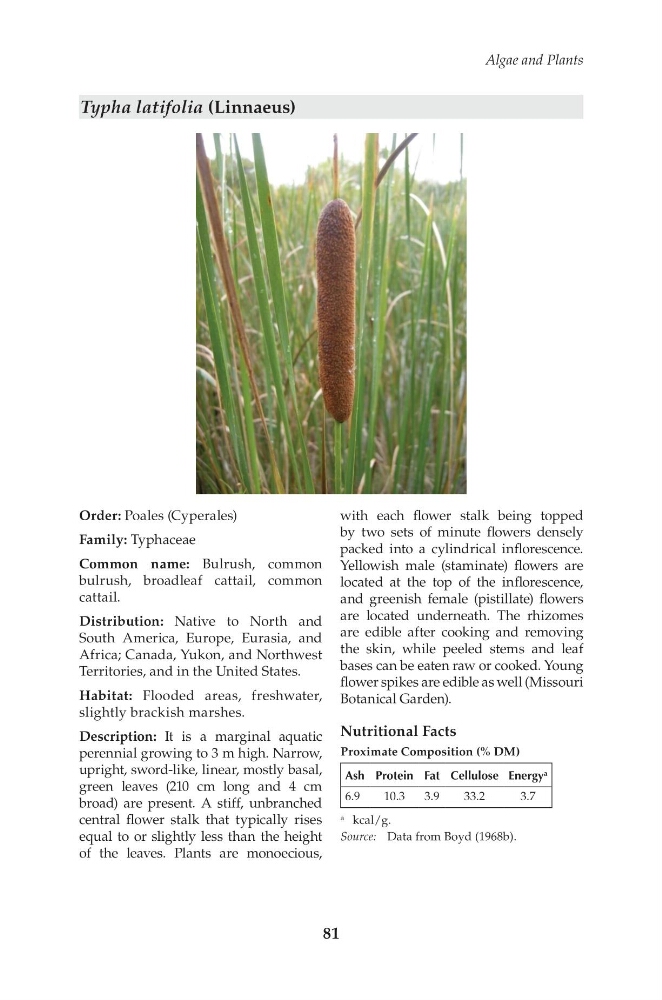
Description: It is a marginal aquatic
perennial growing to 3 m high. Narrow,
upright, sword-like, linear, mostly basal,
green leaves (210 cm long and 4 cm
broad) are present. A stiff, unbranched
central flower stalk that typically rises
equal to or slightly less than the height
of the leaves. Plants are monoecious,
with each flower stalk being topped
by two sets of minute flowers densely
packed into a cylindrical inflorescence.
Yellowish male (staminate) flowers are
located at the top of the inflorescence,
and greenish female (pistillate) flowers
are located underneath. The rhizomes
are edible after cooking and removing
the skin, while peeled stems and leaf
bases can be eaten raw or cooked. Young
flower spikes are edible as well (Missouri
Botanical Garden).
Nutritional Facts
Proximate Composition (% DM)
Ash Protein Fat Cellulose Energy a
6.9
10.3
3.9
33.2
3.7
a kcal/g.
Source: Data from Boyd (1968b).
81
Typha latifolia (Linnaeus)
Order: Poales (Cyperales)
Family: Typhaceae
Common name: Bulrush, common
bulrush, broadleaf cattail, common
cattail.
Distribution: Native to North and
South America, Europe, Eurasia, and
Africa; Canada, Yukon, and Northwest
Territories, and in the United States.
Habitat: Flooded areas, freshwater,
slightly brackish marshes.
Description: It is a marginal aquatic
perennial growing to 3 m high. Narrow,
upright, sword-like, linear, mostly basal,
green leaves (210 cm long and 4 cm
broad) are present. A stiff, unbranched
central flower stalk that typically rises
equal to or slightly less than the height
of the leaves. Plants are monoecious,
with each flower stalk being topped
by two sets of minute flowers densely
packed into a cylindrical inflorescence.
Yellowish male (staminate) flowers are
located at the top of the inflorescence,
and greenish female (pistillate) flowers
are located underneath. The rhizomes
are edible after cooking and removing
the skin, while peeled stems and leaf
bases can be eaten raw or cooked. Young
flower spikes are edible as well (Missouri
Botanical Garden).
Nutritional Facts
Proximate Composition (% DM)
Ash Protein Fat Cellulose Energy a
6.9
10.3
3.9
33.2
3.7
a kcal/g.
Source: Data from Boyd (1968b).