

Algae and Plants
79
Order: Alismatales
Family: Potamogetonaceae
Common name: Large-leaf pondweed,
broad-leaved pondweed.
Distribution: Through much of North
America.
Habitat: Lakes, ponds, and rivers, often
in deep water.
Description: This perennial plant
grows from rhizomes and produces a
very slender, cylindrical, sometimes
spotted stem up to a meter or so long.
Leaves take two forms. Submersed
leaves are up to 20 cm long by 7 cm
wide and may be folded along their
midribs. Floating leaves are up to 10 cm
long by 5 cm wide, leathery in texture,
and borne on long petioles. The inflorescence is a spike of many flowers rising above the water surface on a thick
peduncle. The tuber of this species is
edible (Naturalist.org).
Nutritional Facts
Proximate Composition (% DM)
Protein
Ash
Fiber
14.36
2.39
15.72
Minerals (% or mg/100 g DM)
Ca
(%)
P
(%)
K
(%)
Na
(%)
Mg
(%)
Fe
(mg)
Mn
(mg)
Mo
(mg)
1.01 0.83 2.91 0.172 0.232 1651 505 41.0
Source: Data from Linn et al. (1975).
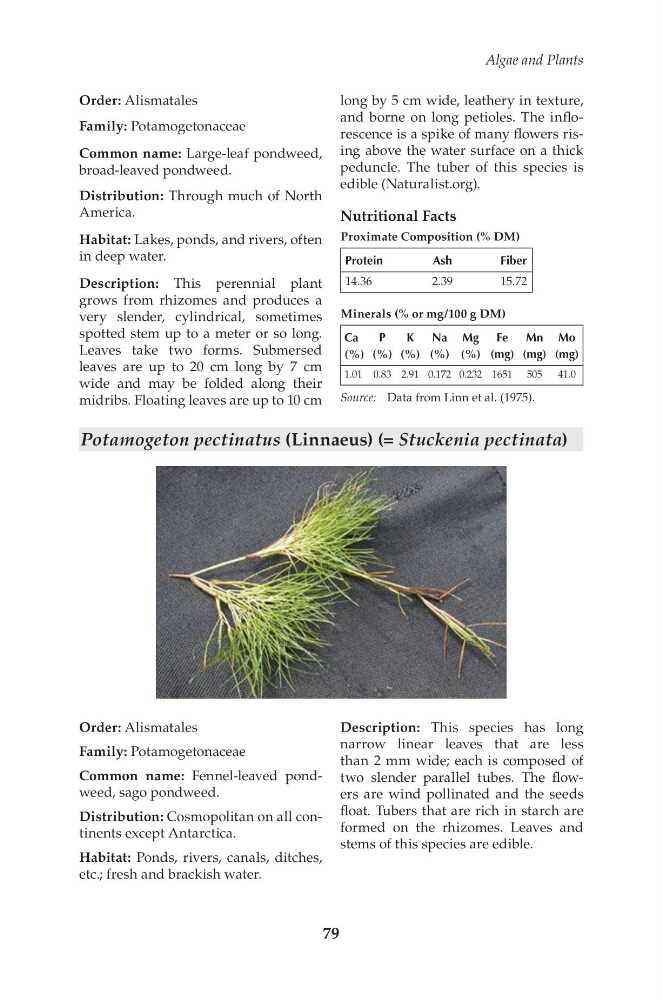
Potamogeton pectinatus (Linnaeus) (= Stuckenia pectinata)
Order: Alismatales
Family: Potamogetonaceae
Common name: Fennel-leaved pondweed, sago pondweed.
Distribution: Cosmopolitan on all continents except Antarctica.
Habitat: Ponds, rivers, canals, ditches,
etc.; fresh and brackish water.
Description: This species has long
narrow linear leaves that are less
than 2 mm wide; each is composed of
two slender parallel tubes. The flowers are wind pollinated and the seeds
float. Tubers that are rich in starch are
formed on the rhizomes. Leaves and
stems of this species are edible.
79
Order: Alismatales
Family: Potamogetonaceae
Common name: Large-leaf pondweed,
broad-leaved pondweed.
Distribution: Through much of North
America.
Habitat: Lakes, ponds, and rivers, often
in deep water.
Description: This perennial plant
grows from rhizomes and produces a
very slender, cylindrical, sometimes
spotted stem up to a meter or so long.
Leaves take two forms. Submersed
leaves are up to 20 cm long by 7 cm
wide and may be folded along their
midribs. Floating leaves are up to 10 cm
long by 5 cm wide, leathery in texture,
and borne on long petioles. The inflorescence is a spike of many flowers rising above the water surface on a thick
peduncle. The tuber of this species is
edible (Naturalist.org).
Nutritional Facts
Proximate Composition (% DM)
Protein
Ash
Fiber
14.36
2.39
15.72
Minerals (% or mg/100 g DM)
Ca
(%)
P
(%)
K
(%)
Na
(%)
Mg
(%)
Fe
(mg)
Mn
(mg)
Mo
(mg)
1.01 0.83 2.91 0.172 0.232 1651 505 41.0
Source: Data from Linn et al. (1975).
Potamogeton pectinatus (Linnaeus) (= Stuckenia pectinata)
Order: Alismatales
Family: Potamogetonaceae
Common name: Fennel-leaved pondweed, sago pondweed.
Distribution: Cosmopolitan on all continents except Antarctica.
Habitat: Ponds, rivers, canals, ditches,
etc.; fresh and brackish water.
Description: This species has long
narrow linear leaves that are less
than 2 mm wide; each is composed of
two slender parallel tubes. The flowers are wind pollinated and the seeds
float. Tubers that are rich in starch are
formed on the rhizomes. Leaves and
stems of this species are edible.