

R e f o r m a g e d u m é t h a n e
Le gaz naturel, d’abord désulfuré, subit les réactions de reformage qui s’effectuent
en deux étapes, le reformage primaire et le reformage secondaire.
Une des réactions essentielles impliquée dans le reformage primaire est :
CH 4(g) + H 2 O (g) = CO (g) + 3H 2(g)
(1)
1. Calculez l’enthalpie standard de formation de H 2 O (g) à 298 K.
2. Calculez l’enthalpie standard de réaction à 298 K de la réaction (1). Commentez
son signe.
Données thermodynamiques à 298 K sous p
0
= 1 bar :
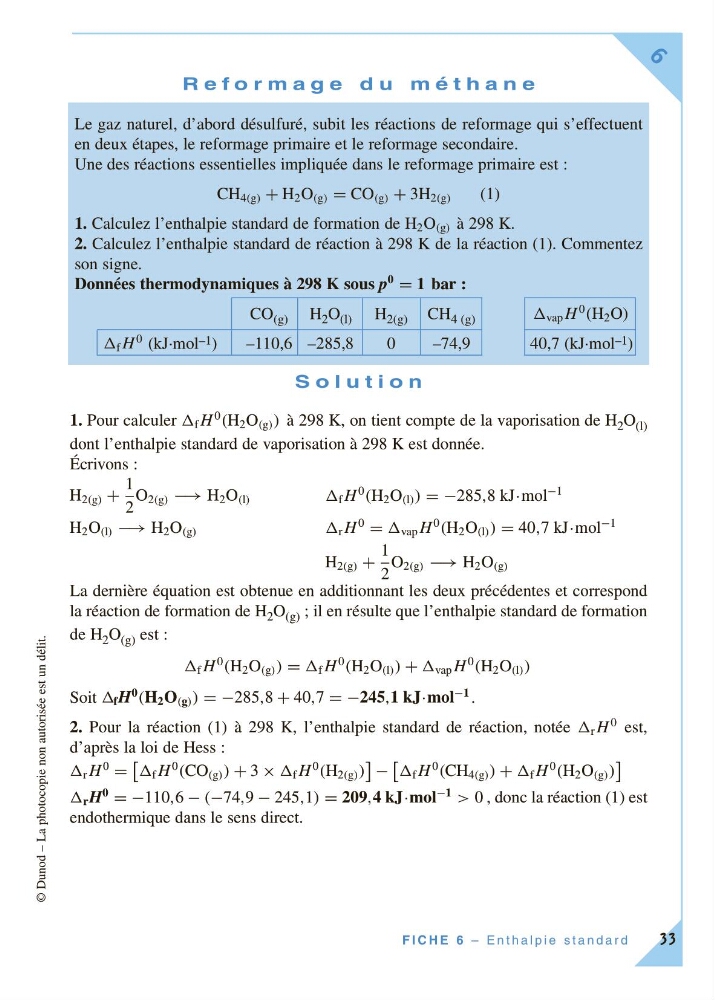
CO (g) H 2 O (l) H 2(g) CH 4 (g)
vap H
0
(H 2 O)
f H
0 (kJ·mol –1 )
–110,6 –285,8
0
–74,9
40,7 (kJ·mol –1 )
S o l u t i o n
1. Pour calculer f H
0
(H 2 O (g) ) à 298 K, on tient compte de la vaporisation de H 2 O (l)
dont l’enthalpie standard de vaporisation à 298 K est donnée.
Écrivons :
H 2(g) +
1
2
O 2(g) −→ H 2 O (l)
f H
0
(H 2 O (l) ) = −285,8 kJ·mol
−1
H 2 O (l) −→ H 2 O (g)
r H
0
= vap H
0
(H 2 O (l) ) = 40,7 kJ·mol
−1
H 2(g) +
1
2
O 2(g) −→ H 2 O (g)
La dernière équation est obtenue en additionnant les deux précédentes et correspond
la réaction de formation de H 2 O (g) ; il en résulte que l’enthalpie standard de formation
de H 2 O (g) est :
f H
0
(H 2 O (g) ) = f H
0
(H 2 O (l) ) + vap H
0
(H 2 O (l) )
Soit f H
0
(H 2 O (g) ) = −285,8 + 40,7 = −245,1 kJ·mol
−1 .
2. Pour la réaction (1) à 298 K, l’enthalpie standard de réaction, notée r H
0 est,
d’après la loi de Hess :
r H
0
=
f H
0
(CO (g) ) + 3 × f H
0
(H 2(g) )
−
f H
0
(CH 4(g) ) + f H
0
(H 2 O (g) )
r H
0
= −110,6 − (−74,9 − 245,1) = 209,4 kJ·mol
−1
> 0 , donc la réaction (1) est
endothermique dans le sens direct.
33
F I C H E 6 – E n t h a l p i e s t a n d a r d
© Dunod – La photocopie non autorisée est un délit.
6
Le gaz naturel, d’abord désulfuré, subit les réactions de reformage qui s’effectuent
en deux étapes, le reformage primaire et le reformage secondaire.
Une des réactions essentielles impliquée dans le reformage primaire est :
CH 4(g) + H 2 O (g) = CO (g) + 3H 2(g)
(1)
1. Calculez l’enthalpie standard de formation de H 2 O (g) à 298 K.
2. Calculez l’enthalpie standard de réaction à 298 K de la réaction (1). Commentez
son signe.
Données thermodynamiques à 298 K sous p
0
= 1 bar :
CO (g) H 2 O (l) H 2(g) CH 4 (g)
vap H
0
(H 2 O)
f H
0 (kJ·mol –1 )
–110,6 –285,8
0
–74,9
40,7 (kJ·mol –1 )
S o l u t i o n
1. Pour calculer f H
0
(H 2 O (g) ) à 298 K, on tient compte de la vaporisation de H 2 O (l)
dont l’enthalpie standard de vaporisation à 298 K est donnée.
Écrivons :
H 2(g) +
1
2
O 2(g) −→ H 2 O (l)
f H
0
(H 2 O (l) ) = −285,8 kJ·mol
−1
H 2 O (l) −→ H 2 O (g)
r H
0
= vap H
0
(H 2 O (l) ) = 40,7 kJ·mol
−1
H 2(g) +
1
2
O 2(g) −→ H 2 O (g)
La dernière équation est obtenue en additionnant les deux précédentes et correspond
la réaction de formation de H 2 O (g) ; il en résulte que l’enthalpie standard de formation
de H 2 O (g) est :
f H
0
(H 2 O (g) ) = f H
0
(H 2 O (l) ) + vap H
0
(H 2 O (l) )
Soit f H
0
(H 2 O (g) ) = −285,8 + 40,7 = −245,1 kJ·mol
−1 .
2. Pour la réaction (1) à 298 K, l’enthalpie standard de réaction, notée r H
0 est,
d’après la loi de Hess :
r H
0
=
f H
0
(CO (g) ) + 3 × f H
0
(H 2(g) )
−
f H
0
(CH 4(g) ) + f H
0
(H 2 O (g) )
r H
0
= −110,6 − (−74,9 − 245,1) = 209,4 kJ·mol
−1
> 0 , donc la réaction (1) est
endothermique dans le sens direct.
33
F I C H E 6 – E n t h a l p i e s t a n d a r d
© Dunod – La photocopie non autorisée est un délit.
6