

50
Air Pollution and Turbulence: Modeling and Applications
Finally, inserting Equations 3.63 and 3.65 into Equation 3.60 yields the following
relation between C S and C 0 for the γ coeffi cient:
( )
α
π
⎛ ⎞
γ = ⎜ ⎟
⎝ ⎠
3 2
3 2
0
3
8
i
i S
C
C
(3.66)
A study from Anfossi et al. (2000) suggests a value for C S ≈ 1.65, whereas Hanna’s
experimental work (Hanna, 1981) leads to C 0 ≈ 4.0. The substitution of these numerical constants in the relation (Equation 3.66) sets a value for γ ≈ 0.58. This result
agrees with the value of γ ≈ 0.55 ± 0.14, which was estimated as a mean value
obtained from a large number of theoretical and experimental works found in the
literature by Degrazia and Anfossi (1998).
3.5 DERIVATION OF AN EDDY DIFFUSIVITY FOR
INHOMOGENEOUS TURBULENCE IN
A CONVECTIVE BOUNDARY LAYER
The aim of this section is to report a new formulation for eddy diffusivities as functions
of distance (travel times) from the source in inhomogeneous turbulence. It is based on
turbulent velocity spectra and the statistical diffusion theory. These eddy diffusivities,
derived for convective and moderately unstable conditions, contain the characteristic
velocity and length scales of energy concentration containing eddies and can describe
dispersion in the near and intermediate fi elds of an elevated continuous point source,
that is, when the scale of the plume is smaller than the scale of the turbulence.
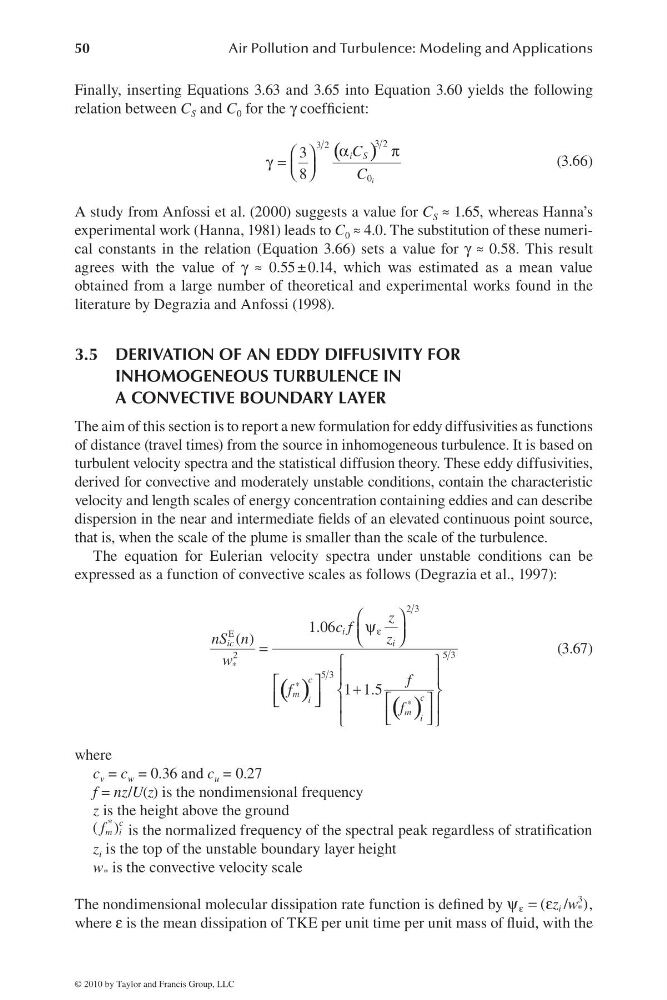
The equation for Eulerian velocity spectra under unstable conditions can be
expressed as a function of convective scales as follows (Degrazia et al., 1997):
( )
( )
ε
∗
∗
∗
⎛
⎞
ψ
⎜
⎟
⎝
⎠
=
⎧
⎫
⎪
⎪
⎡
⎤
+
⎨
⎬
⎢
⎥
⎣
⎦
⎡
⎤
⎪
⎪
⎢
⎥
⎣
⎦
⎩
⎭
2 3
E
5 3
2
5 3
1.06
( )
1 1.5
i
i
ic
c
m
c
i
m i
z
c f
z
nS n
w
f
f
f
(3.67)
where
c v = c w = 0.36 and c u = 0.27
f = nz/U(z) is the nondimensional frequency
z is the height above the ground
*
( )
c
m i
f is the normalized frequency of the spectral peak regardless of stratifi cation
z i is the top of the unstable boundary layer height
w * is the convective velocity scale
The nondimensional molecular dissipation rate function is defi ned by
3
*
( / )
i
z w
ε
ψ = ε
,
where ε is the mean dissipation of TKE per unit time per unit mass of fl uid, with the
© 2010 by Taylor and Francis Group, LLC
Air Pollution and Turbulence: Modeling and Applications
Finally, inserting Equations 3.63 and 3.65 into Equation 3.60 yields the following
relation between C S and C 0 for the γ coeffi cient:
( )
α
π
⎛ ⎞
γ = ⎜ ⎟
⎝ ⎠
3 2
3 2
0
3
8
i
i S
C
C
(3.66)
A study from Anfossi et al. (2000) suggests a value for C S ≈ 1.65, whereas Hanna’s
experimental work (Hanna, 1981) leads to C 0 ≈ 4.0. The substitution of these numerical constants in the relation (Equation 3.66) sets a value for γ ≈ 0.58. This result
agrees with the value of γ ≈ 0.55 ± 0.14, which was estimated as a mean value
obtained from a large number of theoretical and experimental works found in the
literature by Degrazia and Anfossi (1998).
3.5 DERIVATION OF AN EDDY DIFFUSIVITY FOR
INHOMOGENEOUS TURBULENCE IN
A CONVECTIVE BOUNDARY LAYER
The aim of this section is to report a new formulation for eddy diffusivities as functions
of distance (travel times) from the source in inhomogeneous turbulence. It is based on
turbulent velocity spectra and the statistical diffusion theory. These eddy diffusivities,
derived for convective and moderately unstable conditions, contain the characteristic
velocity and length scales of energy concentration containing eddies and can describe
dispersion in the near and intermediate fi elds of an elevated continuous point source,
that is, when the scale of the plume is smaller than the scale of the turbulence.
The equation for Eulerian velocity spectra under unstable conditions can be
expressed as a function of convective scales as follows (Degrazia et al., 1997):
( )
( )
ε
∗
∗
∗
⎛
⎞
ψ
⎜
⎟
⎝
⎠
=
⎧
⎫
⎪
⎪
⎡
⎤
+
⎨
⎬
⎢
⎥
⎣
⎦
⎡
⎤
⎪
⎪
⎢
⎥
⎣
⎦
⎩
⎭
2 3
E
5 3
2
5 3
1.06
( )
1 1.5
i
i
ic
c
m
c
i
m i
z
c f
z
nS n
w
f
f
f
(3.67)
where
c v = c w = 0.36 and c u = 0.27
f = nz/U(z) is the nondimensional frequency
z is the height above the ground
*
( )
c
m i
f is the normalized frequency of the spectral peak regardless of stratifi cation
z i is the top of the unstable boundary layer height
w * is the convective velocity scale
The nondimensional molecular dissipation rate function is defi ned by
3
*
( / )
i
z w
ε
ψ = ε
,
where ε is the mean dissipation of TKE per unit time per unit mass of fl uid, with the
© 2010 by Taylor and Francis Group, LLC