

44
Air Pollution and Turbulence: Modeling and Applications
and
=
2
L (0)
4
i
i
i
v F
L
(3.34)
where L i
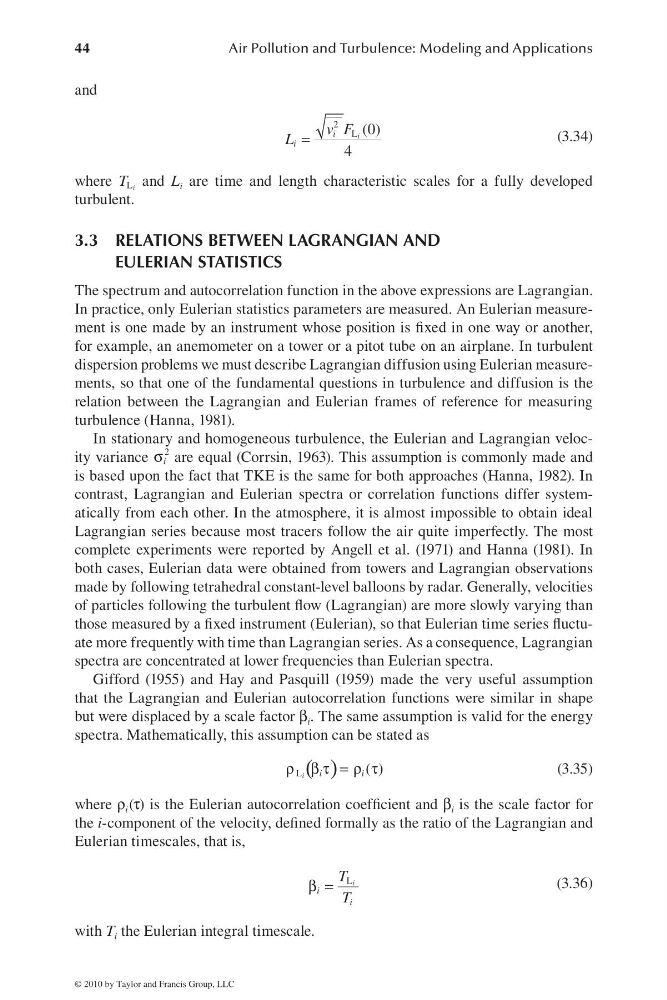
T and L i are time and length characteristic scales for a fully developed
turbulent.
3.3 RELATIONS BETWEEN LAGRANGIAN AND
EULERIAN STATISTICS
The spectrum and autocorrelation function in the above expressions are Lagrangian.
In practice, only Eulerian statistics parameters are measured. An Eulerian measurement is one made by an instrument whose position is fi xed in one way or another,
for example, an anemometer on a tower or a pitot tube on an airplane. In turbulent
dispersion problems we must describe Lagrangian diffusion using Eulerian measurements, so that one of the fundamental questions in turbulence and diffusion is the
relation between the Lagrangian and Eulerian frames of reference for measuring
turbulence (Hanna, 1981).
In stationary and homogeneous turbulence, the Eulerian and Lagrangian velocity variance σ
2
i are equal (Corrsin, 1963). This assumption is commonly made and
is based upon the fact that TKE is the same for both approaches (Hanna, 1982). In
contrast, Lagrangian and Eulerian spectra or correlation functions differ systematically from each other. In the atmosphere, it is almost impossible to obtain ideal
Lagrangian series because most tracers follow the air quite imperfectly. The most
complete experiments were reported by Angell et al. (1971) and Hanna (1981). In
both cases, Eulerian data were obtained from towers and Lagrangian observations
made by following tetrahedral constant-level balloons by radar. Generally, velocities
of particles following the turbulent fl ow (Lagrangian) are more slowly varying than
those measured by a fi xed instrument (Eulerian), so that Eulerian time series fl uctuate more frequently with time than Lagrangian series. As a consequence, Lagrangian
spectra are concentrated at lower frequencies than Eulerian spectra.
Gifford (1955) and Hay and Pasquill (1959) made the very useful assumption
that the Lagrangian and Eulerian autocorrelation functions were similar in shape
but were displaced by a scale factor β i . The same assumption is valid for the energy
spectra. Mathematically, this assumption can be stated as
( )
ρ β τ = ρ τ
L
( )
i
i
i
(3.35)
where ρ i (τ) is the Eulerian autocorrelation coeffi cient and β i is the scale factor for
the i-component of the velocity, defi ned formally as the ratio of the Lagrangian and
Eulerian timescales, that is,
β =
L i
i
i
T
T
(3.36)
with T i the Eulerian integral timescale.
© 2010 by Taylor and Francis Group, LLC
Air Pollution and Turbulence: Modeling and Applications
and
=
2
L (0)
4
i
i
i
v F
L
(3.34)
where L i
T and L i are time and length characteristic scales for a fully developed
turbulent.
3.3 RELATIONS BETWEEN LAGRANGIAN AND
EULERIAN STATISTICS
The spectrum and autocorrelation function in the above expressions are Lagrangian.
In practice, only Eulerian statistics parameters are measured. An Eulerian measurement is one made by an instrument whose position is fi xed in one way or another,
for example, an anemometer on a tower or a pitot tube on an airplane. In turbulent
dispersion problems we must describe Lagrangian diffusion using Eulerian measurements, so that one of the fundamental questions in turbulence and diffusion is the
relation between the Lagrangian and Eulerian frames of reference for measuring
turbulence (Hanna, 1981).
In stationary and homogeneous turbulence, the Eulerian and Lagrangian velocity variance σ
2
i are equal (Corrsin, 1963). This assumption is commonly made and
is based upon the fact that TKE is the same for both approaches (Hanna, 1982). In
contrast, Lagrangian and Eulerian spectra or correlation functions differ systematically from each other. In the atmosphere, it is almost impossible to obtain ideal
Lagrangian series because most tracers follow the air quite imperfectly. The most
complete experiments were reported by Angell et al. (1971) and Hanna (1981). In
both cases, Eulerian data were obtained from towers and Lagrangian observations
made by following tetrahedral constant-level balloons by radar. Generally, velocities
of particles following the turbulent fl ow (Lagrangian) are more slowly varying than
those measured by a fi xed instrument (Eulerian), so that Eulerian time series fl uctuate more frequently with time than Lagrangian series. As a consequence, Lagrangian
spectra are concentrated at lower frequencies than Eulerian spectra.
Gifford (1955) and Hay and Pasquill (1959) made the very useful assumption
that the Lagrangian and Eulerian autocorrelation functions were similar in shape
but were displaced by a scale factor β i . The same assumption is valid for the energy
spectra. Mathematically, this assumption can be stated as
( )
ρ β τ = ρ τ
L
( )
i
i
i
(3.35)
where ρ i (τ) is the Eulerian autocorrelation coeffi cient and β i is the scale factor for
the i-component of the velocity, defi ned formally as the ratio of the Lagrangian and
Eulerian timescales, that is,
β =
L i
i
i
T
T
(3.36)
with T i the Eulerian integral timescale.
© 2010 by Taylor and Francis Group, LLC