

42
Air Pollution and Turbulence: Modeling and Applications
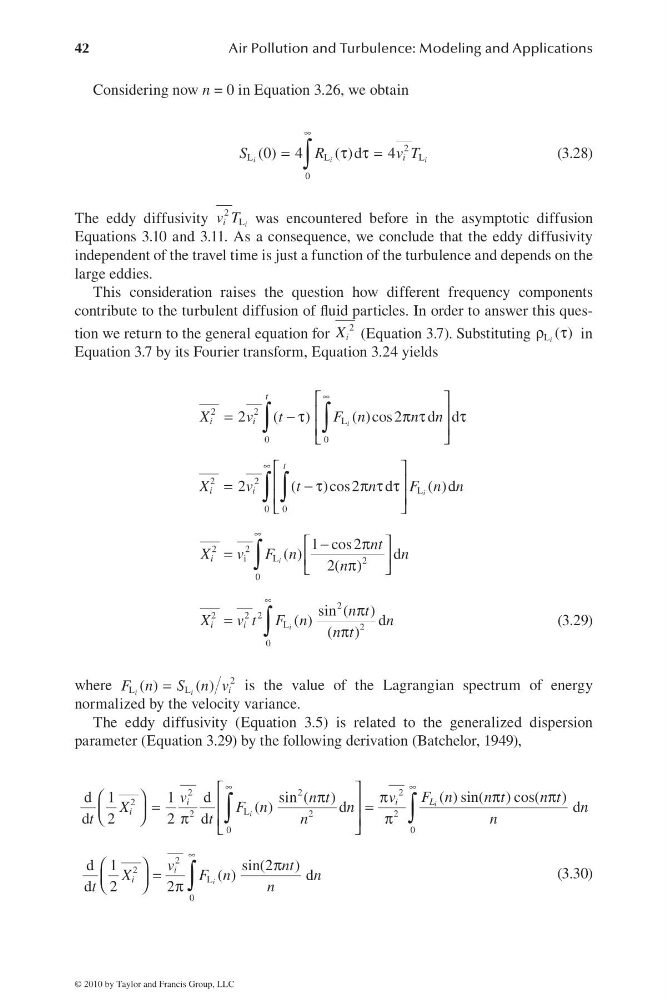
Considering now n = 0 in Equation 3.26, we obtain
∞
=
τ τ=
∫
2
L
L
L
0
(0) 4
( ) d
4
i
i
i
i
S
R
vT
(3.28)
The eddy diffusivity
2
L i
i
v T was encountered before in the asymptotic diffusion
Equations 3.10 and 3.11. As a consequence, we conclude that the eddy diffusivity
independent of the travel time is just a function of the turbulence and depends on the
large eddies.
This consideration raises the question how different frequency components
contribute to the turbulent diffusion of fl uid particles. In order to answer this question we return to the general equation for
2
i
X (Equation 3.7). Substituting ρ τ
L ( )
i
in
Equation 3.7 by its Fourier transform, Equation 3.24 yields
∞
⎡
⎤
⎢
⎥
=
−τ
π τ
τ
⎢
⎥
⎣
⎦
∫
∫
2
2
L
0
0
2
(
)
( ) cos 2
d d
i
t
i
i
X
v
t
F n
n n
∞
⎡
⎤
⎢
⎥
=
−τ
πτ τ
⎢
⎥
⎣
⎦
∫ ∫
2
2
L
0 0
2
(
) cos 2
d
( ) d
i
t
i
i
X
v
t
n
F n n
∞
⎡
⎤
−
π
=
⎢
⎥
π
⎣
⎦
∫
2
2
i
L
2
0
1 cos 2
( )
d
2( )
i
i
nt
X
v F n
n
n
∞
π
=
π
∫
2
2
2 2
L
2
0
sin ( )
( )
d
( )
i
i
i
n t
X
v t F n
n
n t
(3.29)
where
=
2
L
L
( )
( )
i
i
i
F n
S n v is the value of the Lagrangian spectrum of energy
normalized by the velocity variance.
The eddy diffusivity (Equation 3.5) is related to the generalized dispersion
parameter (Equation 3.29) by the following derivation (Batchelor, 1949),
∞
∞
⎡
⎤
π
π
π
π
⎛
⎞
⎢
⎥
=
=
⎜
⎟
⎝
⎠
π
π
⎢
⎥
⎣
⎦
∫
∫
2
2
2
2
L
2
2
2
0
0
( ) sin( ) cos( )
d 1
1
d
sin ( )
( )
d
d
d 2
2
d
i
i
L
i
i
i
F n
n t
n t
v
nt
v
X
F n
n
n
t
t
n
n
∞
π
⎛
⎞ =
⎜
⎟
⎝
⎠
π ∫
2
2
L
0
d 1
sin(2 )
( )
d
d 2
2
i
i
i
v
n t
X
F n
n
t
n
(3.30)
© 2010 by Taylor and Francis Group, LLC
Air Pollution and Turbulence: Modeling and Applications
Considering now n = 0 in Equation 3.26, we obtain
∞
=
τ τ=
∫
2
L
L
L
0
(0) 4
( ) d
4
i
i
i
i
S
R
vT
(3.28)
The eddy diffusivity
2
L i
i
v T was encountered before in the asymptotic diffusion
Equations 3.10 and 3.11. As a consequence, we conclude that the eddy diffusivity
independent of the travel time is just a function of the turbulence and depends on the
large eddies.
This consideration raises the question how different frequency components
contribute to the turbulent diffusion of fl uid particles. In order to answer this question we return to the general equation for
2
i
X (Equation 3.7). Substituting ρ τ
L ( )
i
in
Equation 3.7 by its Fourier transform, Equation 3.24 yields
∞
⎡
⎤
⎢
⎥
=
−τ
π τ
τ
⎢
⎥
⎣
⎦
∫
∫
2
2
L
0
0
2
(
)
( ) cos 2
d d
i
t
i
i
X
v
t
F n
n n
∞
⎡
⎤
⎢
⎥
=
−τ
πτ τ
⎢
⎥
⎣
⎦
∫ ∫
2
2
L
0 0
2
(
) cos 2
d
( ) d
i
t
i
i
X
v
t
n
F n n
∞
⎡
⎤
−
π
=
⎢
⎥
π
⎣
⎦
∫
2
2
i
L
2
0
1 cos 2
( )
d
2( )
i
i
nt
X
v F n
n
n
∞
π
=
π
∫
2
2
2 2
L
2
0
sin ( )
( )
d
( )
i
i
i
n t
X
v t F n
n
n t
(3.29)
where
=
2
L
L
( )
( )
i
i
i
F n
S n v is the value of the Lagrangian spectrum of energy
normalized by the velocity variance.
The eddy diffusivity (Equation 3.5) is related to the generalized dispersion
parameter (Equation 3.29) by the following derivation (Batchelor, 1949),
∞
∞
⎡
⎤
π
π
π
π
⎛
⎞
⎢
⎥
=
=
⎜
⎟
⎝
⎠
π
π
⎢
⎥
⎣
⎦
∫
∫
2
2
2
2
L
2
2
2
0
0
( ) sin( ) cos( )
d 1
1
d
sin ( )
( )
d
d
d 2
2
d
i
i
L
i
i
i
F n
n t
n t
v
nt
v
X
F n
n
n
t
t
n
n
∞
π
⎛
⎞ =
⎜
⎟
⎝
⎠
π ∫
2
2
L
0
d 1
sin(2 )
( )
d
d 2
2
i
i
i
v
n t
X
F n
n
t
n
(3.30)
© 2010 by Taylor and Francis Group, LLC