

Turbulence and Dispersion of Contaminants in the Planetary Boundary Layer 37
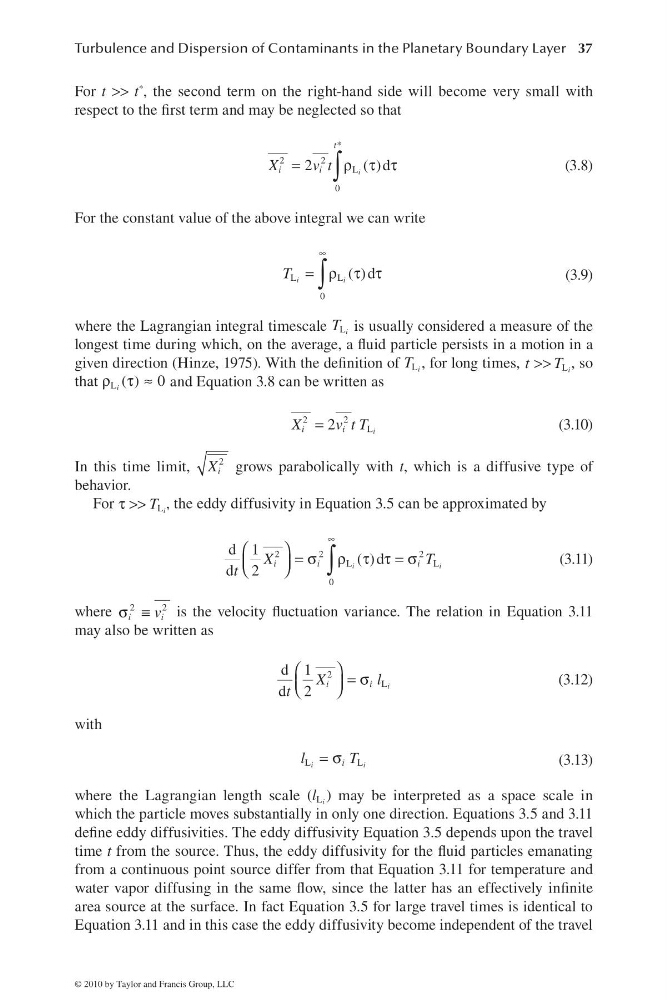
For t >> t * , the second term on the right-hand side will become very small with
respect to the fi rst term and may be neglected so that
=
ρ τ τ
∫
*
2
2
L
0
2
( )d
i
t
i
i
X
v t
(3.8)
For the constant value of the above integral we can write
∞
= ρ τ τ
∫
L
L
0
( )d
i
i
T
(3.9)
where the Lagrangian integral timescale L i
T is usually considered a measure of the
longest time during which, on the average, a fl uid particle persists in a motion in a
given direction (Hinze, 1975). With the defi nition of L i
T , for long times,
L i
t
T
>> , so
that ρ τ ≈
L ( ) 0
i
and Equation 3.8 can be written as
=
2
2
L
2
i
i
i
X
v tT
(3.10)
In this time limit,
2
i
X grows parabolically with t, which is a diffusive type of
behavior.
For τ >> L i
T , the eddy diffusivity in Equation 3.5 can be approximated by
∞
⎛
⎞ = σ ρ τ τ = σ
⎜
⎟
⎝
⎠
∫
2
2
2
L
L
0
d 1
( )d
d 2
i
i
i
i
i
X
T
t
(3.11)
where σ ≡
2
2
i
i
v is the velocity fl uctuation variance. The relation in Equation 3.11
may also be written as
⎛
⎞ = σ
⎜
⎟
⎝
⎠
2
L
d 1
d 2
i
i
i
X
l
t
(3.12)
with
= σ
L
L
i
i
i
l
T
(3.13)
where the Lagrangian length scale L
( )
i
l may be interpreted as a space scale in
which the particle moves substantially in only one direction. Equations 3.5 and 3.11
defi ne eddy diffusivities. The eddy diffusivity Equation 3.5 depends upon the travel
time t from the source. Thus, the eddy diffusivity for the fl uid particles emanating
from a continuous point source differ from that Equation 3.11 for temperature and
water vapor diffusing in the same fl ow, since the latter has an effectively infi nite
area source at the surface. In fact Equation 3.5 for large travel times is identical to
Equation 3.11 and in this case the eddy diffusivity become independent of the travel
© 2010 by Taylor and Francis Group, LLC
For t >> t * , the second term on the right-hand side will become very small with
respect to the fi rst term and may be neglected so that
=
ρ τ τ
∫
*
2
2
L
0
2
( )d
i
t
i
i
X
v t
(3.8)
For the constant value of the above integral we can write
∞
= ρ τ τ
∫
L
L
0
( )d
i
i
T
(3.9)
where the Lagrangian integral timescale L i
T is usually considered a measure of the
longest time during which, on the average, a fl uid particle persists in a motion in a
given direction (Hinze, 1975). With the defi nition of L i
T , for long times,
L i
t
T
>> , so
that ρ τ ≈
L ( ) 0
i
and Equation 3.8 can be written as
=
2
2
L
2
i
i
i
X
v tT
(3.10)
In this time limit,
2
i
X grows parabolically with t, which is a diffusive type of
behavior.
For τ >> L i
T , the eddy diffusivity in Equation 3.5 can be approximated by
∞
⎛
⎞ = σ ρ τ τ = σ
⎜
⎟
⎝
⎠
∫
2
2
2
L
L
0
d 1
( )d
d 2
i
i
i
i
i
X
T
t
(3.11)
where σ ≡
2
2
i
i
v is the velocity fl uctuation variance. The relation in Equation 3.11
may also be written as
⎛
⎞ = σ
⎜
⎟
⎝
⎠
2
L
d 1
d 2
i
i
i
X
l
t
(3.12)
with
= σ
L
L
i
i
i
l
T
(3.13)
where the Lagrangian length scale L
( )
i
l may be interpreted as a space scale in
which the particle moves substantially in only one direction. Equations 3.5 and 3.11
defi ne eddy diffusivities. The eddy diffusivity Equation 3.5 depends upon the travel
time t from the source. Thus, the eddy diffusivity for the fl uid particles emanating
from a continuous point source differ from that Equation 3.11 for temperature and
water vapor diffusing in the same fl ow, since the latter has an effectively infi nite
area source at the surface. In fact Equation 3.5 for large travel times is identical to
Equation 3.11 and in this case the eddy diffusivity become independent of the travel
© 2010 by Taylor and Francis Group, LLC