

36
Air Pollution and Turbulence: Modeling and Applications
do not change with time, so that the correlation function L i
R in the integrand of
Equation 3.3 is an even function of the time difference τ = t − t′. For an arbitrary
turbulent velocity component the form of the function
τ
L ( )
i
R
is given by
τ =
+ τ = ρ τ
′
′
2
L
( )
( ) (
)
( )
i
i
L
i
i
i
R
v t v t
v
(3.4)
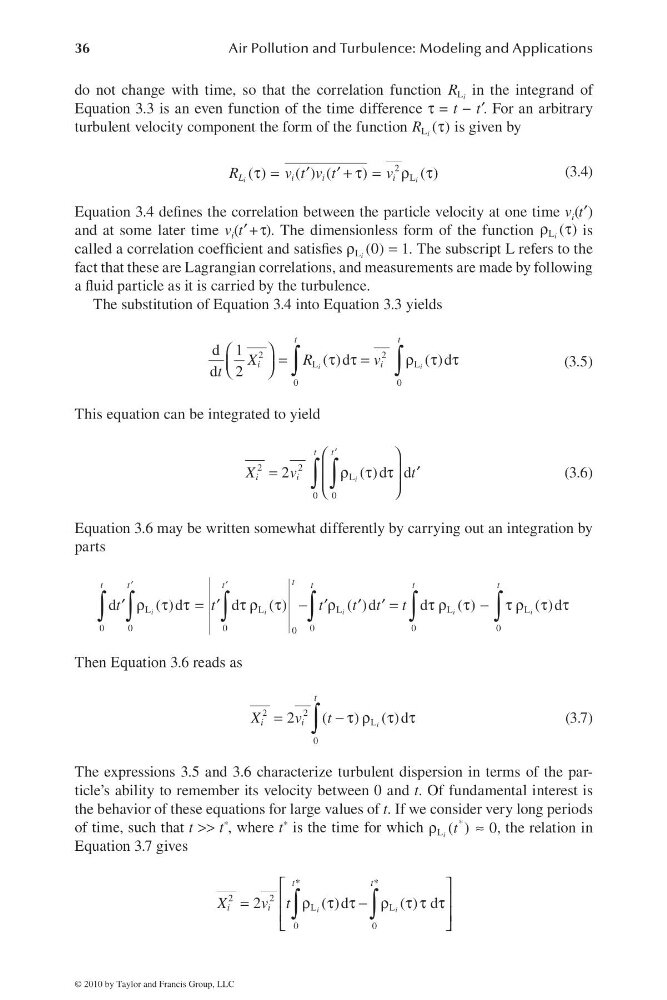
Equation 3.4 defi nes the correlation between the particle velocity at one time v i (t′)
and at some later time v i (t′ + τ). The dimensionless form of the function ρ τ
L ( )
i
is
called a correlation coeffi cient and satisfi es ρ
=
L (0) 1
i
. The subscript L refers to the
fact that these are Lagrangian correlations, and measurements are made by following
a fl uid particle as it is carried by the turbulence.
The substitution of Equation 3.4 into Equation 3.3 yields
⎛
⎞ =
τ τ=
ρ τ τ
⎜
⎟
⎝
⎠ ∫
∫
2
2
L
L
0
0
d 1
( )d
( )d
d 2
i
i
t
t
i
i
X
R
v
t
(3.5)
This equation can be integrated to yield
′
⎛
⎞
=
ρ τ τ ′
⎜
⎟
⎜
⎟
⎝
⎠
∫ ∫
2
2
L
0 0
2
() d d
i
t
t
i
i
X
v
t
(3.6)
Equation 3.6 may be written somewhat differently by carrying out an integration by
parts
′
′
ρ τ τ =
τ ρ τ − ρ
=
τ ρ τ − τ ρ τ τ
′
′
′
′ ′
∫ ∫
∫
∫
∫
∫
L
L
L
L
L
0
0
0
0
0
0
0
d
( )d
d
( )
( )d
d
( )
( )d
i
i
i
i
i
t
t
t
t
t
t
t
t
t
t
t t t
Then Equation 3.6 reads as
=
−τ ρ τ τ
∫
2
2
L
0
2
(
) ( )d
i
t
i
i
X
v
t
(3.7)
The expressions 3.5 and 3.6 characterize turbulent dispersion in terms of the particle’s ability to remember its velocity between 0 and t. Of fundamental interest is
the behavior of these equations for large values of t. If we consider very long periods
of time, such that t >> t * , where t * is the time for which ρ
≈
*
L ( ) 0
i
t
, the relation in
Equation 3.7 gives
⎡
⎤
⎢
⎥
=
ρ τ τ− ρ τ τ τ
⎢
⎥
⎣
⎦
∫
∫
*
*
2
2
L
L
0
0
2
()d
() d
i
i
t
t
i
i
X
v t
© 2010 by Taylor and Francis Group, LLC
Air Pollution and Turbulence: Modeling and Applications
do not change with time, so that the correlation function L i
R in the integrand of
Equation 3.3 is an even function of the time difference τ = t − t′. For an arbitrary
turbulent velocity component the form of the function
τ
L ( )
i
R
is given by
τ =
+ τ = ρ τ
′
′
2
L
( )
( ) (
)
( )
i
i
L
i
i
i
R
v t v t
v
(3.4)
Equation 3.4 defi nes the correlation between the particle velocity at one time v i (t′)
and at some later time v i (t′ + τ). The dimensionless form of the function ρ τ
L ( )
i
is
called a correlation coeffi cient and satisfi es ρ
=
L (0) 1
i
. The subscript L refers to the
fact that these are Lagrangian correlations, and measurements are made by following
a fl uid particle as it is carried by the turbulence.
The substitution of Equation 3.4 into Equation 3.3 yields
⎛
⎞ =
τ τ=
ρ τ τ
⎜
⎟
⎝
⎠ ∫
∫
2
2
L
L
0
0
d 1
( )d
( )d
d 2
i
i
t
t
i
i
X
R
v
t
(3.5)
This equation can be integrated to yield
′
⎛
⎞
=
ρ τ τ ′
⎜
⎟
⎜
⎟
⎝
⎠
∫ ∫
2
2
L
0 0
2
() d d
i
t
t
i
i
X
v
t
(3.6)
Equation 3.6 may be written somewhat differently by carrying out an integration by
parts
′
′
ρ τ τ =
τ ρ τ − ρ
=
τ ρ τ − τ ρ τ τ
′
′
′
′ ′
∫ ∫
∫
∫
∫
∫
L
L
L
L
L
0
0
0
0
0
0
0
d
( )d
d
( )
( )d
d
( )
( )d
i
i
i
i
i
t
t
t
t
t
t
t
t
t
t
t t t
Then Equation 3.6 reads as
=
−τ ρ τ τ
∫
2
2
L
0
2
(
) ( )d
i
t
i
i
X
v
t
(3.7)
The expressions 3.5 and 3.6 characterize turbulent dispersion in terms of the particle’s ability to remember its velocity between 0 and t. Of fundamental interest is
the behavior of these equations for large values of t. If we consider very long periods
of time, such that t >> t * , where t * is the time for which ρ
≈
*
L ( ) 0
i
t
, the relation in
Equation 3.7 gives
⎡
⎤
⎢
⎥
=
ρ τ τ− ρ τ τ τ
⎢
⎥
⎣
⎦
∫
∫
*
*
2
2
L
L
0
0
2
()d
() d
i
i
t
t
i
i
X
v t
© 2010 by Taylor and Francis Group, LLC