

22
Air Pollution and Turbulence: Modeling and Applications
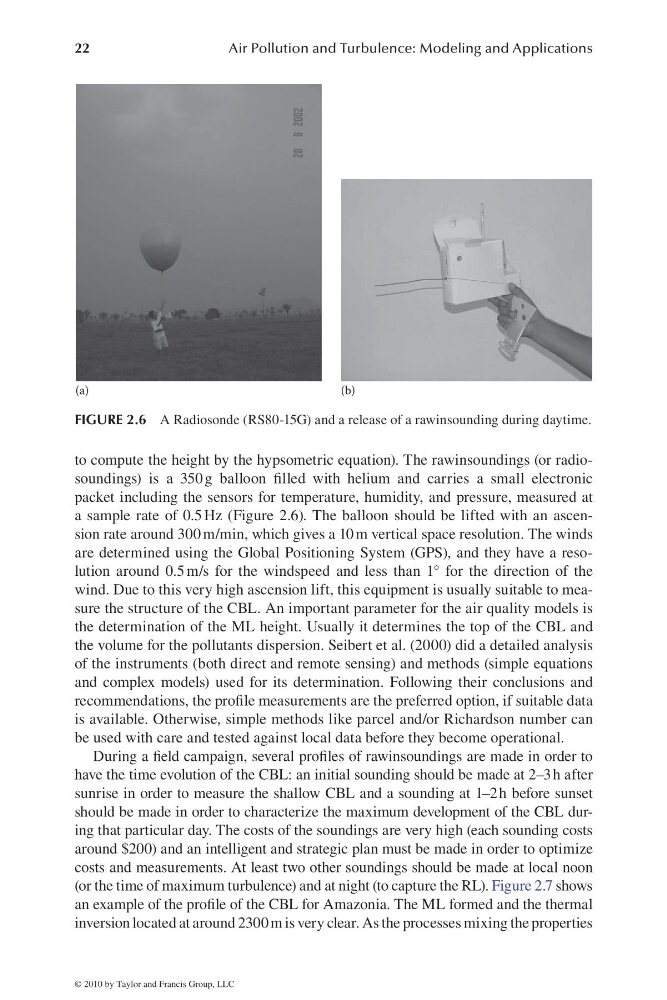
to compute the height by the hypsometric equation). The rawinsoundings (or radiosoundings) is a 350 g balloon fi lled with helium and carries a small electronic
packet including the sensors for temperature, humidity, and pressure, measured at
a sample rate of 0.5 Hz (Figure 2.6). The balloon should be lifted with an ascension rate around 300 m/min, which gives a 10 m vertical space resolution. The winds
are determined using the Global Positioning System (GPS), and they have a resolution around 0.5 m/s for the windspeed and less than 1° for the direction of the
wind. Due to this very high ascension lift, this equipment is usually suitable to measure the structure of the CBL. An important parameter for the air quality models is
the determination of the ML height. Usually it determines the top of the CBL and
the volume for the pollutants dispersion. Seibert et al. (2000) did a detailed analysis
of the instruments (both direct and remote sensing) and methods (simple equations
and complex models) used for its determination. Following their conclusions and
recommendations, the profi le measurements are the preferred option, if suitable data
is available. Otherwise, simple methods like parcel and/or Richardson number can
be used with care and tested against local data before they become operational.
During a fi eld campaign, several profi les of rawinsoundings are made in order to
have the time evolution of the CBL: an initial sounding should be made at 2–3 h after
sunrise in order to measure the shallow CBL and a sounding at 1–2 h before sunset
should be made in order to characterize the maximum development of the CBL during that particular day. The costs of the soundings are very high (each sounding costs
around $200) and an intelligent and strategic plan must be made in order to optimize
costs and measurements. At least two other soundings should be made at local noon
(or the time of maximum turbulence) and at night (to capture the RL). Figure 2.7 shows
an example of the profi le of the CBL for Amazonia. The ML formed and the thermal
inversion located at around 2300 m is very clear. As the processes mixing the properties
(a)
(b)
FIGURE 2.6 A Radiosonde (RS80-15G) and a release of a rawinsounding during daytime.
© 2010 by Taylor and Francis Group, LLC
Air Pollution and Turbulence: Modeling and Applications
to compute the height by the hypsometric equation). The rawinsoundings (or radiosoundings) is a 350 g balloon fi lled with helium and carries a small electronic
packet including the sensors for temperature, humidity, and pressure, measured at
a sample rate of 0.5 Hz (Figure 2.6). The balloon should be lifted with an ascension rate around 300 m/min, which gives a 10 m vertical space resolution. The winds
are determined using the Global Positioning System (GPS), and they have a resolution around 0.5 m/s for the windspeed and less than 1° for the direction of the
wind. Due to this very high ascension lift, this equipment is usually suitable to measure the structure of the CBL. An important parameter for the air quality models is
the determination of the ML height. Usually it determines the top of the CBL and
the volume for the pollutants dispersion. Seibert et al. (2000) did a detailed analysis
of the instruments (both direct and remote sensing) and methods (simple equations
and complex models) used for its determination. Following their conclusions and
recommendations, the profi le measurements are the preferred option, if suitable data
is available. Otherwise, simple methods like parcel and/or Richardson number can
be used with care and tested against local data before they become operational.
During a fi eld campaign, several profi les of rawinsoundings are made in order to
have the time evolution of the CBL: an initial sounding should be made at 2–3 h after
sunrise in order to measure the shallow CBL and a sounding at 1–2 h before sunset
should be made in order to characterize the maximum development of the CBL during that particular day. The costs of the soundings are very high (each sounding costs
around $200) and an intelligent and strategic plan must be made in order to optimize
costs and measurements. At least two other soundings should be made at local noon
(or the time of maximum turbulence) and at night (to capture the RL). Figure 2.7 shows
an example of the profi le of the CBL for Amazonia. The ML formed and the thermal
inversion located at around 2300 m is very clear. As the processes mixing the properties
(a)
(b)
FIGURE 2.6 A Radiosonde (RS80-15G) and a release of a rawinsounding during daytime.
© 2010 by Taylor and Francis Group, LLC