

Atmospheric Boundary Layer: Concepts and Measurements
17
in the form of thermals and plumes. Because of that, it occurs predominantly at daytime. The top is very well defi ned, and it can be easily determined by measurements
(remote sensing or soundings) and this will be discussed in Section 2.3. Inside the
CBL, the pollutants are trapped and vertically mixed by convection. Consequently,
this layer is dirtier than the FA in episodes of air pollution. The maximum extension
of the CBL is at late afternoon, ranging from 0.8 km up to 2–3 km. The CBL presents
a time evolution of its depth, which is dependent on the surface sensible heat fl ux.
This is a key parameter in the development of the CBL: for wetter surfaces, the partition of energy is more pronounced for latent heat fl uxes, so the height of the CBL
is lower (e.g., oceanic and wet soil conditions). On the contrary, for dry surfaces
(continental areas and deserts), the partition energy occurs predominantly at sensible
heat fl uxes, so the depth of the CBL is very high. Sometimes, the CBL is called ML
because the properties (mainly temperature and humidity) are vertically well mixed
so the profi les are constant with height. At the top of the CBL, there is a small layer
(called entrainment zone—ZE) that connects the CBL and FA through the convective penetration (Stull, 1988). This zone is not very well understood so far due to the
diffi culties in obtaining data (mainly by aircrafts). However, the large-eddy simulation (LES) technique appears to be a solution in understanding this important zone
better (Wyngaard, 1998).
The SBL occurs mostly (but not exclusively) at night due to the nocturnal cooling
of the surface. Consequently, it is sometimes also referred to as nocturnal boundary
layer. The top of the SBL is not well defi ned as the CBL and the depth of the SBL can
be computed in many different ways: at a height where there is no turbulence or at a
height where the surface nocturnal cooling does not affect anymore. The extension
of the SBL is much lower than that of the CBL, ranging from 0.1 km up to 0.3 km.
This time evolution depends strongly on the winds. For a windy night, the SBL will
extend deeper due to the generated mechanical turbulence. For a calm wind with low
turbulence, this depth is very shallow. During nighttime, although there is a medium
between the top of the SBL and the FA, this layer is inactive and collapsing. The better characterization for it is like a residual layer (RL). The structure is similar to the
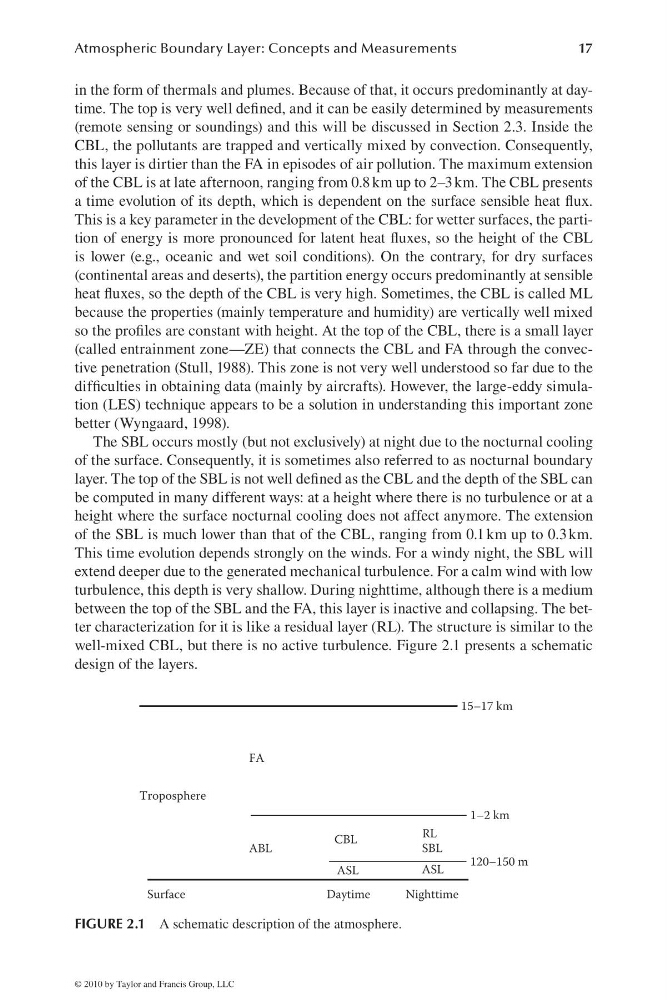
well-mixed CBL, but there is no active turbulence. Figure 2.1 presents a schematic
design of the layers.
15–17 km
1–2 km
FA
ABL
CBL
RL
SBL
ASL
Nighttime
Daytime
Surface
Troposphere
ASL
120–150 m
FIGURE 2.1 A schematic description of the atmosphere.
© 2010 by Taylor and Francis Group, LLC
17
in the form of thermals and plumes. Because of that, it occurs predominantly at daytime. The top is very well defi ned, and it can be easily determined by measurements
(remote sensing or soundings) and this will be discussed in Section 2.3. Inside the
CBL, the pollutants are trapped and vertically mixed by convection. Consequently,
this layer is dirtier than the FA in episodes of air pollution. The maximum extension
of the CBL is at late afternoon, ranging from 0.8 km up to 2–3 km. The CBL presents
a time evolution of its depth, which is dependent on the surface sensible heat fl ux.
This is a key parameter in the development of the CBL: for wetter surfaces, the partition of energy is more pronounced for latent heat fl uxes, so the height of the CBL
is lower (e.g., oceanic and wet soil conditions). On the contrary, for dry surfaces
(continental areas and deserts), the partition energy occurs predominantly at sensible
heat fl uxes, so the depth of the CBL is very high. Sometimes, the CBL is called ML
because the properties (mainly temperature and humidity) are vertically well mixed
so the profi les are constant with height. At the top of the CBL, there is a small layer
(called entrainment zone—ZE) that connects the CBL and FA through the convective penetration (Stull, 1988). This zone is not very well understood so far due to the
diffi culties in obtaining data (mainly by aircrafts). However, the large-eddy simulation (LES) technique appears to be a solution in understanding this important zone
better (Wyngaard, 1998).
The SBL occurs mostly (but not exclusively) at night due to the nocturnal cooling
of the surface. Consequently, it is sometimes also referred to as nocturnal boundary
layer. The top of the SBL is not well defi ned as the CBL and the depth of the SBL can
be computed in many different ways: at a height where there is no turbulence or at a
height where the surface nocturnal cooling does not affect anymore. The extension
of the SBL is much lower than that of the CBL, ranging from 0.1 km up to 0.3 km.
This time evolution depends strongly on the winds. For a windy night, the SBL will
extend deeper due to the generated mechanical turbulence. For a calm wind with low
turbulence, this depth is very shallow. During nighttime, although there is a medium
between the top of the SBL and the FA, this layer is inactive and collapsing. The better characterization for it is like a residual layer (RL). The structure is similar to the
well-mixed CBL, but there is no active turbulence. Figure 2.1 presents a schematic
design of the layers.
15–17 km
1–2 km
FA
ABL
CBL
RL
SBL
ASL
Nighttime
Daytime
Surface
Troposphere
ASL
120–150 m
FIGURE 2.1 A schematic description of the atmosphere.
© 2010 by Taylor and Francis Group, LLC