

10
Air Pollution and Turbulence: Modeling and Applications
that “light or moderate blackening around architectural details could improve the
visual appearance of the building by increasing contrast and enhancing shadowing
effects.”
We also noted that complex feathery shading was generally less acceptable than
linear forms that aligned with the architecture. Fractals seemed a useful way to
explore this idea as architecture is build from elements that have an integer fractal
dimension (i.e., one lines, two areas, three volumes). Architectural features with soiling patterns of noninteger fractal dimension would potentially confuse our reading
of architectural form and thus be less acceptable. We measured the fractal dimension
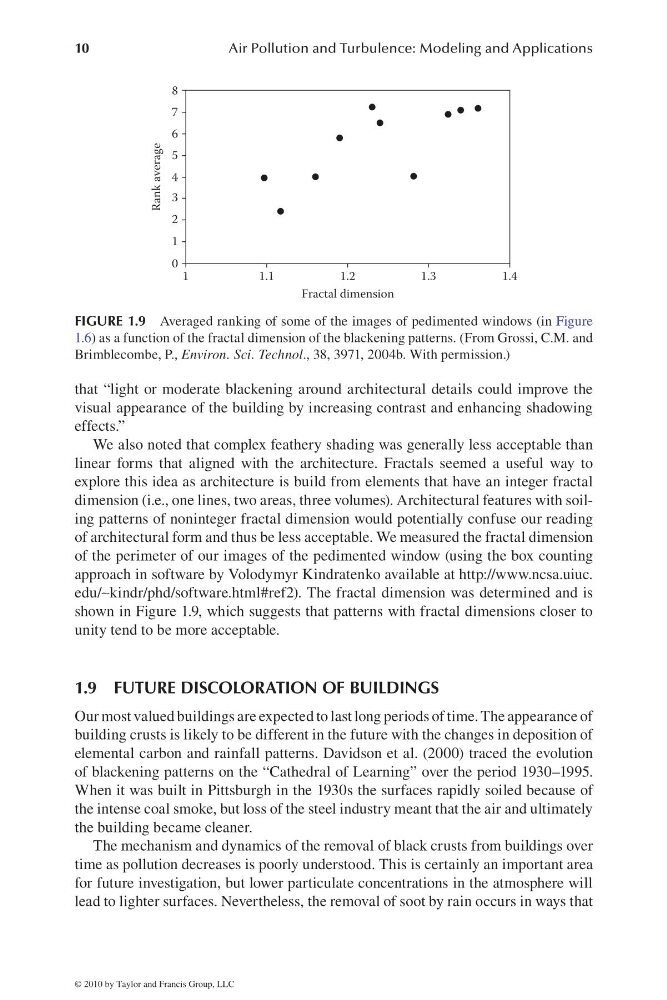
of the perimeter of our images of the pedimented window (using the box counting
approach in software by Volodymyr Kindratenko available at http://www.ncsa.uiuc.
edu/∼kindr/phd/software.html#ref2). The fractal dimension was determined and is
shown in Figure 1.9, which suggests that patterns with fractal dimensions closer to
unity tend to be more acceptable.
1.9 FUTURE DISCOLORATION OF BUILDINGS
Our most valued buildings are expected to last long periods of time. The appearance of
building crusts is likely to be different in the future with the changes in deposition of
elemental carbon and rainfall patterns. Davidson et al. (2000) traced the evolution
of blackening patterns on the “Cathedral of Learning” over the period 1930–1995.
When it was built in Pittsburgh in the 1930s the surfaces rapidly soiled because of
the intense coal smoke, but loss of the steel industry meant that the air and ultimately
the building became cleaner.
The mechanism and dynamics of the removal of black crusts from buildings over
time as pollution decreases is poorly understood. This is certainly an important area
for future investigation, but lower particulate concentrations in the atmosphere will
lead to lighter surfaces. Nevertheless, the removal of soot by rain occurs in ways that
0
1
1.1
1.2
1.3
1.4
1
2
3
4
5
6
7
8
Fractal dimension
Rank average
FIGURE 1.9 Averaged ranking of some of the images of pedimented windows (in Figure
1.6) as a function of the fractal dimension of the blackening patterns. (From Grossi, C.M. and
Brimblecombe, P., Environ. Sci. Technol., 38, 3971, 2004b. With permission.)
© 2010 by Taylor and Francis Group, LLC
Air Pollution and Turbulence: Modeling and Applications
that “light or moderate blackening around architectural details could improve the
visual appearance of the building by increasing contrast and enhancing shadowing
effects.”
We also noted that complex feathery shading was generally less acceptable than
linear forms that aligned with the architecture. Fractals seemed a useful way to
explore this idea as architecture is build from elements that have an integer fractal
dimension (i.e., one lines, two areas, three volumes). Architectural features with soiling patterns of noninteger fractal dimension would potentially confuse our reading
of architectural form and thus be less acceptable. We measured the fractal dimension
of the perimeter of our images of the pedimented window (using the box counting
approach in software by Volodymyr Kindratenko available at http://www.ncsa.uiuc.
edu/∼kindr/phd/software.html#ref2). The fractal dimension was determined and is
shown in Figure 1.9, which suggests that patterns with fractal dimensions closer to
unity tend to be more acceptable.
1.9 FUTURE DISCOLORATION OF BUILDINGS
Our most valued buildings are expected to last long periods of time. The appearance of
building crusts is likely to be different in the future with the changes in deposition of
elemental carbon and rainfall patterns. Davidson et al. (2000) traced the evolution
of blackening patterns on the “Cathedral of Learning” over the period 1930–1995.
When it was built in Pittsburgh in the 1930s the surfaces rapidly soiled because of
the intense coal smoke, but loss of the steel industry meant that the air and ultimately
the building became cleaner.
The mechanism and dynamics of the removal of black crusts from buildings over
time as pollution decreases is poorly understood. This is certainly an important area
for future investigation, but lower particulate concentrations in the atmosphere will
lead to lighter surfaces. Nevertheless, the removal of soot by rain occurs in ways that
0
1
1.1
1.2
1.3
1.4
1
2
3
4
5
6
7
8
Fractal dimension
Rank average
FIGURE 1.9 Averaged ranking of some of the images of pedimented windows (in Figure
1.6) as a function of the fractal dimension of the blackening patterns. (From Grossi, C.M. and
Brimblecombe, P., Environ. Sci. Technol., 38, 3971, 2004b. With permission.)
© 2010 by Taylor and Francis Group, LLC