

Photochemical Air Pollution Modeling
273
in Europe) are some of the most used mechanisms. CB-IV is a lumped structure
mechanism used for both urban and regional-scale modeling. In this lumped structure approach, organics are divided into smaller reaction elements based on the types
of carbon bonds existing in each of the 12 VOC species (alkanes, 1-alkenes, ethane,
toluene, monoalkybenzene, dialkybenzenes, trialkybenzenes, formaldehyde, other
aldehydes isoprene, methylglyixal, and unsaturated dicarbonyls). One hundred and
ten chemical reactions and 34 gas species are considered in CB-IV.
The EMEP (Simpson et al., 1993) mechanism describes the tropospheric gasphase chemistry with 66 species and 139 photochemical reactions, including 34 photolysis reactions. The KOREM, which is simpler, includes 39 chemical reactions
and 20 reactive pollutants. KOREM results from the combination of inorganic reactions of the CERT mechanism (Atkinson et al., 1982) and organic reactions of the
compact mechanism of Bottenheim and Strausz (1982). Volatile organic compounds
are divided into fi ve classes: methane, alkanes, alkenes, aromatics, and aldehydes.
On the other hand, the EMEP mechanism considers the following VOC speciation:
methane, ethane, n-butane, propene, o-xylene, formaldehyde, acetaldehyde, methylethylketone, methanol, ethanol, and isoprene (Moussiopoulos, 1992).
The latest version of the SAPRC mechanism, designated SAPRC99 (Carter,
2000), has assignments for 400 types of VOC, and can be used to estimate reactivity
for 550 VOC categories. A total of 24 model species are used to represent the reactive organic product species: 11 are explicit and 13 represent groups of similar products using the lumped molecule approach. The peroxyacyl nitrates (PAN) analogue
0.28
0 3 = 0.08 0.16 0.24
0.30
0.28 0.32
0.36
0.40
0.34
4
1
0.20
B
A
0.12
0.24
0.20
0.16
0.12
0.08
0.04
0
0
0.2
0.4
0.6
0.8
1.0
NMHC (ppm)
NO
x (ppm)
1.2
1.4
1.6
1.8
2.0
15
1
8
1
=
NMHC
NO
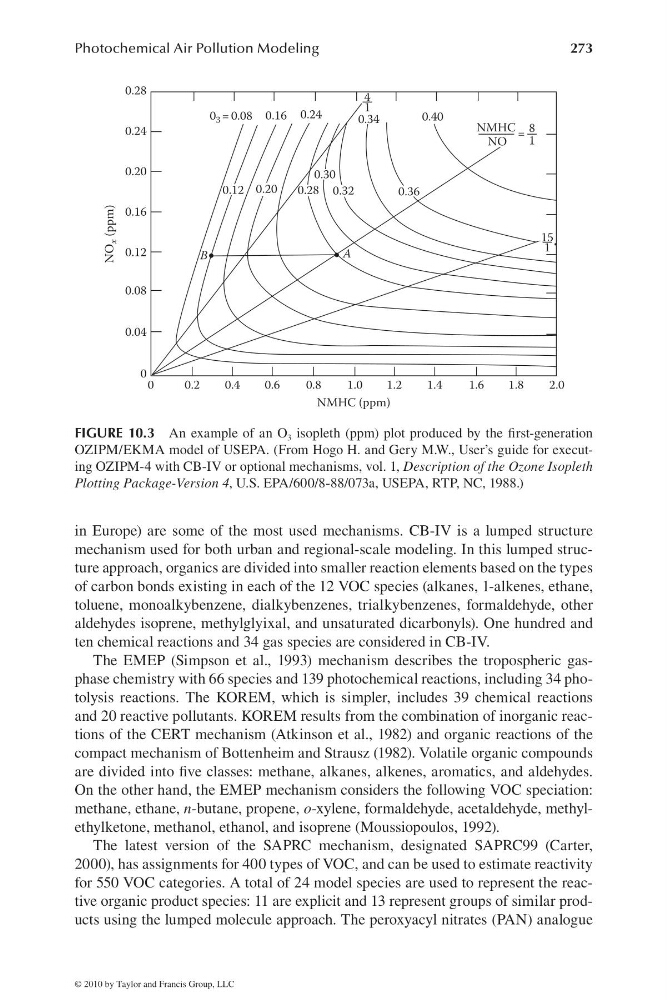
FIGURE 10.3 An example of an O 3 isopleth (ppm) plot produced by the fi rst-generation
OZIPM/EKMA model of USEPA. (From Hogo H. and Gery M.W., User’s guide for executing OZIPM-4 with CB-IV or optional mechanisms, vol. 1, Description of the Ozone Isopleth
Plotting Package-Version 4, U.S. EPA/600/8-88/073a, USEPA, RTP, NC, 1988.)
© 2010 by Taylor and Francis Group, LLC
273
in Europe) are some of the most used mechanisms. CB-IV is a lumped structure
mechanism used for both urban and regional-scale modeling. In this lumped structure approach, organics are divided into smaller reaction elements based on the types
of carbon bonds existing in each of the 12 VOC species (alkanes, 1-alkenes, ethane,
toluene, monoalkybenzene, dialkybenzenes, trialkybenzenes, formaldehyde, other
aldehydes isoprene, methylglyixal, and unsaturated dicarbonyls). One hundred and
ten chemical reactions and 34 gas species are considered in CB-IV.
The EMEP (Simpson et al., 1993) mechanism describes the tropospheric gasphase chemistry with 66 species and 139 photochemical reactions, including 34 photolysis reactions. The KOREM, which is simpler, includes 39 chemical reactions
and 20 reactive pollutants. KOREM results from the combination of inorganic reactions of the CERT mechanism (Atkinson et al., 1982) and organic reactions of the
compact mechanism of Bottenheim and Strausz (1982). Volatile organic compounds
are divided into fi ve classes: methane, alkanes, alkenes, aromatics, and aldehydes.
On the other hand, the EMEP mechanism considers the following VOC speciation:
methane, ethane, n-butane, propene, o-xylene, formaldehyde, acetaldehyde, methylethylketone, methanol, ethanol, and isoprene (Moussiopoulos, 1992).
The latest version of the SAPRC mechanism, designated SAPRC99 (Carter,
2000), has assignments for 400 types of VOC, and can be used to estimate reactivity
for 550 VOC categories. A total of 24 model species are used to represent the reactive organic product species: 11 are explicit and 13 represent groups of similar products using the lumped molecule approach. The peroxyacyl nitrates (PAN) analogue
0.28
0 3 = 0.08 0.16 0.24
0.30
0.28 0.32
0.36
0.40
0.34
4
1
0.20
B
A
0.12
0.24
0.20
0.16
0.12
0.08
0.04
0
0
0.2
0.4
0.6
0.8
1.0
NMHC (ppm)
NO
x (ppm)
1.2
1.4
1.6
1.8
2.0
15
1
8
1
=
NMHC
NO
FIGURE 10.3 An example of an O 3 isopleth (ppm) plot produced by the fi rst-generation
OZIPM/EKMA model of USEPA. (From Hogo H. and Gery M.W., User’s guide for executing OZIPM-4 with CB-IV or optional mechanisms, vol. 1, Description of the Ozone Isopleth
Plotting Package-Version 4, U.S. EPA/600/8-88/073a, USEPA, RTP, NC, 1988.)
© 2010 by Taylor and Francis Group, LLC