

Photochemical Air Pollution Modeling
271
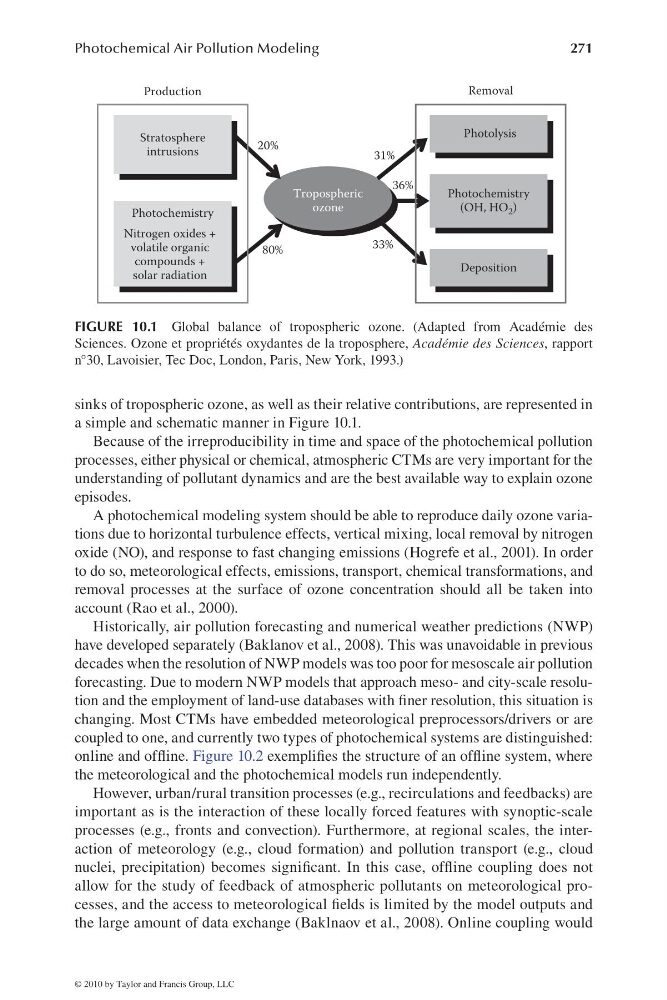
sinks of tropospheric ozone, as well as their relative contributions, are represented in
a simple and schematic manner in Figure 10.1.
Because of the irreproducibility in time and space of the photochemical pollution
processes, either physical or chemical, atmospheric CTMs are very important for the
understanding of pollutant dynamics and are the best available way to explain ozone
episodes.
A photochemical modeling system should be able to reproduce daily ozone variations due to horizontal turbulence effects, vertical mixing, local removal by nitrogen
oxide (NO), and response to fast changing emissions (Hogrefe et al., 2001). In order
to do so, meteorological effects, emissions, transport, chemical transformations, and
removal processes at the surface of ozone concentration should all be taken into
account (Rao et al., 2000).
Historically, air pollution forecasting and numerical weather predictions (NWP)
have developed separately (Baklanov et al., 2008). This was unavoidable in previous
decades when the resolution of NWP models was too poor for mesoscale air pollution
forecasting. Due to modern NWP models that approach meso- and city-scale resolution and the employment of land-use databases with fi ner resolution, this situation is
changing. Most CTMs have embedded meteorological preprocessors/drivers or are
coupled to one, and currently two types of photochemical systems are distinguished:
online and offl ine. Figure 10.2 exemplifi es the structure of an offl ine system, where
the meteorological and the photochemical models run independently.
However, urban/rural transition processes (e.g., recirculations and feedbacks) are
important as is the interaction of these locally forced features with synoptic-scale
processes (e.g., fronts and convection). Furthermore, at regional scales, the interaction of meteorology (e.g., cloud formation) and pollution transport (e.g., cloud
nuclei, precipitation) becomes signifi cant. In this case, offl ine coupling does not
allow for the study of feedback of atmospheric pollutants on meteorological processes, and the access to meteorological fi elds is limited by the model outputs and
the large amount of data exchange (Baklnaov et al., 2008). Online coupling would
Production
Photochemistry
Nitrogen oxides +
volatile organic
compounds +
solar radiation
Stratosphere
intrusions
20%
33%
36%
31%
80%
Tropospheric
ozone
Removal
Photolysis
Photochemistry
(OH, HO 2 )
Deposition
FIGURE 10.1 Global balance of tropospheric ozone. (Adapted from Académie des
Sciences. Ozone et propriétés oxydantes de la troposphere, Académie des Sciences, rapport
n°30, Lavoisier, Tec Doc, London, Paris, New York, 1993.)
© 2010 by Taylor and Francis Group, LLC
271
sinks of tropospheric ozone, as well as their relative contributions, are represented in
a simple and schematic manner in Figure 10.1.
Because of the irreproducibility in time and space of the photochemical pollution
processes, either physical or chemical, atmospheric CTMs are very important for the
understanding of pollutant dynamics and are the best available way to explain ozone
episodes.
A photochemical modeling system should be able to reproduce daily ozone variations due to horizontal turbulence effects, vertical mixing, local removal by nitrogen
oxide (NO), and response to fast changing emissions (Hogrefe et al., 2001). In order
to do so, meteorological effects, emissions, transport, chemical transformations, and
removal processes at the surface of ozone concentration should all be taken into
account (Rao et al., 2000).
Historically, air pollution forecasting and numerical weather predictions (NWP)
have developed separately (Baklanov et al., 2008). This was unavoidable in previous
decades when the resolution of NWP models was too poor for mesoscale air pollution
forecasting. Due to modern NWP models that approach meso- and city-scale resolution and the employment of land-use databases with fi ner resolution, this situation is
changing. Most CTMs have embedded meteorological preprocessors/drivers or are
coupled to one, and currently two types of photochemical systems are distinguished:
online and offl ine. Figure 10.2 exemplifi es the structure of an offl ine system, where
the meteorological and the photochemical models run independently.
However, urban/rural transition processes (e.g., recirculations and feedbacks) are
important as is the interaction of these locally forced features with synoptic-scale
processes (e.g., fronts and convection). Furthermore, at regional scales, the interaction of meteorology (e.g., cloud formation) and pollution transport (e.g., cloud
nuclei, precipitation) becomes signifi cant. In this case, offl ine coupling does not
allow for the study of feedback of atmospheric pollutants on meteorological processes, and the access to meteorological fi elds is limited by the model outputs and
the large amount of data exchange (Baklnaov et al., 2008). Online coupling would
Production
Photochemistry
Nitrogen oxides +
volatile organic
compounds +
solar radiation
Stratosphere
intrusions
20%
33%
36%
31%
80%
Tropospheric
ozone
Removal
Photolysis
Photochemistry
(OH, HO 2 )
Deposition
FIGURE 10.1 Global balance of tropospheric ozone. (Adapted from Académie des
Sciences. Ozone et propriétés oxydantes de la troposphere, Académie des Sciences, rapport
n°30, Lavoisier, Tec Doc, London, Paris, New York, 1993.)
© 2010 by Taylor and Francis Group, LLC