

An Outline of Lagrangian Stochastic Dispersion Models
219
b
p
F
G
g
R
u
+
=
(8.46e)
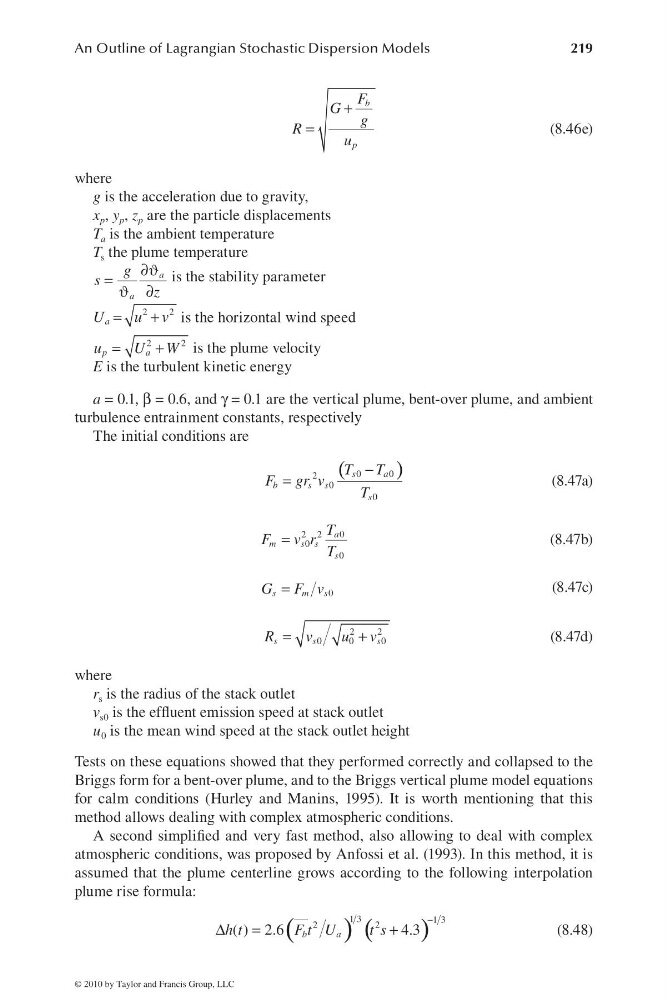
where
g is the acceleration due to gravity,
x p , y p , z p are the particle displacements
T a is the ambient temperature
T s the plume temperature
∂ϑ
= ϑ ∂
a
a
g
s
z
is the stability parameter
2
2
a
U
u v
=
+ is the horizontal wind speed
2
2
p
a
u
U W
=
+
is the plume velocity
E is the turbulent kinetic energy
a = 0.1, β = 0.6, and γ = 0.1 are the vertical plume, bent-over plume, and ambient
turbulence entrainment constants, respectively
The initial conditions are
(
)
0
0
2
0
0
s
a
b
s s
s
T T
F gr v
T
−
=
(8.47a)
0
2 2
0
0
a
m
s s
s
T
F v r
T
=
(8.47b)
0
s
m
s
G F v
=
(8.47c)
2
2
0
0
0
s
s
s
R
v
u v
=
+
(8.47d)
where
r s is the radius of the stack outlet
v s0 is the effl uent emission speed at stack outlet
u 0 is the mean wind speed at the stack outlet height
Tests on these equations showed that they performed correctly and collapsed to the
Briggs form for a bent-over plume, and to the Briggs vertical plume model equations
for calm conditions (Hurley and Manins, 1995). It is worth mentioning that this
method allows dealing with complex atmospheric conditions.
A second simplifi ed and very fast method, also allowing to deal with complex
atmospheric conditions, was proposed by Anfossi et al. (1993). In this method, it is
assumed that the plume centerline grows according to the following interpolation
plume rise formula:
(
) (
)
−
Δ
=
+
1 3
1 3
2
2
( ) 2.6
4.3
b
a
h t
F t U
t s
(8.48)
© 2010 by Taylor and Francis Group, LLC
219
b
p
F
G
g
R
u
+
=
(8.46e)
where
g is the acceleration due to gravity,
x p , y p , z p are the particle displacements
T a is the ambient temperature
T s the plume temperature
∂ϑ
= ϑ ∂
a
a
g
s
z
is the stability parameter
2
2
a
U
u v
=
+ is the horizontal wind speed
2
2
p
a
u
U W
=
+
is the plume velocity
E is the turbulent kinetic energy
a = 0.1, β = 0.6, and γ = 0.1 are the vertical plume, bent-over plume, and ambient
turbulence entrainment constants, respectively
The initial conditions are
(
)
0
0
2
0
0
s
a
b
s s
s
T T
F gr v
T
−
=
(8.47a)
0
2 2
0
0
a
m
s s
s
T
F v r
T
=
(8.47b)
0
s
m
s
G F v
=
(8.47c)
2
2
0
0
0
s
s
s
R
v
u v
=
+
(8.47d)
where
r s is the radius of the stack outlet
v s0 is the effl uent emission speed at stack outlet
u 0 is the mean wind speed at the stack outlet height
Tests on these equations showed that they performed correctly and collapsed to the
Briggs form for a bent-over plume, and to the Briggs vertical plume model equations
for calm conditions (Hurley and Manins, 1995). It is worth mentioning that this
method allows dealing with complex atmospheric conditions.
A second simplifi ed and very fast method, also allowing to deal with complex
atmospheric conditions, was proposed by Anfossi et al. (1993). In this method, it is
assumed that the plume centerline grows according to the following interpolation
plume rise formula:
(
) (
)
−
Δ
=
+
1 3
1 3
2
2
( ) 2.6
4.3
b
a
h t
F t U
t s
(8.48)
© 2010 by Taylor and Francis Group, LLC