

164
Air Pollution and Turbulence: Modeling and Applications
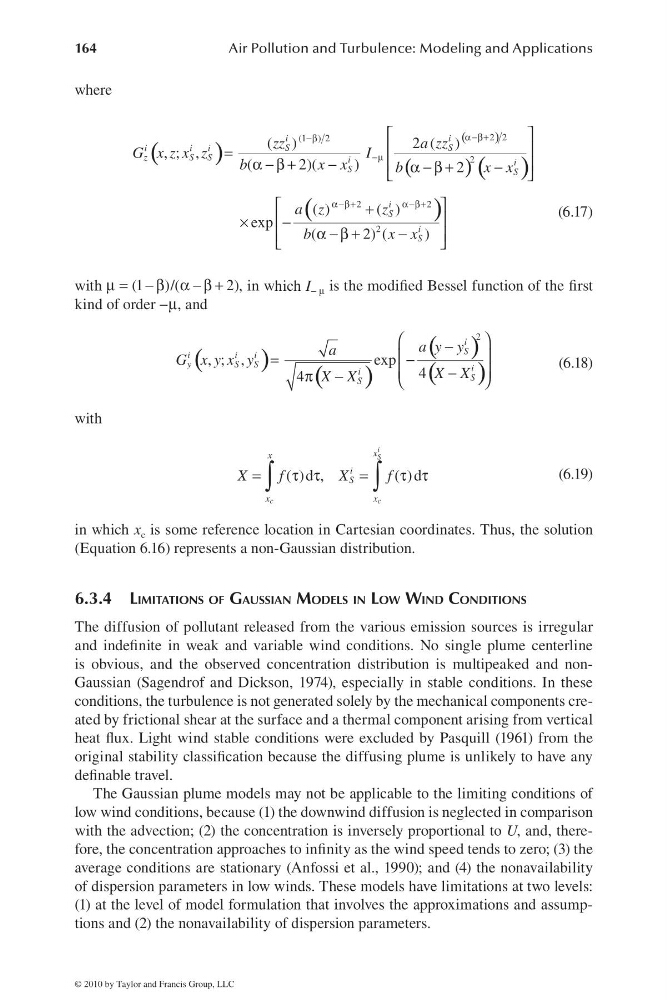
where
(
)
(
)
(
)(
)
(
)
α−β+
−β
−μ
α−β+
α−β+
⎡
⎤
⎢
⎥
= α − β +
−
⎢
⎥
α − β +
−
⎣
⎦
⎡
⎤
+
⎢
⎥
×
−
α − β +
−
⎢
⎥
⎣
⎦
2 2
(1 ) 2
2
2
2
2
( )
2 ( )
, ; ,
(
2) (
)
2
( )
( )
exp
(
2)(
)
i
i
S
S
i
i
i
z
S S
i
i
S
S
i
S
i
S
zz
a zz
G x z x z
I
b
x x
b
x x
a z
z
b
x x
(6.17)
with μ = − β α − β +
(1 )/(
2), in which I − μ is the modifi ed Bessel function of the fi rst
kind of order −μ, and
(
)
(
)
( )
(
)
⎛
⎞
−
⎜
⎟
=
−
⎜
⎟
−
π −
⎝
⎠
2
, ; ,
exp
4
4
i
S
i
i
i
y
S
S
i
i
S
S
a y y
a
G x y x y
X X
X X
(6.18)
with
=
τ τ
=
τ τ
∫
∫
( )d ,
( )d
i
S
c
c
x
x
i
S
x
x
X
f
X
f
(6.19)
in which x c is some reference location in Cartesian coordinates. Thus, the solution
(Equation 6.16) represents a non-Gaussian distribution.
6.3.4 LIMITATIONS OF GAUSSIAN MODELS IN LOW WIND CONDITIONS
The diffusion of pollutant released from the various emission sources is irregular
and indefi nite in weak and variable wind conditions. No single plume centerline
is obvious, and the observed concentration distribution is multipeaked and nonGaussian (Sagendrof and Dickson, 1974), especially in stable conditions. In these
conditions, the turbulence is not generated solely by the mechanical components created by frictional shear at the surface and a thermal component arising from vertical
heat fl ux. Light wind stable conditions were excluded by Pasquill (1961) from the
original stability classifi cation because the diffusing plume is unlikely to have any
defi nable travel.
The Gaussian plume models may not be applicable to the limiting conditions of
low wind conditions, because (1) the downwind diffusion is neglected in comparison
with the advection; (2) the concentration is inversely proportional to U, and, therefore, the concentration approaches to infi nity as the wind speed tends to zero; (3) the
average conditions are stationary (Anfossi et al., 1990); and (4) the nonavailability
of dispersion parameters in low winds. These models have limitations at two levels:
(1) at the level of model formulation that involves the approximations and assumptions and (2) the nonavailability of dispersion parameters.
© 2010 by Taylor and Francis Group, LLC
Air Pollution and Turbulence: Modeling and Applications
where
(
)
(
)
(
)(
)
(
)
α−β+
−β
−μ
α−β+
α−β+
⎡
⎤
⎢
⎥
= α − β +
−
⎢
⎥
α − β +
−
⎣
⎦
⎡
⎤
+
⎢
⎥
×
−
α − β +
−
⎢
⎥
⎣
⎦
2 2
(1 ) 2
2
2
2
2
( )
2 ( )
, ; ,
(
2) (
)
2
( )
( )
exp
(
2)(
)
i
i
S
S
i
i
i
z
S S
i
i
S
S
i
S
i
S
zz
a zz
G x z x z
I
b
x x
b
x x
a z
z
b
x x
(6.17)
with μ = − β α − β +
(1 )/(
2), in which I − μ is the modifi ed Bessel function of the fi rst
kind of order −μ, and
(
)
(
)
( )
(
)
⎛
⎞
−
⎜
⎟
=
−
⎜
⎟
−
π −
⎝
⎠
2
, ; ,
exp
4
4
i
S
i
i
i
y
S
S
i
i
S
S
a y y
a
G x y x y
X X
X X
(6.18)
with
=
τ τ
=
τ τ
∫
∫
( )d ,
( )d
i
S
c
c
x
x
i
S
x
x
X
f
X
f
(6.19)
in which x c is some reference location in Cartesian coordinates. Thus, the solution
(Equation 6.16) represents a non-Gaussian distribution.
6.3.4 LIMITATIONS OF GAUSSIAN MODELS IN LOW WIND CONDITIONS
The diffusion of pollutant released from the various emission sources is irregular
and indefi nite in weak and variable wind conditions. No single plume centerline
is obvious, and the observed concentration distribution is multipeaked and nonGaussian (Sagendrof and Dickson, 1974), especially in stable conditions. In these
conditions, the turbulence is not generated solely by the mechanical components created by frictional shear at the surface and a thermal component arising from vertical
heat fl ux. Light wind stable conditions were excluded by Pasquill (1961) from the
original stability classifi cation because the diffusing plume is unlikely to have any
defi nable travel.
The Gaussian plume models may not be applicable to the limiting conditions of
low wind conditions, because (1) the downwind diffusion is neglected in comparison
with the advection; (2) the concentration is inversely proportional to U, and, therefore, the concentration approaches to infi nity as the wind speed tends to zero; (3) the
average conditions are stationary (Anfossi et al., 1990); and (4) the nonavailability
of dispersion parameters in low winds. These models have limitations at two levels:
(1) at the level of model formulation that involves the approximations and assumptions and (2) the nonavailability of dispersion parameters.
© 2010 by Taylor and Francis Group, LLC