

Parameterization of Convective Boundary Layer Turbulence and Clouds
121
4.7 FINAL REMARKS
In this chapter, a review of some of the most common methods for parameterizing
turbulent and convective mixing in the atmospheric BL is presented, together with
a short review on the different types of cloud parameterizations utilized in global
climate and weather prediction models. In particular, it is shown in detail that simple
combinations of ED and MF closures can realistically describe the turbulent transport in the CBL.
The main advantage of this eddy diffusivity/mass-fl ux (EDMF) parameterization
is that it allows for the unifi cation of parameterizations for the clear CBL and the
moist shallow cumulus boundary layer. No switching to a separate convection scheme
is then necessary, until deep convection is triggered. This approach has the conceptual advantage that the whole CBL is parameterized by a single scheme that has local
(diffusive) and nonlocal (MF) closures in both the cloud and sub-cloud layers.
With EDMF, the clear CBL is rather well represented, with a good prediction of
both the time evolution and the vertical development of the mixed layer. The potential temperature profi les clearly show the typical mixed layer shape: an unstable
surface layer, followed by a well-mixed mid-BL and a slightly stable layer below the
inversion. The improved behavior of the CBL structure is associated with a better
representation of counter-gradient fl uxes and top-entrainment, including the effect
(a)
0
1
Height (km)
2
3
0.0
0.1
0.2
0.3
Cloud fraction
14:30
17:30
20:30
14:30
17:30
20:30
EDMF
LES
(b)
0
1
Height (km)
2
3
0.00
0.01
0.02
0.03
0.04
0.05
q l (g kg
–1 )
14:30
17:30
20:30
14:30
17:30
20:30
New
LES
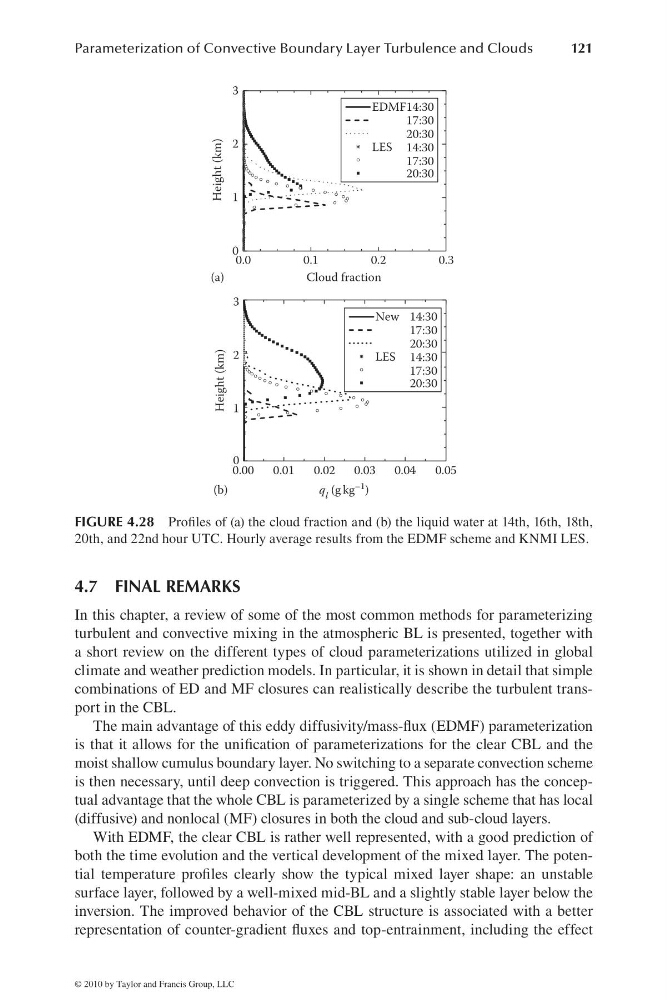
FIGURE 4.28 Profi les of (a) the cloud fraction and (b) the liquid water at 14th, 16th, 18th,
20th, and 22nd hour UTC. Hourly average results from the EDMF scheme and KNMI LES.
© 2010 by Taylor and Francis Group, LLC
121
4.7 FINAL REMARKS
In this chapter, a review of some of the most common methods for parameterizing
turbulent and convective mixing in the atmospheric BL is presented, together with
a short review on the different types of cloud parameterizations utilized in global
climate and weather prediction models. In particular, it is shown in detail that simple
combinations of ED and MF closures can realistically describe the turbulent transport in the CBL.
The main advantage of this eddy diffusivity/mass-fl ux (EDMF) parameterization
is that it allows for the unifi cation of parameterizations for the clear CBL and the
moist shallow cumulus boundary layer. No switching to a separate convection scheme
is then necessary, until deep convection is triggered. This approach has the conceptual advantage that the whole CBL is parameterized by a single scheme that has local
(diffusive) and nonlocal (MF) closures in both the cloud and sub-cloud layers.
With EDMF, the clear CBL is rather well represented, with a good prediction of
both the time evolution and the vertical development of the mixed layer. The potential temperature profi les clearly show the typical mixed layer shape: an unstable
surface layer, followed by a well-mixed mid-BL and a slightly stable layer below the
inversion. The improved behavior of the CBL structure is associated with a better
representation of counter-gradient fl uxes and top-entrainment, including the effect
(a)
0
1
Height (km)
2
3
0.0
0.1
0.2
0.3
Cloud fraction
14:30
17:30
20:30
14:30
17:30
20:30
EDMF
LES
(b)
0
1
Height (km)
2
3
0.00
0.01
0.02
0.03
0.04
0.05
q l (g kg
–1 )
14:30
17:30
20:30
14:30
17:30
20:30
New
LES
FIGURE 4.28 Profi les of (a) the cloud fraction and (b) the liquid water at 14th, 16th, 18th,
20th, and 22nd hour UTC. Hourly average results from the EDMF scheme and KNMI LES.
© 2010 by Taylor and Francis Group, LLC