

Pesticide Metabolism in Plants
41
EEHP, in beans, cotton, and com, but the formation of a glucoside conjugate
was not established (Fig. 2.6) (Akram et al., 1978). Dimethoate was rapidly
hydrolyzed in com, peas, potatoes, and cotton leaves (Dauterman et al., 1960)
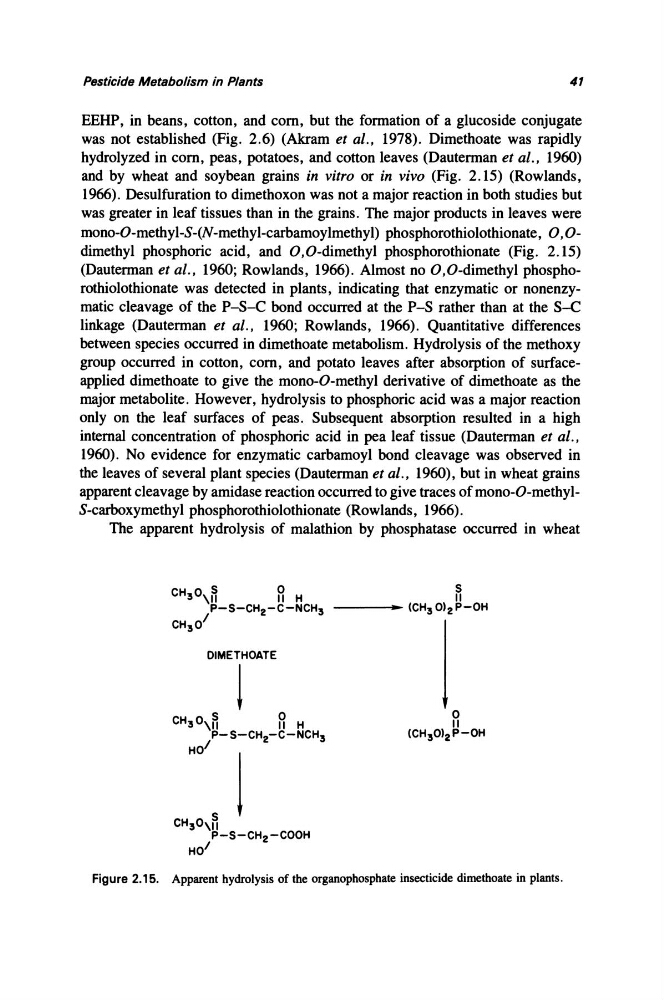
and by wheat and soybean grains in vitro or in vivo (Fig. 2.15) (Rowlands,
1966). Desulfuration to dimethoxon was not a major reaction in both studies but
was greater in leaf tissues than in the grains. The major products in leaves were
mono-O-methyl-S-(N-methyl-carbamoylmethyl) phosphorothiolothionate, 0,0dimethyl phosphoric acid, and O,O-dimethyl phosphorothionate (Fig. 2.15)
(Dauterman et al., 1960; Rowlands, 1966). Almost no O,O-dimethyl phosphorothiolothionate was detected in plants, indicating that enzymatic or nonenzymatic cleavage of the P-S-C bond occurred at the P-S rather than at the S-C
linkage (Dauterman et al., 1960; Rowlands, 1966). Quantitative differences
between species occurred in dimethoate metabolism. Hydrolysis of the methoxy
group occurred in cotton, com, and potato leaves after absorption of surfaceapplied dimethoate to give the mono-O-methyl derivative of dimethoate as the
major metabolite. However, hydrolysis to phosphoric acid was a major reaction
only on the leaf surfaces of peas. Subsequent absorption resulted in a high
internal concentration of phosphoric acid in pea leaf tissue (Dauterman et al.,
1960). No evidence for enzymatic carbamoyl bond cleavage was observed in
the leaves of several plant species (Dauterman et al., 1960), but in wheat grains
apparent cleavage by amidase reaction occurred to give traces of mono-O-methylS-carboxymethyl phosphorothiolothionate (Rowlands, 1966).
The apparent hydrolysis of malathion by phosphatase occurred in wheat
CH 30,ft
R H
P-S-CHz-C-NCH3
CH 3 0/
DIMETHOATE
I
Figure 2.15. Apparent hydrolysis of the organophosphate insecticide dimethoate in plants.
41
EEHP, in beans, cotton, and com, but the formation of a glucoside conjugate
was not established (Fig. 2.6) (Akram et al., 1978). Dimethoate was rapidly
hydrolyzed in com, peas, potatoes, and cotton leaves (Dauterman et al., 1960)
and by wheat and soybean grains in vitro or in vivo (Fig. 2.15) (Rowlands,
1966). Desulfuration to dimethoxon was not a major reaction in both studies but
was greater in leaf tissues than in the grains. The major products in leaves were
mono-O-methyl-S-(N-methyl-carbamoylmethyl) phosphorothiolothionate, 0,0dimethyl phosphoric acid, and O,O-dimethyl phosphorothionate (Fig. 2.15)
(Dauterman et al., 1960; Rowlands, 1966). Almost no O,O-dimethyl phosphorothiolothionate was detected in plants, indicating that enzymatic or nonenzymatic cleavage of the P-S-C bond occurred at the P-S rather than at the S-C
linkage (Dauterman et al., 1960; Rowlands, 1966). Quantitative differences
between species occurred in dimethoate metabolism. Hydrolysis of the methoxy
group occurred in cotton, com, and potato leaves after absorption of surfaceapplied dimethoate to give the mono-O-methyl derivative of dimethoate as the
major metabolite. However, hydrolysis to phosphoric acid was a major reaction
only on the leaf surfaces of peas. Subsequent absorption resulted in a high
internal concentration of phosphoric acid in pea leaf tissue (Dauterman et al.,
1960). No evidence for enzymatic carbamoyl bond cleavage was observed in
the leaves of several plant species (Dauterman et al., 1960), but in wheat grains
apparent cleavage by amidase reaction occurred to give traces of mono-O-methylS-carboxymethyl phosphorothiolothionate (Rowlands, 1966).
The apparent hydrolysis of malathion by phosphatase occurred in wheat
CH 30,ft
R H
P-S-CHz-C-NCH3
CH 3 0/
DIMETHOATE
I
Figure 2.15. Apparent hydrolysis of the organophosphate insecticide dimethoate in plants.