

Pesticide Metabolism in Plants
39
2.13) and 2,6-dichlorobenzamide have not been identified positively in plants.
Instead, these compounds are aryl hydroxylated and conjugated (Frear, 1976).
It is likely that steric hindrance by the adjacent chlorine atoms prevents hydrolysis
of the cyano group.
Many carbamate insecticides and carbanilate herbicides that contain an
aromatic moiety resist hydrolysis in plants (Kuhr and Casida, 1967; Still and
Mansager, 1973). However, the insecticide oxamyl, which lacks an aromatic
moiety, was readily metabolized in plants by hydrolysis of the methylcarbamoyl
group, conjugated and incorporated into insoluble residue (Fig. 2.13) (Harvey
et ai., 1978). In alfalfa, 98% of the extracted radioactivity from labeled oxamyl
was in the form of polar metabolites. No sulfoxide or sulfone metabolites were
detected in several plant species tested (Harvey et ai., 1978).
Many carboxylic acid esters are hydrolyzed readily to their free acids in
plants. The free acid forms of herbicides are often presumed to be the active
forms. Activation by hydrolysis of 2,4-D esters, amides, and nitriles to the free
acid and by a- and j3-oxidation of higher phenoxyaIkanoic acids to active 2,4D has been demonstrated (Loos, 1975; Wain and Smith, 1976). Hydrolysis of
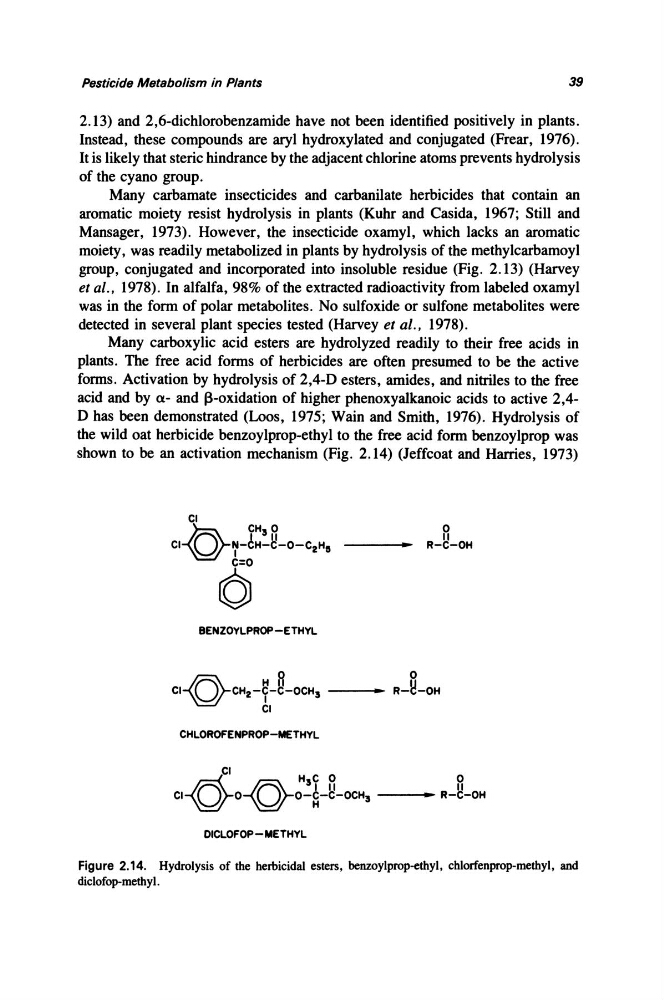
the wild oat herbicide benzoylprop-ethyl to the free acid form benzoylprop was
shown to be an activation mechanism (Fig. 2.14) (Jeffcoat and Harries, 1973)
R
- - -....... ~ R-C-OH
BENZOYLPROP-ETHYL
CHLOROFENPROP-METHYL
-o
CI
H c o o
~s
II
CI 0 0V-o-~-H-OCHs - -....... ~ R-C-OH
OICLOFOP - METHYL
Figure 2.14. Hydrolysis of the herbicidal esters, benzoylprop-ethyl, chlorfenprop-methyl, and
diciofop-methyl.
39
2.13) and 2,6-dichlorobenzamide have not been identified positively in plants.
Instead, these compounds are aryl hydroxylated and conjugated (Frear, 1976).
It is likely that steric hindrance by the adjacent chlorine atoms prevents hydrolysis
of the cyano group.
Many carbamate insecticides and carbanilate herbicides that contain an
aromatic moiety resist hydrolysis in plants (Kuhr and Casida, 1967; Still and
Mansager, 1973). However, the insecticide oxamyl, which lacks an aromatic
moiety, was readily metabolized in plants by hydrolysis of the methylcarbamoyl
group, conjugated and incorporated into insoluble residue (Fig. 2.13) (Harvey
et ai., 1978). In alfalfa, 98% of the extracted radioactivity from labeled oxamyl
was in the form of polar metabolites. No sulfoxide or sulfone metabolites were
detected in several plant species tested (Harvey et ai., 1978).
Many carboxylic acid esters are hydrolyzed readily to their free acids in
plants. The free acid forms of herbicides are often presumed to be the active
forms. Activation by hydrolysis of 2,4-D esters, amides, and nitriles to the free
acid and by a- and j3-oxidation of higher phenoxyaIkanoic acids to active 2,4D has been demonstrated (Loos, 1975; Wain and Smith, 1976). Hydrolysis of
the wild oat herbicide benzoylprop-ethyl to the free acid form benzoylprop was
shown to be an activation mechanism (Fig. 2.14) (Jeffcoat and Harries, 1973)
R
- - -....... ~ R-C-OH
BENZOYLPROP-ETHYL
CHLOROFENPROP-METHYL
-o
CI
H c o o
~s
II
CI 0 0V-o-~-H-OCHs - -....... ~ R-C-OH
OICLOFOP - METHYL
Figure 2.14. Hydrolysis of the herbicidal esters, benzoylprop-ethyl, chlorfenprop-methyl, and
diciofop-methyl.