

Biodegradable Pesticides in Public Health Entomology
221
residual effectiveness of 15 days was obtained at an application rate of 0.01 lb/
acre. The LCso against fourth instar C. quinquefasciatus in the laboratory was
0.15 ppb, indicating a toxicity between that of pennethrin (FMC-33297) and
decamethrin (FMC-45498), since Mulla et al. (1978) found an LCso of 1.40 and
0.02 ppb, respectively, for the latter two pyrethroids against C. quinquefasciatus.
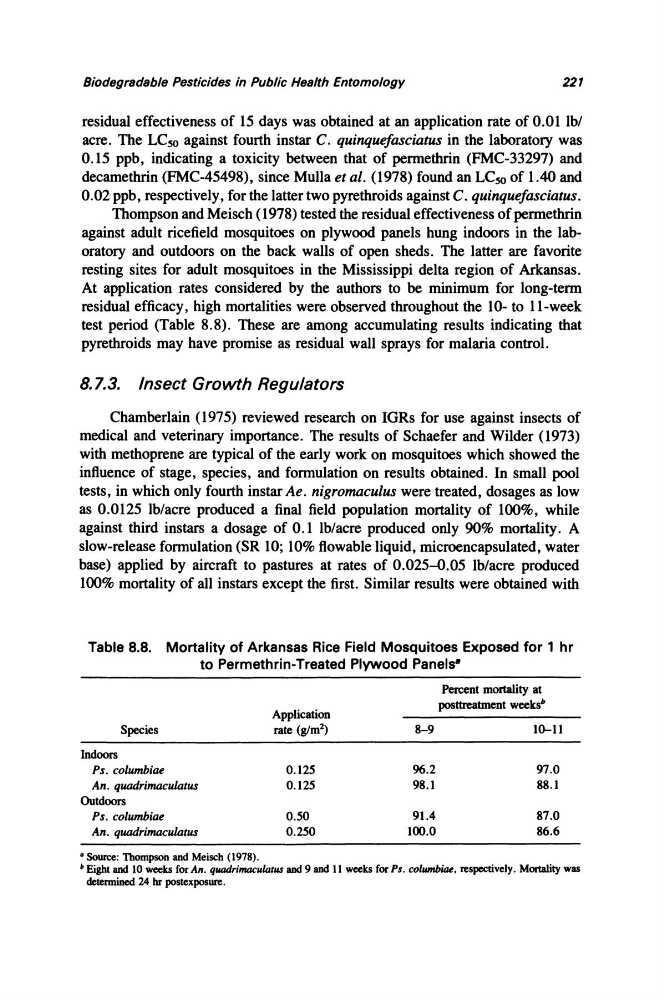
Thompson and Meisch (1978) tested the residual effectiveness ofpennethrin
against adult ricefield mosquitoes on plywood panels hung indoors in the laboratory and outdoors on the back walls of open sheds. The latter are favorite
resting sites for adult mosquitoes in the Mississippi delta region of Arkansas.
At application rates considered by the authors to be minimum for long-tenn
residual efficacy, high mortalities were observed throughout the 10- to ll-week
test period (Table 8.8). These are among accumulating results indicating that
pyrethroids may have promise as residual wall sprays for malaria control.
8.7.3. Insect Growth Regulators
Chamberlain (1975) reviewed research on IGRs for use against insects of
medical and veterinary importance. The results of Schaefer and Wilder (1973)
with methoprene are typical of the early work on mosquitoes which showed the
influence of stage, species, and fonnulation on results obtained. In small pool
tests, in which only fourth instar Ae. nigromaculus were treated, dosages as low
as 0.0125 lb/acre produced a final field population mortality of 100%, while
against third instars a dosage of 0.1 lb/acre produced only 90% mortality. A
slow-release fonnulation (SR 10; 10% flowable liquid, microencapsulated, water
base) applied by aircraft to pastures at rates of 0.025-0.05 lb/acre produced
100% mortality of all instars except the first. Similar results were obtained with
Table S.S. Mortality of Arkansas Rice Field Mosquitoes Exposed for 1 hr
to Permethrin-Treated Plywood Panels·
Percent mortality at
Application
posttreatment weeks b
Species
rate (glm2)
8-9
10--11
Indoors
Ps. columbiae
0.125
96.2
97.0
An. quadrimaculatus
0.125
98.1
88.1
Outdoors
Ps. columbiae
0.50
91.4
87.0
An. quadrimaculatus
0.250
100.0
86.6
a Source: Thompson and Meisch (1918).
b Eight and 10 weeks for An. quodrimaculatus and 9 and II weeks for Ps. columbiae. respectively. Mortality was
determined 24 hr postexposure.
221
residual effectiveness of 15 days was obtained at an application rate of 0.01 lb/
acre. The LCso against fourth instar C. quinquefasciatus in the laboratory was
0.15 ppb, indicating a toxicity between that of pennethrin (FMC-33297) and
decamethrin (FMC-45498), since Mulla et al. (1978) found an LCso of 1.40 and
0.02 ppb, respectively, for the latter two pyrethroids against C. quinquefasciatus.
Thompson and Meisch (1978) tested the residual effectiveness ofpennethrin
against adult ricefield mosquitoes on plywood panels hung indoors in the laboratory and outdoors on the back walls of open sheds. The latter are favorite
resting sites for adult mosquitoes in the Mississippi delta region of Arkansas.
At application rates considered by the authors to be minimum for long-tenn
residual efficacy, high mortalities were observed throughout the 10- to ll-week
test period (Table 8.8). These are among accumulating results indicating that
pyrethroids may have promise as residual wall sprays for malaria control.
8.7.3. Insect Growth Regulators
Chamberlain (1975) reviewed research on IGRs for use against insects of
medical and veterinary importance. The results of Schaefer and Wilder (1973)
with methoprene are typical of the early work on mosquitoes which showed the
influence of stage, species, and fonnulation on results obtained. In small pool
tests, in which only fourth instar Ae. nigromaculus were treated, dosages as low
as 0.0125 lb/acre produced a final field population mortality of 100%, while
against third instars a dosage of 0.1 lb/acre produced only 90% mortality. A
slow-release fonnulation (SR 10; 10% flowable liquid, microencapsulated, water
base) applied by aircraft to pastures at rates of 0.025-0.05 lb/acre produced
100% mortality of all instars except the first. Similar results were obtained with
Table S.S. Mortality of Arkansas Rice Field Mosquitoes Exposed for 1 hr
to Permethrin-Treated Plywood Panels·
Percent mortality at
Application
posttreatment weeks b
Species
rate (glm2)
8-9
10--11
Indoors
Ps. columbiae
0.125
96.2
97.0
An. quadrimaculatus
0.125
98.1
88.1
Outdoors
Ps. columbiae
0.50
91.4
87.0
An. quadrimaculatus
0.250
100.0
86.6
a Source: Thompson and Meisch (1918).
b Eight and 10 weeks for An. quodrimaculatus and 9 and II weeks for Ps. columbiae. respectively. Mortality was
determined 24 hr postexposure.