

220
Gene R. DeFoliart
1977; Hadaway et al., 1977) and hundreds of times more toxic than dieldrin to
tsetse flies as a residual application on leaf surfaces.
Pyrethroids have some disadvantages. In aquatic situations, in addition to
mayfly nymphs, they are somewhat toxic to fish (Mauck et al., 1976; NAS,
1976). Although there have been no cases as yet of resistance developed to
pyrethroids by natural populations, op- and OC-resistant strains are somewhat
cross-tolerant to them and resistance can be expected as they come into regular
use. Finally, Holmstead et al. (1977) have raised a question as to whether further
stabilization may increase the risk of unfavorable environmental persistence.
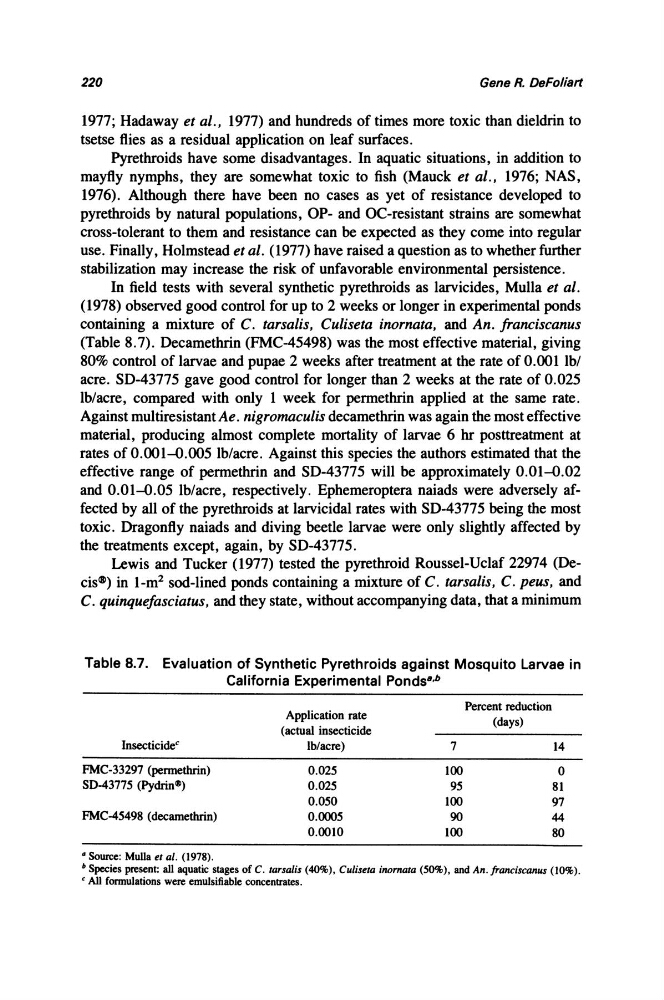
In field tests with several synthetic pyrethroids as larvicides, Mulla et al.
(1978) observed good control for up to 2 weeks or longer in experimental ponds
containing a mixture of C. tarsalis, Culiseta inornata, and An. franciscanus
(Table 8.7). Decamethrin (FMC-45498) was the most effective material, giving
80% control of larvae and pupae 2 weeks after treatment at the rate of O.OOllbl
acre. SD-43775 gave good control for longer than 2 weeks at the rate of 0.025
lb/acre, compared with only 1 week for permethrin applied at the same rate.
Against multiresistant Ae. nigromaculis decamethrin was again the most effective
material, producing almost complete mortality of larvae 6 hr posttreatment at
rates of 0.001-0.005 lb/acre. Against this species the authors estimated that the
effective range of permethrin and SD-43775 will be approximately 0.01-0.02
and 0.01-0.05 lb/acre, respectively. Ephemeroptera naiads were adversely affected by all of the pyrethroids at larvicidal rates with SD-43775 being the most
toxic. Dragonfly naiads and diving beetle larvae were only slightly affected by
the treatments except, again, by SD-43775.
Lewis and Tucker (1977) tested the pyrethroid Roussel-Uclaf 22974 (Decis®) in I-m 2 sod-lined ponds containing a mixture of C. tarsalis, C. peus, and
C. quinquefasciatus, and they state, without accompanying data, that a minimum
Table 8.7. Evaluation of Synthetic Pyrethroids against Mosquito Larvae in
California Experimental Ponds .. · b
Application rate
Percent reduction
(actual insecticide
(days)
Insecticide c
Ib/acre)
7
14
FMC-33297 (pennetbrin)
0.025
100
0
5D-43775 (Pydrin®)
0.025
95
81
0.050
100
97
FMC-45498 (decametbrin)
0.0005
90
44
0.0010
100
80
• Source: Mulla et al. (1978).
b Species present: all aquatic stages of C. tarsalis (40%), Culiseta inornata (50%), and An. franciscanus (10%).
< All formulations were emulsifiable concentrates.
Gene R. DeFoliart
1977; Hadaway et al., 1977) and hundreds of times more toxic than dieldrin to
tsetse flies as a residual application on leaf surfaces.
Pyrethroids have some disadvantages. In aquatic situations, in addition to
mayfly nymphs, they are somewhat toxic to fish (Mauck et al., 1976; NAS,
1976). Although there have been no cases as yet of resistance developed to
pyrethroids by natural populations, op- and OC-resistant strains are somewhat
cross-tolerant to them and resistance can be expected as they come into regular
use. Finally, Holmstead et al. (1977) have raised a question as to whether further
stabilization may increase the risk of unfavorable environmental persistence.
In field tests with several synthetic pyrethroids as larvicides, Mulla et al.
(1978) observed good control for up to 2 weeks or longer in experimental ponds
containing a mixture of C. tarsalis, Culiseta inornata, and An. franciscanus
(Table 8.7). Decamethrin (FMC-45498) was the most effective material, giving
80% control of larvae and pupae 2 weeks after treatment at the rate of O.OOllbl
acre. SD-43775 gave good control for longer than 2 weeks at the rate of 0.025
lb/acre, compared with only 1 week for permethrin applied at the same rate.
Against multiresistant Ae. nigromaculis decamethrin was again the most effective
material, producing almost complete mortality of larvae 6 hr posttreatment at
rates of 0.001-0.005 lb/acre. Against this species the authors estimated that the
effective range of permethrin and SD-43775 will be approximately 0.01-0.02
and 0.01-0.05 lb/acre, respectively. Ephemeroptera naiads were adversely affected by all of the pyrethroids at larvicidal rates with SD-43775 being the most
toxic. Dragonfly naiads and diving beetle larvae were only slightly affected by
the treatments except, again, by SD-43775.
Lewis and Tucker (1977) tested the pyrethroid Roussel-Uclaf 22974 (Decis®) in I-m 2 sod-lined ponds containing a mixture of C. tarsalis, C. peus, and
C. quinquefasciatus, and they state, without accompanying data, that a minimum
Table 8.7. Evaluation of Synthetic Pyrethroids against Mosquito Larvae in
California Experimental Ponds .. · b
Application rate
Percent reduction
(actual insecticide
(days)
Insecticide c
Ib/acre)
7
14
FMC-33297 (pennetbrin)
0.025
100
0
5D-43775 (Pydrin®)
0.025
95
81
0.050
100
97
FMC-45498 (decametbrin)
0.0005
90
44
0.0010
100
80
• Source: Mulla et al. (1978).
b Species present: all aquatic stages of C. tarsalis (40%), Culiseta inornata (50%), and An. franciscanus (10%).
< All formulations were emulsifiable concentrates.