

Biodegradable Insecticides in Forestry
163
insect behavior regulators will provide alternatives to insecticides, but in the last
10 years, relatively few successes have been achieved, and the list of alternative
controls remains small (NAS, 1975b).
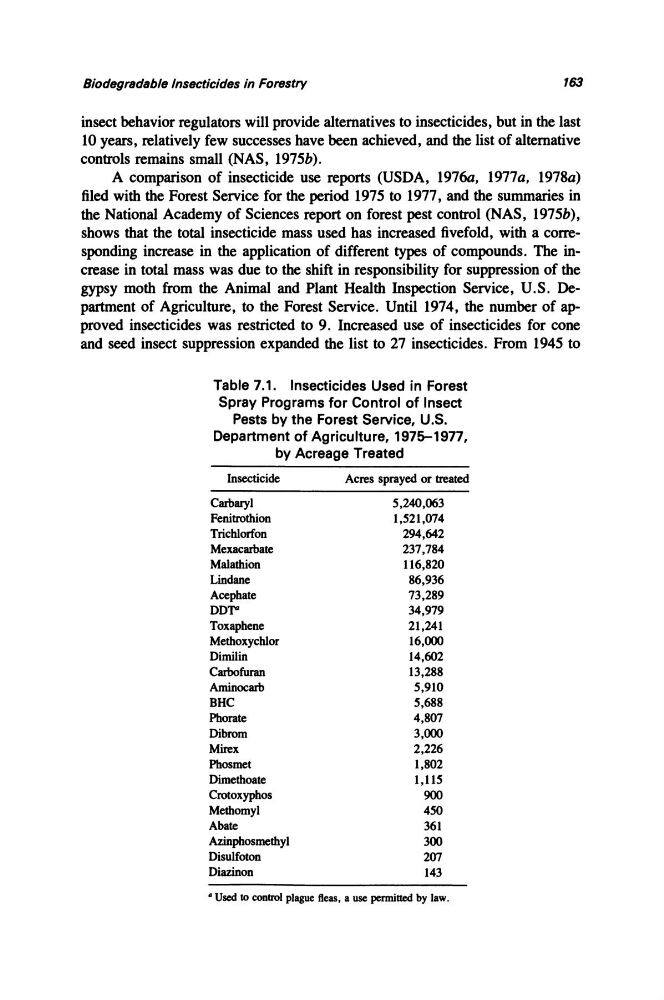
A comparison of insecticide use reports (USDA, 1976a, 1977a, 1978a)
filed with the Forest Service for the period 1975 to 1977, and the summaries in
the National Academy of Sciences report on forest pest control (NAS, 1975b),
shows that the total insecticide mass used has increased fivefold, with a corresponding increase in the application of different types of compounds. The increase in total mass was due to the shift in responsibility for suppression of the
gypsy moth from the Animal and Plant Health Inspection Service, U.S. Department of Agriculture, to the Forest Service. Until 1974, the number of approved insecticides was restricted to 9. Increased use of insecticides for cone
and seed insect suppression expanded the list to 27 insecticides. From 1945 to
Table 7.1. Insecticides Used in Forest
Spray Programs for Control of Insect
Pests by the Forest Service, U.S.
Department of Agriculture, 1975--1977,
by Acreage Treated
Insecticide
Acres sprayed or treated
Carbaryl
5,240,063
Fenitrothion
1,521,074
Trichlorfon
294,642
Mexacarbate
237,784
Malathion
116,820
Lindane
86,936
Acephate
73,289
DDT"
34,979
Toxaphene
21,241
Methoxychlor
16,000
Dimilin
14,602
Carbofuran
13,288
Aminocarb
5,910
BHC
5,688
Phorate
4,807
Dibrom
3,000
Mirex
2,226
Phosmet
1,802
Dimethoate
1,115
Crotoxyphos
900
Methomyl
450
Abate
361
Azinphosmethyl
300
Disulfoton
207
Diazinon
143
• Used to control plague fteas, a use permitted by law.
163
insect behavior regulators will provide alternatives to insecticides, but in the last
10 years, relatively few successes have been achieved, and the list of alternative
controls remains small (NAS, 1975b).
A comparison of insecticide use reports (USDA, 1976a, 1977a, 1978a)
filed with the Forest Service for the period 1975 to 1977, and the summaries in
the National Academy of Sciences report on forest pest control (NAS, 1975b),
shows that the total insecticide mass used has increased fivefold, with a corresponding increase in the application of different types of compounds. The increase in total mass was due to the shift in responsibility for suppression of the
gypsy moth from the Animal and Plant Health Inspection Service, U.S. Department of Agriculture, to the Forest Service. Until 1974, the number of approved insecticides was restricted to 9. Increased use of insecticides for cone
and seed insect suppression expanded the list to 27 insecticides. From 1945 to
Table 7.1. Insecticides Used in Forest
Spray Programs for Control of Insect
Pests by the Forest Service, U.S.
Department of Agriculture, 1975--1977,
by Acreage Treated
Insecticide
Acres sprayed or treated
Carbaryl
5,240,063
Fenitrothion
1,521,074
Trichlorfon
294,642
Mexacarbate
237,784
Malathion
116,820
Lindane
86,936
Acephate
73,289
DDT"
34,979
Toxaphene
21,241
Methoxychlor
16,000
Dimilin
14,602
Carbofuran
13,288
Aminocarb
5,910
BHC
5,688
Phorate
4,807
Dibrom
3,000
Mirex
2,226
Phosmet
1,802
Dimethoate
1,115
Crotoxyphos
900
Methomyl
450
Abate
361
Azinphosmethyl
300
Disulfoton
207
Diazinon
143
• Used to control plague fteas, a use permitted by law.