

Biodegradation of Agricultural Fungicides
O
~
C\
CI
I
N-S-?-CI
C I
CI
II
o
Caplan
O
R
/"
C\
CI
I
N-s-9-CI
: : -. . .
ci CI
"-............
" o
Folpel
c\
CI CI
O
~
I N-S-~-~-H
c i
CI CI
"
o
Capla fo I
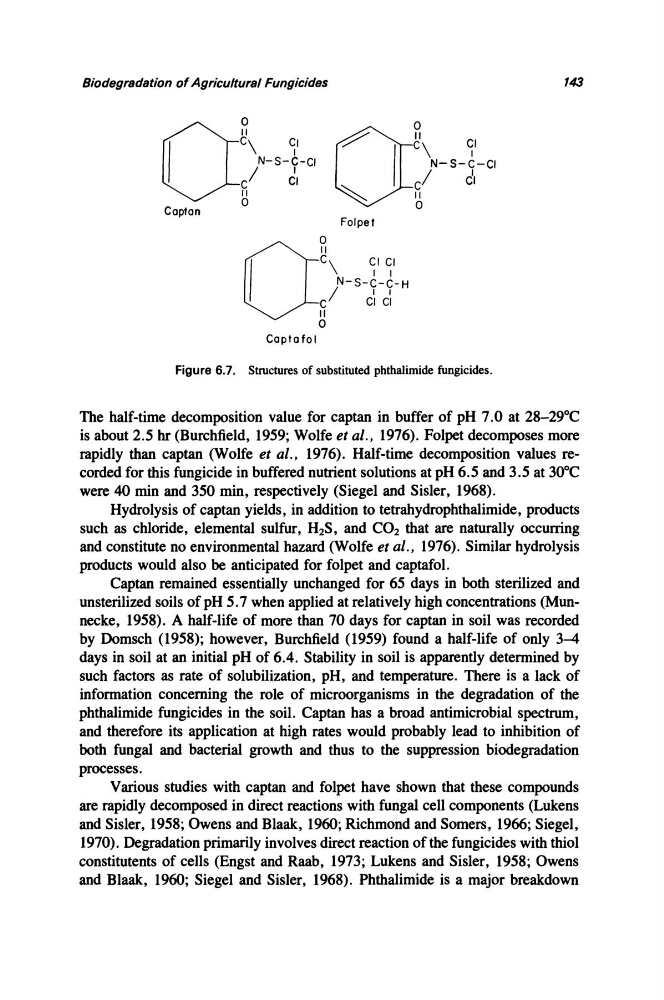
Figure 6.7. Structures of substituted phthalimide fungicides.
143
The half-time decomposition value for captan in buffer of pH 7.0 at 28-29°C
is about 2.5 hr (Burchfield, 1959; Wolfe et al., 1976). Folpet decomposes more
rapidly than captan (Wolfe et al., 1976). Half-time decomposition values recorded for this fungicide in buffered nutrient solutions at pH 6.5 and 3.5 at 30°C
were 40 min and 350 min, respectively (Siegel and Sisler, 1968).
Hydrolysis of captan yields, in addition to tetrahydrophthalimide, products
such as chloride, elemental sulfur, H2S, and CO2 that are naturally occurring
and constitute no environmental hazard (Wolfe et al., 1976). Similar hydrolysis
products would also be anticipated for folpet and captafol.
Captan remained essentially unchanged for 65 days in both sterilized and
unsterilized soils of pH 5.7 when applied at relatively high concentrations (Munnecke, 1958). A half-life of more than 70 days for captan in soil was recorded
by Domsch (1958); however, Burchfield (1959) found a half-life of only 3-4
days in soil at an initial pH of 6.4. Stability in soil is apparently determined by
such factors as rate of solubilization, pH, and temperature. There is a lack of
information concerning the role of microorganisms in the degradation of the
phthalimide fungicides in the soil. Captan has a broad antimicrobial spectrum,
and therefore its application at high rates would probably lead to inhibition of
both fungal and bacterial growth and thus to the suppression biodegradation
processes.
Various studies with captan and folpet have shown that these compounds
are rapidly decomposed in direct reactions with fungal cell components (Lukens
and Sisler, 1958; Owens and Blaak, 1960; Richmond and Somers, 1966; Siegel,
1970). Degradation primarily involves direct reaction of the fungicides with thiol
constitutents of cells (Engst and Raab, 1973; Lukens and Sisler, 1958; Owens
and Blaak, 1960; Siegel and Sisler, 1968). Phthalimide is a major breakdown
O
~
C\
CI
I
N-S-?-CI
C I
CI
II
o
Caplan
O
R
/"
C\
CI
I
N-s-9-CI
: : -. . .
ci CI
"-............
" o
Folpel
c\
CI CI
O
~
I N-S-~-~-H
c i
CI CI
"
o
Capla fo I
Figure 6.7. Structures of substituted phthalimide fungicides.
143
The half-time decomposition value for captan in buffer of pH 7.0 at 28-29°C
is about 2.5 hr (Burchfield, 1959; Wolfe et al., 1976). Folpet decomposes more
rapidly than captan (Wolfe et al., 1976). Half-time decomposition values recorded for this fungicide in buffered nutrient solutions at pH 6.5 and 3.5 at 30°C
were 40 min and 350 min, respectively (Siegel and Sisler, 1968).
Hydrolysis of captan yields, in addition to tetrahydrophthalimide, products
such as chloride, elemental sulfur, H2S, and CO2 that are naturally occurring
and constitute no environmental hazard (Wolfe et al., 1976). Similar hydrolysis
products would also be anticipated for folpet and captafol.
Captan remained essentially unchanged for 65 days in both sterilized and
unsterilized soils of pH 5.7 when applied at relatively high concentrations (Munnecke, 1958). A half-life of more than 70 days for captan in soil was recorded
by Domsch (1958); however, Burchfield (1959) found a half-life of only 3-4
days in soil at an initial pH of 6.4. Stability in soil is apparently determined by
such factors as rate of solubilization, pH, and temperature. There is a lack of
information concerning the role of microorganisms in the degradation of the
phthalimide fungicides in the soil. Captan has a broad antimicrobial spectrum,
and therefore its application at high rates would probably lead to inhibition of
both fungal and bacterial growth and thus to the suppression biodegradation
processes.
Various studies with captan and folpet have shown that these compounds
are rapidly decomposed in direct reactions with fungal cell components (Lukens
and Sisler, 1958; Owens and Blaak, 1960; Richmond and Somers, 1966; Siegel,
1970). Degradation primarily involves direct reaction of the fungicides with thiol
constitutents of cells (Engst and Raab, 1973; Lukens and Sisler, 1958; Owens
and Blaak, 1960; Siegel and Sisler, 1968). Phthalimide is a major breakdown