

Biodegradation of Agricultural Fungicides
137
microorganism (Barnes et al., 1971, 1973). Studies made with 5 and 10 ppm
of 14C-aromatic-Iabeled triphenyltin acetate in soil showed that the half-life was
about 140 days based on 14C02 evolution; only traces of 14C02 were evolved
from heat-sterilized soil (Barnes et al., 1971, 1973). These and other studies
indicate a slow conversion of 14C phenyl groups of triphenyltin to CO2 (Kaufman,
1977). There remains, however, the need for better characterization of intermediate breakdown products. Although inorganic tin, the anticipated end product
of degradation, is essentially devoid of biological activity (Kaars Sijpesteijn et
al., 1969), the fate of the tin is of interest since it is subject to biological
methylation and may enter a food chain as highly toxic methyl tin derivatives
(Ridley et al., 1977).
6.4.2. peNB (Terrae/or, Quintozene)
PeNB is used as a seed and soil treatment to control several soil-borne
fungal pathogens. It is sometimes used at rates as high as 200 lb/acre, but the
usual application rates are much lower (Sharvelle, 1961). Disease control in soil
may persist for as long as 1 year following application, although it is not known
whether the parent compound accounts for the long residual activity (Ko and
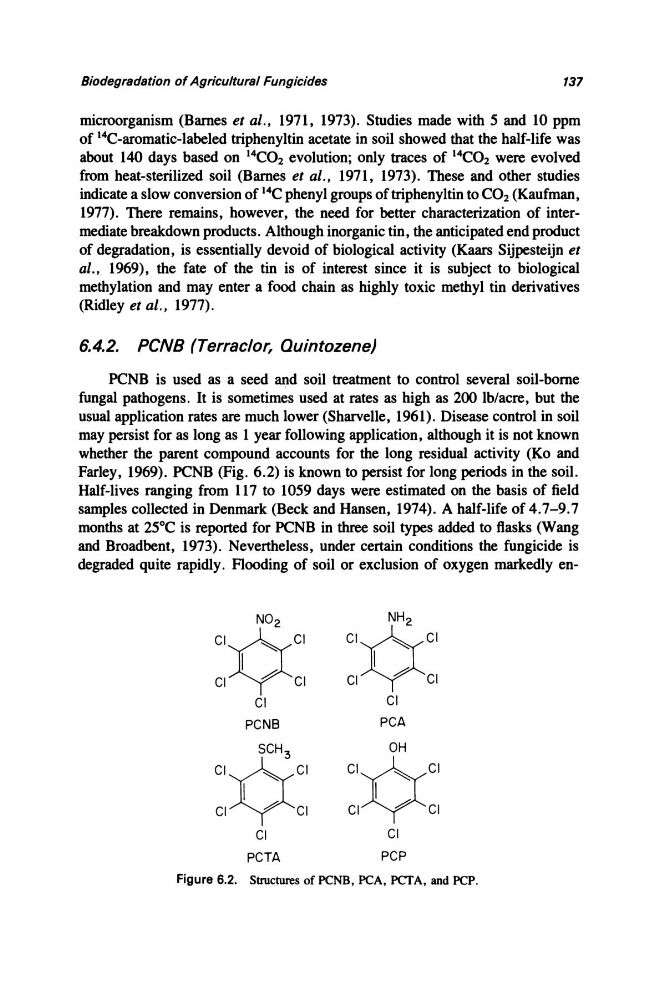
Farley, 1969). PeNB (Fig. 6.2) is known to persist for long periods in the soil.
Half-lives ranging from 117 to 1059 days were estimated on the basis of field
samples collected in Denmark (Beck and Hansen, 1974). A half-life of 4.7-9.7
months at 25°C is reported for PeNB in three soil types added to flasks (Wang
and Broadbent, 1973). Nevertheless, under certain conditions the fungicide is
degraded quite rapidly. Flooding of soil or exclusion of oxygen markedly enN0 2
CI~CI
C I V C I
CI
PCNS
SCH 3
CI~CI
C I V C I
CI
PCTA
NH2
CI~CI
C I V C I
CI
PCA
OH
CI~CI
C I V C I
CI
PCP
Figure 6.2. Structures of PCNB, PCA, PCTA, and PCP.
137
microorganism (Barnes et al., 1971, 1973). Studies made with 5 and 10 ppm
of 14C-aromatic-Iabeled triphenyltin acetate in soil showed that the half-life was
about 140 days based on 14C02 evolution; only traces of 14C02 were evolved
from heat-sterilized soil (Barnes et al., 1971, 1973). These and other studies
indicate a slow conversion of 14C phenyl groups of triphenyltin to CO2 (Kaufman,
1977). There remains, however, the need for better characterization of intermediate breakdown products. Although inorganic tin, the anticipated end product
of degradation, is essentially devoid of biological activity (Kaars Sijpesteijn et
al., 1969), the fate of the tin is of interest since it is subject to biological
methylation and may enter a food chain as highly toxic methyl tin derivatives
(Ridley et al., 1977).
6.4.2. peNB (Terrae/or, Quintozene)
PeNB is used as a seed and soil treatment to control several soil-borne
fungal pathogens. It is sometimes used at rates as high as 200 lb/acre, but the
usual application rates are much lower (Sharvelle, 1961). Disease control in soil
may persist for as long as 1 year following application, although it is not known
whether the parent compound accounts for the long residual activity (Ko and
Farley, 1969). PeNB (Fig. 6.2) is known to persist for long periods in the soil.
Half-lives ranging from 117 to 1059 days were estimated on the basis of field
samples collected in Denmark (Beck and Hansen, 1974). A half-life of 4.7-9.7
months at 25°C is reported for PeNB in three soil types added to flasks (Wang
and Broadbent, 1973). Nevertheless, under certain conditions the fungicide is
degraded quite rapidly. Flooding of soil or exclusion of oxygen markedly enN0 2
CI~CI
C I V C I
CI
PCNS
SCH 3
CI~CI
C I V C I
CI
PCTA
NH2
CI~CI
C I V C I
CI
PCA
OH
CI~CI
C I V C I
CI
PCP
Figure 6.2. Structures of PCNB, PCA, PCTA, and PCP.