

136
Hugh D. Sisler
generally recognized as a factor leading to environmental problems, this may
reflect, in part, a lack of knowledge in this area.
Few organic fungicides are highly stable under a wide variety of conditions.
Only hexachlorobenzene, which is used in minor quantities for seed treatment,
appears to rival the more stable chlorinated hydrocarbon insecticides in persistence. The half-life of several fungicides in nonsterile soil is given in Table 6.2.
The important soil fungicide pentachloronitrobenzene (PCNB) is quite stable and
may persist in the soil for several years. Maximum persistence of other fungicides
listed in Table 6.2 is considerably less than that of PCNB; however, benzimidazole residues of benomyl have a half-life in soil of a year under certain
conditions.
In the following section, consideration will be given to the degradation
characteristics of several types of agricultural fungicides.
6.4. BIODEGRADA TION OF SELECTED FUNGICIDES
6.4. 1. Triphenyltins
Certain organometallic compounds of mercury and tin are potent fungicides.
The organic mercuries were introduced in 1915 (Ulfvarson, 1969) and proved
to be highly valuable for seed treatments; however, toxicity to various forms of
animal life led to discontinued or severely restricted use of these compounds as
agricultural fungicides in many countries.
Organic tin compounds have come into widespread use as fungicides during
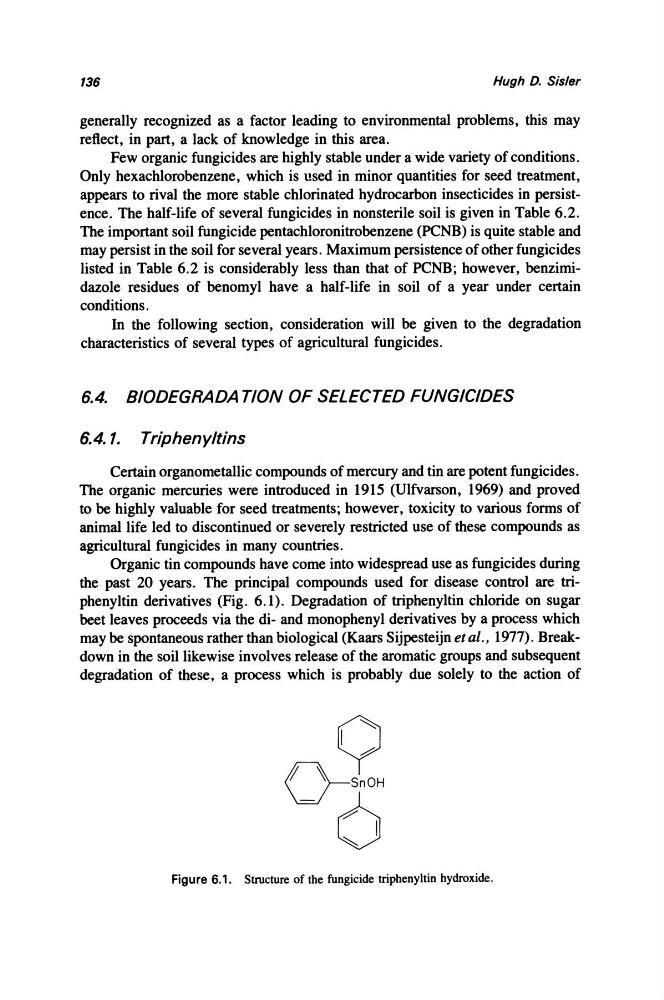
the past 20 years. The principal compounds used for disease control are triphenyltin derivatives (Fig. 6.1). Degradation of triphenyltin chloride on sugar
beet leaves proceeds via the di- and monophenyl derivatives by a process which
may be spontaneous rather than biological (Kaars Sijpesteijn et al., 1977). Breakdown in the soil likewise involves release of the aromatic groups and subsequent
degradation of these, a process which is probably due solely to the action of
Figure 6.1. Structure of the fungicide triphenyltin hydroxide.
Hugh D. Sisler
generally recognized as a factor leading to environmental problems, this may
reflect, in part, a lack of knowledge in this area.
Few organic fungicides are highly stable under a wide variety of conditions.
Only hexachlorobenzene, which is used in minor quantities for seed treatment,
appears to rival the more stable chlorinated hydrocarbon insecticides in persistence. The half-life of several fungicides in nonsterile soil is given in Table 6.2.
The important soil fungicide pentachloronitrobenzene (PCNB) is quite stable and
may persist in the soil for several years. Maximum persistence of other fungicides
listed in Table 6.2 is considerably less than that of PCNB; however, benzimidazole residues of benomyl have a half-life in soil of a year under certain
conditions.
In the following section, consideration will be given to the degradation
characteristics of several types of agricultural fungicides.
6.4. BIODEGRADA TION OF SELECTED FUNGICIDES
6.4. 1. Triphenyltins
Certain organometallic compounds of mercury and tin are potent fungicides.
The organic mercuries were introduced in 1915 (Ulfvarson, 1969) and proved
to be highly valuable for seed treatments; however, toxicity to various forms of
animal life led to discontinued or severely restricted use of these compounds as
agricultural fungicides in many countries.
Organic tin compounds have come into widespread use as fungicides during
the past 20 years. The principal compounds used for disease control are triphenyltin derivatives (Fig. 6.1). Degradation of triphenyltin chloride on sugar
beet leaves proceeds via the di- and monophenyl derivatives by a process which
may be spontaneous rather than biological (Kaars Sijpesteijn et al., 1977). Breakdown in the soil likewise involves release of the aromatic groups and subsequent
degradation of these, a process which is probably due solely to the action of
Figure 6.1. Structure of the fungicide triphenyltin hydroxide.