

Microbial Degradation of Pesticides in Tropical Soils
109
sulfide and mercury-containing sediment led to the evolution of volatile dimethyl
mercury (Craig and Bartlett, 1978). Evidently, apart from the direct involvement
of anaerobic microorganisms chemical transformations of pesticides and heavy
metals, mediated by the microbial byproducts of anaerobic decomposition of
inorganic soil components, can be common and widespread in anaerobic ecosystems such as lakes or estuarine sediments and flooded soils.
4.4.8. Pesticide Combinations
In recent years, it has been a common practice to apply different groups of
pesticides either simultaneously or in rotation for effecting broad-spectrum control of a variety of pests (e.g., insects, weeds, microbial pathogens) attacking a
single crop, a practice leading to combined residues in the environment. Moreover, commercial formulations of pesticide combinations (for example, Sevidol,
containing carbaryl and HCH) are used increasingly in agriculture. But most
studies are restricted to the overall disappearance of pesticides applied alone and
not in combination. Recently, however, significant interactions between pesticides applied in combination, in terms of their persistence in soils and toxicity
to crops and insects, have been demonstrated (Liang and Lichtenstein, 1974;
Kaufman, 1977).
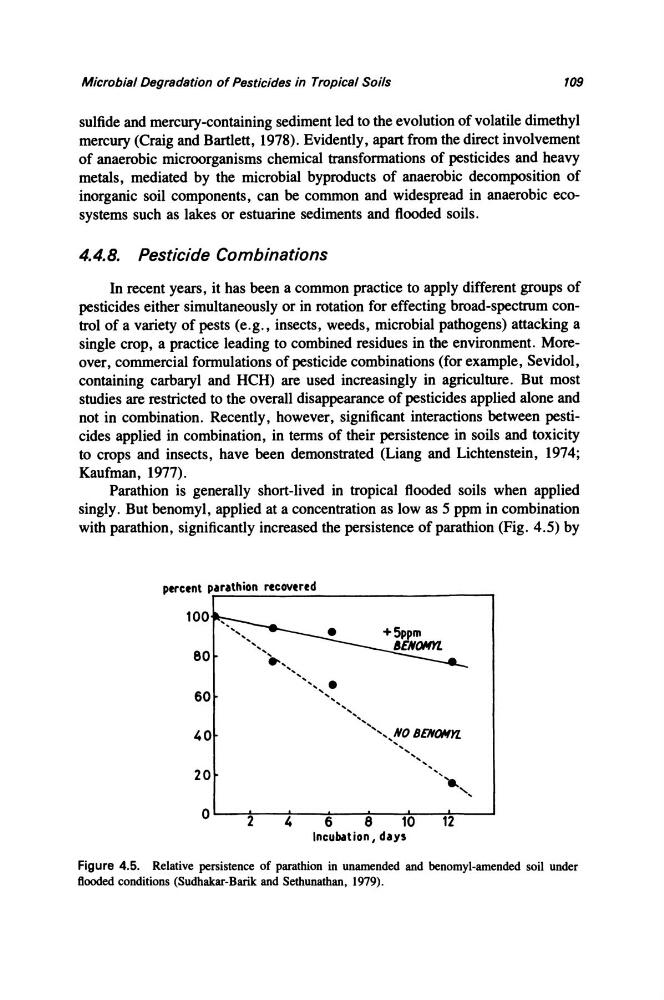
Parathion is generally short-lived in tropical flooded soils when applied
singly. But benomyl, applied at a concentration as low as 5 ppm in combination
with parathion, significantly increased the persistence of parathion (Fig. 4.5) by
percent parathion recovered
80
60
40
20
0~~2---4~~6~~8--~1~0--~12~~
Incubation I days
Figure 4.5. Relative persistence of parathion in unamended and benomyl-amended soil under
flooded conditions (Sudhakar-Barik and Sethunathan, 1979).
109
sulfide and mercury-containing sediment led to the evolution of volatile dimethyl
mercury (Craig and Bartlett, 1978). Evidently, apart from the direct involvement
of anaerobic microorganisms chemical transformations of pesticides and heavy
metals, mediated by the microbial byproducts of anaerobic decomposition of
inorganic soil components, can be common and widespread in anaerobic ecosystems such as lakes or estuarine sediments and flooded soils.
4.4.8. Pesticide Combinations
In recent years, it has been a common practice to apply different groups of
pesticides either simultaneously or in rotation for effecting broad-spectrum control of a variety of pests (e.g., insects, weeds, microbial pathogens) attacking a
single crop, a practice leading to combined residues in the environment. Moreover, commercial formulations of pesticide combinations (for example, Sevidol,
containing carbaryl and HCH) are used increasingly in agriculture. But most
studies are restricted to the overall disappearance of pesticides applied alone and
not in combination. Recently, however, significant interactions between pesticides applied in combination, in terms of their persistence in soils and toxicity
to crops and insects, have been demonstrated (Liang and Lichtenstein, 1974;
Kaufman, 1977).
Parathion is generally short-lived in tropical flooded soils when applied
singly. But benomyl, applied at a concentration as low as 5 ppm in combination
with parathion, significantly increased the persistence of parathion (Fig. 4.5) by
percent parathion recovered
80
60
40
20
0~~2---4~~6~~8--~1~0--~12~~
Incubation I days
Figure 4.5. Relative persistence of parathion in unamended and benomyl-amended soil under
flooded conditions (Sudhakar-Barik and Sethunathan, 1979).