

108
0 1 2 3 4 5 6
Retention time, min
2
3
4
5
N. Sethunathan et 8/.
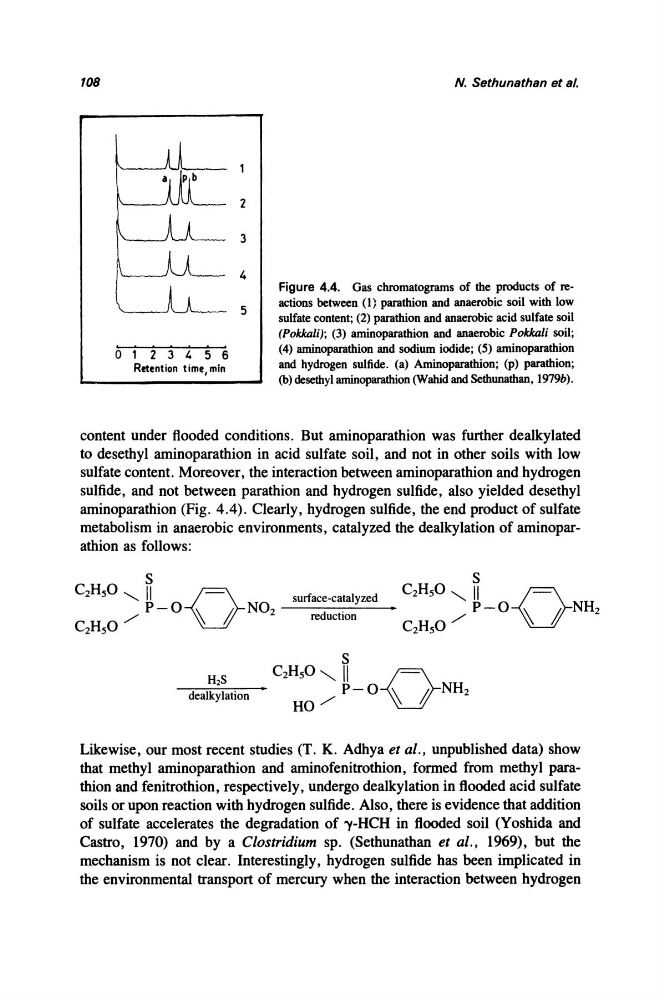
Figure 4.4. Gas chromatograms of the products of reactions between (I} parathion and anaerobic soil with low
sulfate content; (2) parathion and anaerobic acid sulfate soil
(Pokkali); (3) aminoparathion and anaerobic Pokkali soil;
(4) aminoparathion and sodium iodide; (5) aminoparathion
and hydrogen sulfide. (a) Aminoparathion; (p) parathion;
(b) desethyl aminoparathion (Wahid and Sethunathan, 1979b).
content under flooded conditions. But aminoparathion was further dealkylated
to desethyl aminoparathion in acid sulfate soil, and not in other soils with low
sulfate content. Moreover, the interaction between aminoparathion and hydrogen
sulfide, and not between parathion and hydrogen sulfide, also yielded desethyl
aminoparathion (Fig. 4.4). Clearly, hydrogen sulfide, the end product of sulfate
metabolism in anaerobic environments, catalyzed the dealkylation of aminoparathion as follows:
surface-catalyzed
reduction
Likewise, our most recent studies (T. K. Adhya et al., unpublished data) show
that methyl aminoparathion and aminofenitrothion, formed from methyl parathion and fenitrothion, respectively, undergo dealkylation in flooded acid sulfate
soils or upon reaction with hydrogen sulfide. Also, there is evidence that addition
of sulfate accelerates the degradation of 'Y-HCH in flooded soil (Yoshida and
Castro, 1970) and by a Clostridium sp. (Sethunathan et al., 1969), but the
mechanism is not clear. Interestingly, hydrogen sulfide has been implicated in
the environmental transport of mercury when the interaction between hydrogen
0 1 2 3 4 5 6
Retention time, min
2
3
4
5
N. Sethunathan et 8/.
Figure 4.4. Gas chromatograms of the products of reactions between (I} parathion and anaerobic soil with low
sulfate content; (2) parathion and anaerobic acid sulfate soil
(Pokkali); (3) aminoparathion and anaerobic Pokkali soil;
(4) aminoparathion and sodium iodide; (5) aminoparathion
and hydrogen sulfide. (a) Aminoparathion; (p) parathion;
(b) desethyl aminoparathion (Wahid and Sethunathan, 1979b).
content under flooded conditions. But aminoparathion was further dealkylated
to desethyl aminoparathion in acid sulfate soil, and not in other soils with low
sulfate content. Moreover, the interaction between aminoparathion and hydrogen
sulfide, and not between parathion and hydrogen sulfide, also yielded desethyl
aminoparathion (Fig. 4.4). Clearly, hydrogen sulfide, the end product of sulfate
metabolism in anaerobic environments, catalyzed the dealkylation of aminoparathion as follows:
surface-catalyzed
reduction
Likewise, our most recent studies (T. K. Adhya et al., unpublished data) show
that methyl aminoparathion and aminofenitrothion, formed from methyl parathion and fenitrothion, respectively, undergo dealkylation in flooded acid sulfate
soils or upon reaction with hydrogen sulfide. Also, there is evidence that addition
of sulfate accelerates the degradation of 'Y-HCH in flooded soil (Yoshida and
Castro, 1970) and by a Clostridium sp. (Sethunathan et al., 1969), but the
mechanism is not clear. Interestingly, hydrogen sulfide has been implicated in
the environmental transport of mercury when the interaction between hydrogen