

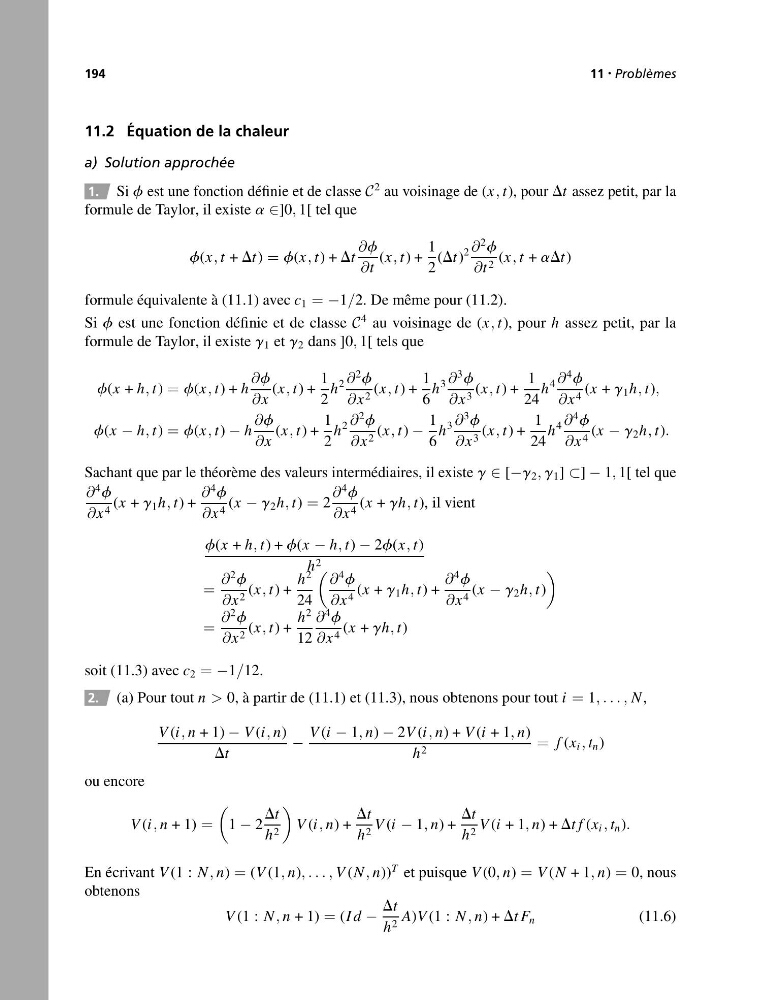
194
11
•
Problèmes
11.2 Équation de la chaleur
a) Solution approchée
1. Si f est une fonction définie et de classe C
2
au voisinage de ( x , t ), pour D t assez petit, par la
formuledeT aylor, il existe a ∈ ]0, 1[ tel que
f ( x , t + D t ) = f ( x , t )+D t
∂ f
∂ t
( x , t )+
1
2
( D t )
2 ∂
2
f
∂ t 2 ( x , t + a D t )
formule équivalente à(11.1) avec c 1 = − 1 / 2. De même pour (11.2).
Si f est une fonction définie et de classe C
4
au voisinage de ( x , t ), pour h assez petit, par la
formule de Taylor, il existe g 1 et g 2 dans ]0, 1[ tels que
f ( x + h , t ) = f ( x , t )+h
∂ f
∂ x
( x , t )+
1
2
h
2 ∂
2
f
∂ x 2 ( x , t )+
1
6
h
3 ∂
3
f
∂ x 3 ( x , t )+
1
24
h
4 ∂
4
f
∂ x 4 ( x + g 1 h , t ) ,
f ( x − h , t ) = f ( x , t ) − h
∂ f
∂ x
( x , t )+
1
2
h
2 ∂
2
f
∂ x 2 ( x , t ) −
1
6
h
3 ∂
3
f
∂ x 3 ( x , t )+
1
24
h
4 ∂
4
f
∂ x 4 ( x − g 2 h , t ) .
Sachant que par le théorème des valeurs intermédiaires, il existe g ∈ [ − g 2 , g 1 ] ⊂ ] − 1 , 1[ tel que
∂
4
f
∂ x 4 ( x + g 1 h , t )+
∂
4
f
∂ x 4 ( x − g 2 h , t ) = 2
∂
4
f
∂ x 4 ( x + g h , t ), il vient
f ( x + h , t )+f ( x − h , t ) − 2 f ( x , t )
h 2
=
∂
2
f
∂ x 2 ( x , t )+
h
2
24
∂
4
f
∂ x 4 ( x + g 1 h , t )+
∂
4
f
∂ x 4 ( x − g 2 h , t )
=
∂
2
f
∂ x 2 ( x , t )+
h
2
12
∂
4
f
∂ x 4 ( x + g h , t )
soit (11.3) avec c 2 = − 1 / 12.
2. (a) Pour tout n > 0, àpartir de (11.1) et (11.3), nous obtenons pour tout i = 1 ,...,N ,
V ( i , n +1) − V ( i , n )
D t
−
V ( i − 1 , n ) − 2 V ( i , n )+V ( i +1, n )
h 2
= f ( x i , t n )
ou encore
V ( i , n +1) =
1 − 2
D t
h 2
V ( i , n )+
D t
h 2 V ( i − 1 , n )+
D t
h 2 V ( i +1, n )+D tf( x i , t n ) .
En écrivant V (1 : N , n ) = ( V (1, n ) ,..., V ( N , n ))
T
et puisque V (0, n ) = V ( N +1, n ) = 0, nous
obtenons
V (1 : N , n +1) = ( Id −
D t
h 2 A ) V (1 : N , n )+D tF n
(11.6)
11
•
Problèmes
11.2 Équation de la chaleur
a) Solution approchée
1. Si f est une fonction définie et de classe C
2
au voisinage de ( x , t ), pour D t assez petit, par la
formuledeT aylor, il existe a ∈ ]0, 1[ tel que
f ( x , t + D t ) = f ( x , t )+D t
∂ f
∂ t
( x , t )+
1
2
( D t )
2 ∂
2
f
∂ t 2 ( x , t + a D t )
formule équivalente à(11.1) avec c 1 = − 1 / 2. De même pour (11.2).
Si f est une fonction définie et de classe C
4
au voisinage de ( x , t ), pour h assez petit, par la
formule de Taylor, il existe g 1 et g 2 dans ]0, 1[ tels que
f ( x + h , t ) = f ( x , t )+h
∂ f
∂ x
( x , t )+
1
2
h
2 ∂
2
f
∂ x 2 ( x , t )+
1
6
h
3 ∂
3
f
∂ x 3 ( x , t )+
1
24
h
4 ∂
4
f
∂ x 4 ( x + g 1 h , t ) ,
f ( x − h , t ) = f ( x , t ) − h
∂ f
∂ x
( x , t )+
1
2
h
2 ∂
2
f
∂ x 2 ( x , t ) −
1
6
h
3 ∂
3
f
∂ x 3 ( x , t )+
1
24
h
4 ∂
4
f
∂ x 4 ( x − g 2 h , t ) .
Sachant que par le théorème des valeurs intermédiaires, il existe g ∈ [ − g 2 , g 1 ] ⊂ ] − 1 , 1[ tel que
∂
4
f
∂ x 4 ( x + g 1 h , t )+
∂
4
f
∂ x 4 ( x − g 2 h , t ) = 2
∂
4
f
∂ x 4 ( x + g h , t ), il vient
f ( x + h , t )+f ( x − h , t ) − 2 f ( x , t )
h 2
=
∂
2
f
∂ x 2 ( x , t )+
h
2
24
∂
4
f
∂ x 4 ( x + g 1 h , t )+
∂
4
f
∂ x 4 ( x − g 2 h , t )
=
∂
2
f
∂ x 2 ( x , t )+
h
2
12
∂
4
f
∂ x 4 ( x + g h , t )
soit (11.3) avec c 2 = − 1 / 12.
2. (a) Pour tout n > 0, àpartir de (11.1) et (11.3), nous obtenons pour tout i = 1 ,...,N ,
V ( i , n +1) − V ( i , n )
D t
−
V ( i − 1 , n ) − 2 V ( i , n )+V ( i +1, n )
h 2
= f ( x i , t n )
ou encore
V ( i , n +1) =
1 − 2
D t
h 2
V ( i , n )+
D t
h 2 V ( i − 1 , n )+
D t
h 2 V ( i +1, n )+D tf( x i , t n ) .
En écrivant V (1 : N , n ) = ( V (1, n ) ,..., V ( N , n ))
T
et puisque V (0, n ) = V ( N +1, n ) = 0, nous
obtenons
V (1 : N , n +1) = ( Id −
D t
h 2 A ) V (1 : N , n )+D tF n
(11.6)