

THE GENEALOGY OF FISHES
205
possessed two dorsal ns and a similar heterocercal tail'to
that of the primitive sharks. But the earliest of them, as
well as many later, had only one dorsal, like Acanthodès.
Other forms of this early period, which" can also be
recognised as belonging to groups existing at the'1‘3resent—
day,
were
the
Dipteridæ.
These
were -
Dipnoans’
characterised by their peculiar, limb—like paired ns; they
had a well-developed opercular coV'er and the same kind“of
heterocercal tail as the forms mentioned above.
Most of
'
them possesSed two dorsal ns,but in thelater forms and
_
those existing at the present day the tail was diph‘ycercàl
with a long mediann Continuous from jab0ut the middle Of
the dorsum round to the anus.
,
’
,
If we
the changes inthe characters of the
"
.
'
"
"
'
"‘
\\ \
"-'.-—
.
-
f'-i
Ç
—
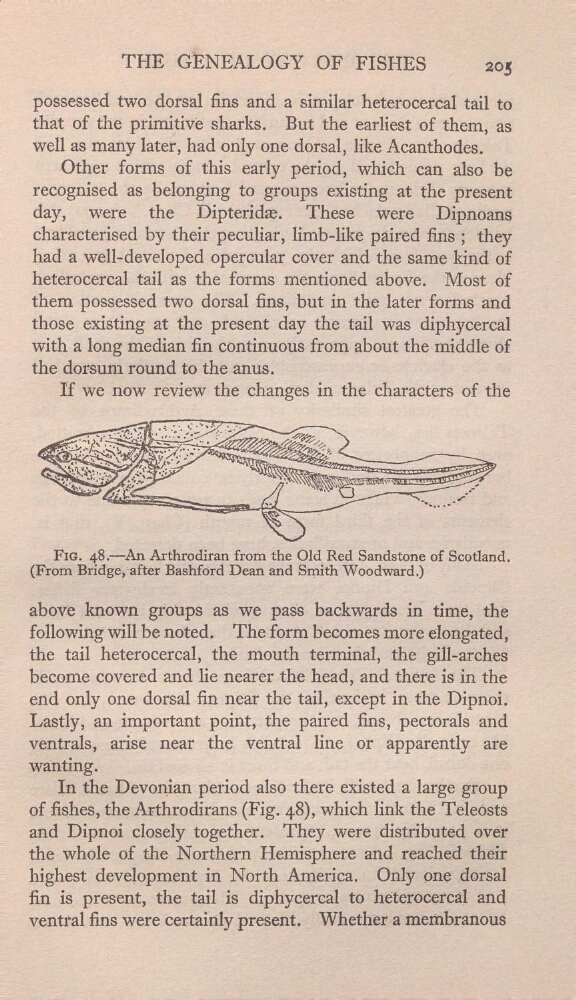
Fra. 485—‘An Arthi‘odiràn from the Old_ Red Sandstone
(FrorhîBridg‘e;after Bàshford
Dean and
above ,knoWn; groups vas we pass backWard3 in time, the
.
following will be noted. The-form
_
the tail hetérocercal, the mouth terminal, — the gin—arches
become covered and lie nearer the head, and there is inthe
.
end only one dorsal n near the tail, except in the Dipno‘i.
_
Lastly, an important point, the paired ns, pectorals and
arise near the ventral line or apparently are
'
Wanting.
,,
,
.
_
_
…In'the Devonian period also there existed a large group
of
the Arthrodii‘ans (Fig. 48), which link the Tele08‘ts -
,
and
-,closely together… They were distributed Over,
the whole of the Northern
_.
'
highest development in North America.
;
nis present, the tail is diphycercal- to héterocei‘*cræl and
_
ventral ns were certainly present;
"
205
possessed two dorsal ns and a similar heterocercal tail'to
that of the primitive sharks. But the earliest of them, as
well as many later, had only one dorsal, like Acanthodès.
Other forms of this early period, which" can also be
recognised as belonging to groups existing at the'1‘3resent—
day,
were
the
Dipteridæ.
These
were -
Dipnoans’
characterised by their peculiar, limb—like paired ns; they
had a well-developed opercular coV'er and the same kind“of
heterocercal tail as the forms mentioned above.
Most of
'
them possesSed two dorsal ns,but in thelater forms and
_
those existing at the present day the tail was diph‘ycercàl
with a long mediann Continuous from jab0ut the middle Of
the dorsum round to the anus.
,
’
,
If we
the changes inthe characters of the
"
.
'
"
"
'
"‘
\\ \
"-'.-—
.
-
f'-i
Ç
—
Fra. 485—‘An Arthi‘odiràn from the Old_ Red Sandstone
(FrorhîBridg‘e;after Bàshford
Dean and
above ,knoWn; groups vas we pass backWard3 in time, the
.
following will be noted. The-form
_
the tail hetérocercal, the mouth terminal, — the gin—arches
become covered and lie nearer the head, and there is inthe
.
end only one dorsal n near the tail, except in the Dipno‘i.
_
Lastly, an important point, the paired ns, pectorals and
arise near the ventral line or apparently are
'
Wanting.
,,
,
.
_
_
…In'the Devonian period also there existed a large group
of
the Arthrodii‘ans (Fig. 48), which link the Tele08‘ts -
,
and
-,closely together… They were distributed Over,
the whole of the Northern
_.
'
highest development in North America.
;
nis present, the tail is diphycercal- to héterocei‘*cræl and
_
ventral ns were certainly present;
"