

204
THE BIOLOGY OF FISHES
'
link between these and the bony shes. Going further back
-
into the Devonian period we nd a number of forms which
bring the relation nearer. In the Acanthodidæ there Was '
j
only one ’dorSal n, near the tail, the gill—arches were free
from the skin and nearer the head but without an operculum,
—
the mouth and Caudal n similar to those of Cladoselache.
In these forms, however, a certain amount of calcication is
present, over the skull and jaws and over the pectoral arch.
We are thus approaching nearer to_the Teleost types and the
_
only distinctive Elasmobranchian character remaining is the
skin with its exoskeleton of shagreen tubercles.
'
’
Further back along the Elasmobranch line we cannot go.
If any form existed previous to these, and With still fewer
-
Elasrobranch - characters, we should be unable to classify
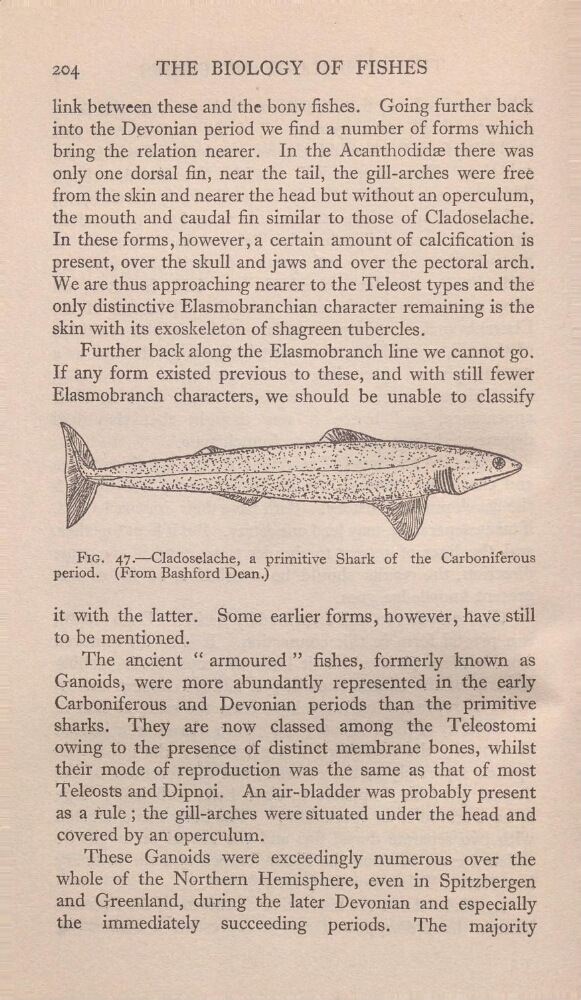
47.’—Cladoselache, a primitive Shark of the Carboniferous
period. . (From Bashf0rd Dean.)
_
-
.
,
-
’
,
it with the “latter.
SOme earlier forms,hoWeve[r, have,sti‘ll
to be mentioned.“
'
—
;_._
,
»
The ancient ‘.‘_. armour—ed
”
;shes;_'
krioWn
? as
* Ganoids, ‘
Were
afhje}jearfly
“ _
petiods than ;thergprimitiVe
,
:
sharksThey .,}are _.Ïïnowi classedË-Î among the ÎTel-eostomi
to
’
of = distinct membrane boues, whilst
…
-
Was
that of most
,
:.
?
was probably present
,
»
_
asa _Ëulejäthe gill—àçhes were situated under the-head and
Î
cavered.by'an_0p_erçulum. ;
,
;
‘
_
=
,
,
'
”
'
_Ganoids were exceedingly numerous over the j
whole of the
even in Spitzbergen
_
 … and,—Greenland, duringthezlaœr 'Devonian and eSpecially
'_Ç_h6‘:; immediately; ;‘SuC_ceedin—g— periode) -—T_he j_ majority
_
THE BIOLOGY OF FISHES
'
link between these and the bony shes. Going further back
-
into the Devonian period we nd a number of forms which
bring the relation nearer. In the Acanthodidæ there Was '
j
only one ’dorSal n, near the tail, the gill—arches were free
from the skin and nearer the head but without an operculum,
—
the mouth and Caudal n similar to those of Cladoselache.
In these forms, however, a certain amount of calcication is
present, over the skull and jaws and over the pectoral arch.
We are thus approaching nearer to_the Teleost types and the
_
only distinctive Elasmobranchian character remaining is the
skin with its exoskeleton of shagreen tubercles.
'
’
Further back along the Elasmobranch line we cannot go.
If any form existed previous to these, and With still fewer
-
Elasrobranch - characters, we should be unable to classify
47.’—Cladoselache, a primitive Shark of the Carboniferous
period. . (From Bashf0rd Dean.)
_
-
.
,
-
’
,
it with the “latter.
SOme earlier forms,hoWeve[r, have,sti‘ll
to be mentioned.“
'
—
;_._
,
»
The ancient ‘.‘_. armour—ed
”
;shes;_'
krioWn
? as
* Ganoids, ‘
Were
afhje}jearfly
“ _
petiods than ;thergprimitiVe
,
:
sharksThey .,}are _.Ïïnowi classedË-Î among the ÎTel-eostomi
to
’
of = distinct membrane boues, whilst
…
-
Was
that of most
,
:.
?
was probably present
,
»
_
asa _Ëulejäthe gill—àçhes were situated under the-head and
Î
cavered.by'an_0p_erçulum. ;
,
;
‘
_
=
,
,
'
”
'
_Ganoids were exceedingly numerous over the j
whole of the
even in Spitzbergen
_
 … and,—Greenland, duringthezlaœr 'Devonian and eSpecially
'_Ç_h6‘:; immediately; ;‘SuC_ceedin—g— periode) -—T_he j_ majority
_