

80
TTHE BIOLOGY OF FISHES
_
.
the Sprat Or Herring, though deCidedly inconvenient, are .
It is not necessary to say how many there
_,
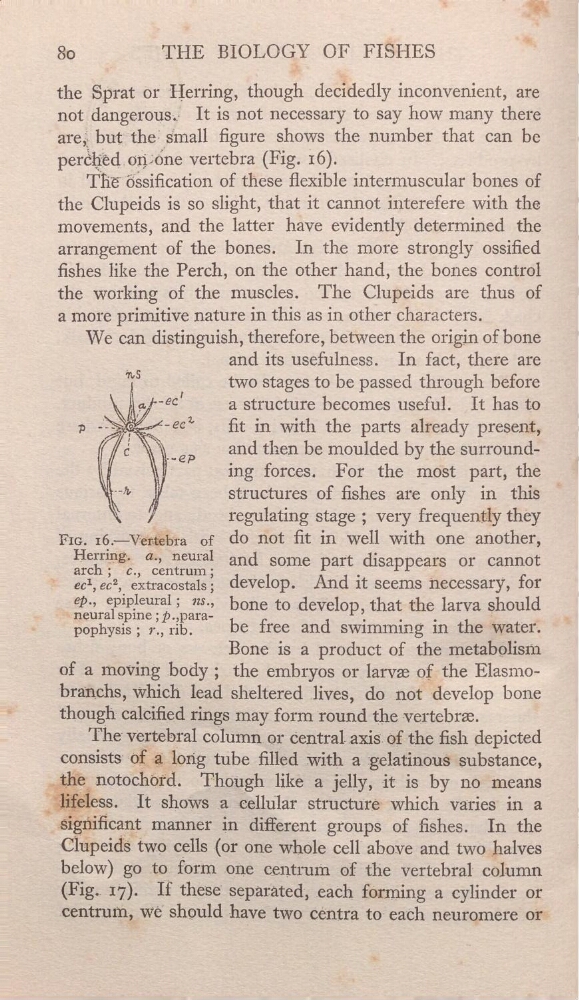
gure shows the number that can be
vertebra (Fig. i6).
Thé“ 'ôësication of these exible intermuscular boues of
the Clupeids is so slight, that it cannot interefere with the
movements, and the latter have evidently determined the
arrangement of the boneS.
In the more strongly ossied
shes like the Perch, on the other hand, the boues control
the working of the muscles. The Clupeids are thus of
_
a more primitive nature in this as in other characters.
.
.
We can distinguish, therefore, between the origin of bone
.
.
and its usefulness.
In fact, there are
M
two stages to be passed through before ' '
a structüre becomes useful.
It has to
'
,
p
> '
.
-8€7“
t in With the parts already present,
{
é
__ép
and then be moulded by the surround—"
'
'
ing forces.. For the most part, the
‘
--’v
structures of shes
only in this
'
-
.
regulatingstàge; very frequentlythey
'
.
F1g. 16.—Vê£îëbæ of do not t in Well with one another,
.
_
ïäfmgc
and some part disappears or cannot
_
,
.,
ntrum,
,
,
_
,
._
extmœ8ta1s;
develop. . And 1t seems necessary, for
'
ePiP.le“falä "Ê-» bone .to develop, that the larva should . Ÿ
,.
.
nwralspme,p.,para.
.
.
.—
,
.
—
'
pophysis; 7.,,1—ib_
be free and sw1mmmg in the
'
__
‘
.
.
Bone is. a product of
.
of amovmg body
the embryos or larvæ of the Elasmo—
,
brainchsf,1Which lead sheltered lives, . do not develop bone
Càlbid-rihgs—rhay form “round the vertebræ.
?
.
'
Central. .aXis. ofthe sh depicted
'
consists of along tube lled {With
Substance,
thenotochold
Though Ëlikè i a
.
.::ît is by 1105 means
_.
11feless. It——ShOWS
in a
*
}
agmcant_; manner .=ifn 'jdierent groups of shes., In the
’
;(or
cell above and two halves
_
below)
'ÏO_Î1.€} ' _ CÇI1ÏIÙ‘IÏL.‘
the ; vertebràl column
»
(F1g17) If ?th_éSeî
forming. a ,cfylinder _o_r_
_.
; _;
centrum, Wë ShÔUÏd‘}—hëVê tW0 Ç.étrà ,' tof each neuromèré or.
TTHE BIOLOGY OF FISHES
_
.
the Sprat Or Herring, though deCidedly inconvenient, are .
It is not necessary to say how many there
_,
gure shows the number that can be
vertebra (Fig. i6).
Thé“ 'ôësication of these exible intermuscular boues of
the Clupeids is so slight, that it cannot interefere with the
movements, and the latter have evidently determined the
arrangement of the boneS.
In the more strongly ossied
shes like the Perch, on the other hand, the boues control
the working of the muscles. The Clupeids are thus of
_
a more primitive nature in this as in other characters.
.
.
We can distinguish, therefore, between the origin of bone
.
.
and its usefulness.
In fact, there are
M
two stages to be passed through before ' '
a structüre becomes useful.
It has to
'
,
p
> '
.
-8€7“
t in With the parts already present,
{
é
__ép
and then be moulded by the surround—"
'
'
ing forces.. For the most part, the
‘
--’v
structures of shes
only in this
'
-
.
regulatingstàge; very frequentlythey
'
.
F1g. 16.—Vê£îëbæ of do not t in Well with one another,
.
_
ïäfmgc
and some part disappears or cannot
_
,
.,
ntrum,
,
,
_
,
._
extmœ8ta1s;
develop. . And 1t seems necessary, for
'
ePiP.le“falä "Ê-» bone .to develop, that the larva should . Ÿ
,.
.
nwralspme,p.,para.
.
.
.—
,
.
—
'
pophysis; 7.,,1—ib_
be free and sw1mmmg in the
'
__
‘
.
.
Bone is. a product of
.
of amovmg body
the embryos or larvæ of the Elasmo—
,
brainchsf,1Which lead sheltered lives, . do not develop bone
Càlbid-rihgs—rhay form “round the vertebræ.
?
.
'
Central. .aXis. ofthe sh depicted
'
consists of along tube lled {With
Substance,
thenotochold
Though Ëlikè i a
.
.::ît is by 1105 means
_.
11feless. It——ShOWS
in a
*
}
agmcant_; manner .=ifn 'jdierent groups of shes., In the
’
;(or
cell above and two halves
_
below)
'ÏO_Î1.€} ' _ CÇI1ÏIÙ‘IÏL.‘
the ; vertebràl column
»
(F1g17) If ?th_éSeî
forming. a ,cfylinder _o_r_
_.
; _;
centrum, Wë ShÔUÏd‘}—hëVê tW0 Ç.étrà ,' tof each neuromèré or.