

§ 3. Some Applications of Cauchy’s Method
85
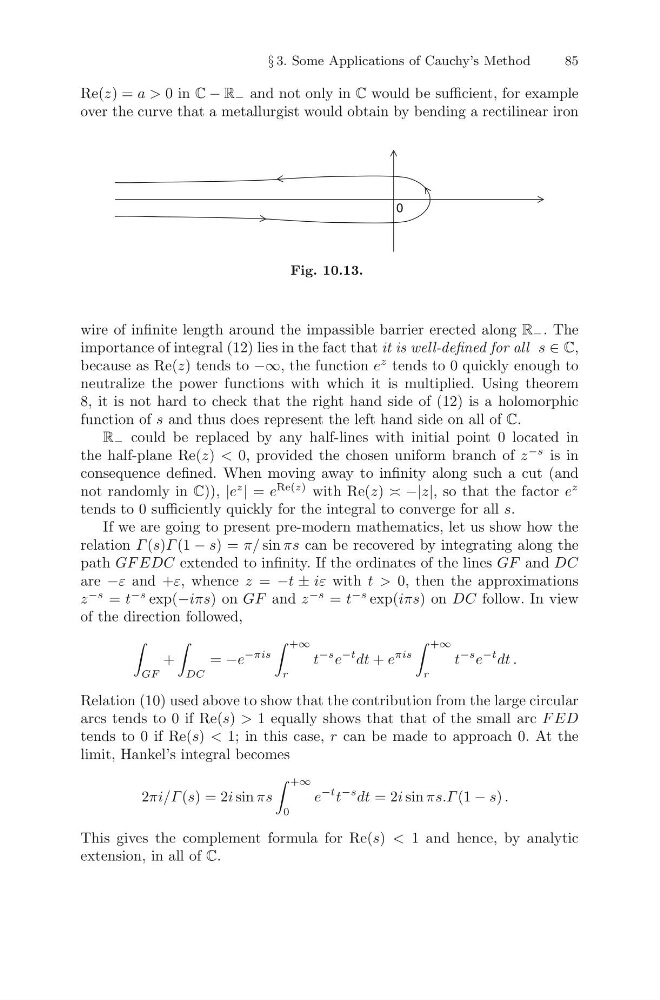
Re(z) = a > 0 in C − R − and not only in C would be sufficient, for example
over the curve that a metallurgist would obtain by bending a rectilinear iron
0
Fig. 10.13.
wire of infinite length around the impassible barrier erected along R − . The
importance of integral (12) lies in the fact that it is well-defined for all s ∈ C,
because as Re(z) tends to −∞, the function e
z tends to 0 quickly enough to
neutralize the power functions with which it is multiplied. Using theorem
8, it is not hard to check that the right hand side of (12) is a holomorphic
function of s and thus does represent the left hand side on all of C.
R − could be replaced by any half-lines with initial point 0 located in
the half-plane Re(z) < 0, provided the chosen uniform branch of z
−s is in
consequence defined. When moving away to infinity along such a cut (and
not randomly in C)), |e
z
| = e
Re(z) with Re(z) −|z|, so that the factor e
z
tends to 0 sufficiently quickly for the integral to converge for all s.
If we are going to present pre-modern mathematics, let us show how the
relation Γ (s)Γ (1 − s) = π/ sin πs can be recovered by integrating along the
path GF EDC extended to infinity. If the ordinates of the lines GF and DC
are −ε and +ε, whence z = −t ± iε with t > 0, then the approximations
z
−s = t
−s exp(−iπs) on GF and z
−s = t
−s exp(iπs) on DC follow. In view
of the direction followed,
GF
+
DC
= −e
−πis
+∞
r
t
−s e
−t dt + e
πis
+∞
r
t
−s e
−t dt .
Relation (10) used above to show that the contribution from the large circular
arcs tends to 0 if Re(s) > 1 equally shows that that of the small arc F ED
tends to 0 if Re(s) < 1; in this case, r can be made to approach 0. At the
limit, Hankel’s integral becomes
2πi/Γ (s) = 2i sin πs
+∞
0
e
−t t
−s dt = 2i sin πs.Γ (1 − s) .
This gives the complement formula for Re(s) < 1 and hence, by analytic
extension, in all of C.
85
Re(z) = a > 0 in C − R − and not only in C would be sufficient, for example
over the curve that a metallurgist would obtain by bending a rectilinear iron
0
Fig. 10.13.
wire of infinite length around the impassible barrier erected along R − . The
importance of integral (12) lies in the fact that it is well-defined for all s ∈ C,
because as Re(z) tends to −∞, the function e
z tends to 0 quickly enough to
neutralize the power functions with which it is multiplied. Using theorem
8, it is not hard to check that the right hand side of (12) is a holomorphic
function of s and thus does represent the left hand side on all of C.
R − could be replaced by any half-lines with initial point 0 located in
the half-plane Re(z) < 0, provided the chosen uniform branch of z
−s is in
consequence defined. When moving away to infinity along such a cut (and
not randomly in C)), |e
z
| = e
Re(z) with Re(z) −|z|, so that the factor e
z
tends to 0 sufficiently quickly for the integral to converge for all s.
If we are going to present pre-modern mathematics, let us show how the
relation Γ (s)Γ (1 − s) = π/ sin πs can be recovered by integrating along the
path GF EDC extended to infinity. If the ordinates of the lines GF and DC
are −ε and +ε, whence z = −t ± iε with t > 0, then the approximations
z
−s = t
−s exp(−iπs) on GF and z
−s = t
−s exp(iπs) on DC follow. In view
of the direction followed,
GF
+
DC
= −e
−πis
+∞
r
t
−s e
−t dt + e
πis
+∞
r
t
−s e
−t dt .
Relation (10) used above to show that the contribution from the large circular
arcs tends to 0 if Re(s) > 1 equally shows that that of the small arc F ED
tends to 0 if Re(s) < 1; in this case, r can be made to approach 0. At the
limit, Hankel’s integral becomes
2πi/Γ (s) = 2i sin πs
+∞
0
e
−t t
−s dt = 2i sin πs.Γ (1 − s) .
This gives the complement formula for Re(s) < 1 and hence, by analytic
extension, in all of C.